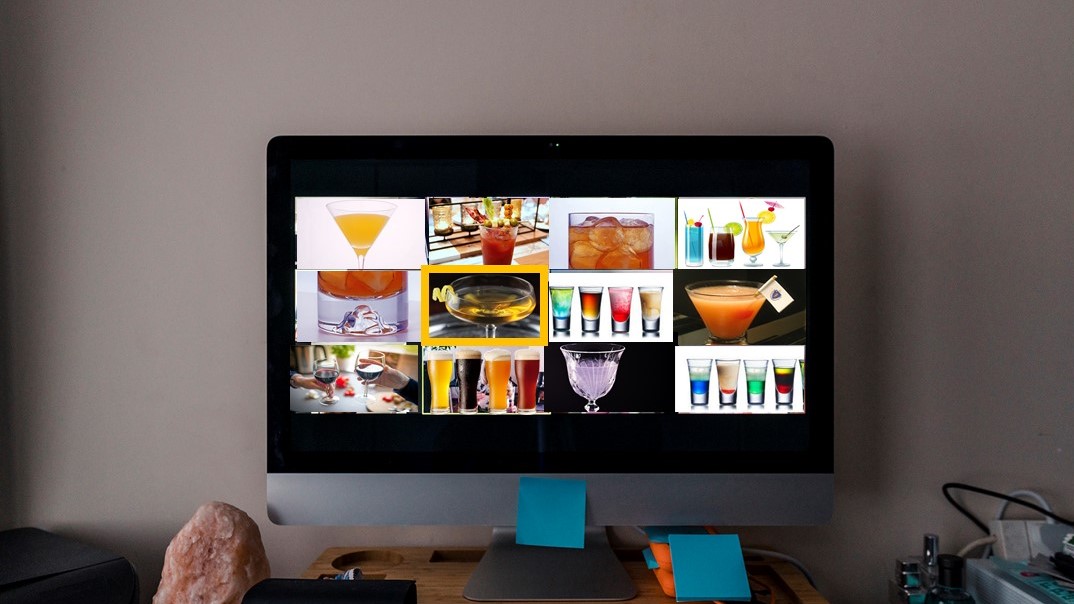
Online Happy Hours

Probably, like me, you thought Virtual Happy Hours were a good idea for keeping-up morale and for giving a forum for casual, non-work conversations. It was a place for the water cooler talk, where you can catch-up on gossip, and maybe overhear some tidbits and gain insights into projects you were all working on separately.

For us, the first few went well and were fun for everyone participating. Then Zoom Fatigue kicked in, and the last thing anyone wanted to do was to spend even more time in front of the computer, even if it was for a (some would consider forced) social call.

When we started, it was great to see and interact with those colleagues that I didn’t directly work with, but had shared an office space with in The Before Time. We all had stories to tell, and lots to catch-up on, so it had an easy, casual flow to it. As the instigator, I felt as though I always had to host this virtual open house party, so I would diligently pour myself something to sip, fill my water bottle, adjust my lighting, and sign on early. I would minimize the screen and continue working on a project until someone else signed on, or I would completely shut-down work so I wouldn’t look at it, as if we were actually meeting at a bar.

After an initial success, attendance eventually dropped down to the same 3 or 4 of us. Two of us saw each other several times a day, so we relied on others joining. Sometimes there was an existing work tension between some of the people that logged on. In a larger group, that would have been diluted, but more than once I was the the one on the virtual bar stool between two warring factions. I was Switzerland. When it became the same group every time, we started cancelling them more often, making them less frequent, or tried to change the day and time to accommodate others. When that failed, they just ended.

There are a few valuable lessons and skills I observed while hosting these drop-in sessions that can work to make awkward social gatherings (virtual or otherwise) FLOW better for everyone:

Facilitate the discussion. Be the unobtrusive host, if there isn’t one identified. As an extrovert surrounded by introverted friends, I have learned how to keep parties going by identifying those that would be comfortable engaging in conversation, and sprinkling seeds about things they get excited or talkative about. Bring like-minded individuals together by bringing-up something you know about each of them that they didn’t know they had in common. Coerce a story you may have heard a million times out of someone in front of a timid audience that hasn’t heard it. Don’t force, but facilitate smooth, relaxed conversations.

Listen when someone is speaking. This seems like a no-brainer, but so many people are bad listeners. We all know someone that loves to hear themselves speak, or lives to one-up every story. They are typically the ones that ask “How was your weekend?” only so they can tell you about theirs. You can see them waiting for their turn to talk. In a Zoom meeting, you can see everyone (in gallery view) at the same time. That means that when I am talking, I can clearly see you checking your email, texting or playing a game on your phone, or talking to someone off-camera. Think of how incredibly rude it would be if we were all in person and you opened your laptop or started playing a game on your phone in front of the person talking. Just because this is a social situation, and you are interacting virtually, doesn’t mean you have to be disrespectful. Listen to each other and be present where you (virtually) are.

Own what you say, be open to new ideas and respect other’s opinions. These go for everyone at any time, not just at happy hour. Again, you’d think that this is pretty easy and straight forward. If you are going to state your own opinion, then make sure you mean it, because others will disagree or have differing opinions they will share. Don’t spout off some popular opinion that you don’t really believe, as you may just get called on it, and don’t be absolute in your opinions. If you say “Grape jelly is the only appropriate choice in a peanut butter and jelly sandwich!” you had better be sure about it because someone else will say “No, strawberry!” or “Almond butter and orange marmalade is better.” be respectful and open to other opinions. (To make this ‘argument’ more realistic, insert ANY political opinion)

Work should stay AT WORK. This is a hard one. Think of What Happens in Vegas Stays in Vegas. – use this time to unwind from work. Don’t use this time to complain about your job, or, more importantly, about other workers. Unlike the aforementioned Vegas slogan, what is said in the (virtual) bar, could easily find its way to the office – to a boss or to the one they are talking about. This should be a time for office bonding. It is acceptable to bond over workloads, or Mondays, or long weeks, etc. but steer clear of specifics, especially if they could break bonds. Two people complaining about a co-worker with three others over drinks could easily become five against one when everyone returns to the office. That’s not the type of bonding you want. Stick to non-work discussions.

Have you hosted or participated in a virtual social situation for work? With the holidays coming up, I assume most of us will be forced to attend at least one. I’d love to hear your thoughts or any tips and tricks you’ve learned in the comments below.

Bartender! Another round, please.

To teach proper behavior or to reward proper behavior? That is the question.

This is such a great idea for dealing with your young children in Disney!  The psychology of an ‘other’ watching over your deeds and rewarding you for doing the right thing – Santa, Elf on a Shelf (what a creep…), etc. – frees the parent from being seen as a ‘mark’ that can be easily blackmailed into providing gifts just for behaving properly.  Kids are smarter than most give them credit for.  As an outside observer (spoiler: I don’t have any children), sometimes I see kids in restaurants or in Walt Disney World that are clearly taking advantage of their tired, overworked parents. And those poor, tired, overworked parents either give in or snap.  Everyone’s time is ruined.  Good manners and proper behavior are learned skills, and I don’t think many people are teaching these things these days.

I had an interview at a local historic hotel yesterday.  In the interview, our discussion included supervising Millennials.  We both gave our observations of entitlement and the nonchalance towards the effects of their actions that have become endemic to that particular demographic.  My interviewer gave an example that one of the young food and beverage workers didn’t know the difference between a coffee cup and an espresso cup; her experience being solely that of Starbucks, where everything comes in paper cups. “Gone are the high teas at the Ritz,” she said.  And she was right.  There was once a time where you went to dinner at Grandma’s house, or had a proper Thanksgiving dinner with all of the silverware and glasses.  You learned how to use everything, to not fidget, to not yell, and THERE WERE NO TABLETS OR PHONES!! (sorry, I know that these are easy ‘babysitters,’ but you are teaching your children to disengage from conversation and from the outside world and its experiences, and not teaching them how they should be acting in public – OK, rant over).  I wish people still took their children to High Tea, or used wedding dinners or eating out at restaurants as exercises in learning how to act properly.  Heck, maybe I’ll invent a game for the iPad that teaches etiquette and table manners!

Back to Walt Disney World and rewarding behavior in kids:  We just returned from a trip earlier this month.  For the middle 3 days, we were joined by our family, which included three children aged 5, 8 and 13.  Because of the age differences, and the demographics (2 young girls, 1 teenage boy), I don’t think the plan in the link above would have worked for all of them.

We went with a different strategy.

My husband and I had long talked about making up business cards to hand to Cast Members that made our experience extra special. Typically, we would keep a list of the names and locations of extraordinary CM’s to include in our trip surveys when we returned home.  We hoped, but never knew for sure, whether they received that recognition.  We knew that with the cards, they could show them to their supervisors, if they wanted, as an immediate recognition of great service.  We finally did make those cards for this trip, and we made one very special and sassy CM almost come to tears when we handed it to her.  She had been extra helpful and so very playful with my husband.  When we handed the card to her, she said “I’m going to hang this on my fridge!” Her supervisor later came to find us in the lobby to thank us for doing that.  She told us that that CM would be retiring next week, and we had touched all their hearts with our kindness.  Another CM immediately ran to her coworker to show off the card we gave her and they both came to tell us that that was the best thing that had happened to them that day.  We also used the back of the cards to write our contact information for friends that we had made during the trip.

The front of our cards:

IMG_0638 [940240]

We had also added a picture of both of us on the back of some of them.

Realizing that today’s youth take a lot of things for granted (I put some blame on grade school graduation ceremonies, everyone-gets-an-award, everyone-gets-on-the-team, and other coddling, character-erasing, entitling practices – sorry, I promised no more rants…), we created simpler cards for the kids that said “Thank you for making my day Magical” with various Disney clip art characters on them.

Here are the cards in Word format if you wish to customize them yourself: Thank you cards.  I do not own the rights to the clip art.  Print them out on standard printable business card stock.

We handed out a stack of these to each of the kids in the morning and told them to ‘sign’ their name on them.  We told them to give them to any Disney employee that made them smile, or helped them to do something, or were just really good at their job.  We thought about incentives for handing them all out, but didn’t want to make it a competition, or have them just randomly giving them out to everyone in the first 10 minutes.  I wasn’t sure they would get the concept, or be willing to participate, but they did.  My heart went into my throat when the teenage boy was the first to give his out, without prompting, to the bus driver that had told corny jokes and teased one of the riders with a birthday button on our way to the park.  We had all laughed along and it was a jovial bus ride. As we exited the bus, he walked to the driver and handed him the card with a “thank you” and walked out.  No one was watching, and he didn’t look for immediate recognition for what he had done.  It was a better start than I had hoped for.  We continued through the day, and I think some of the cards were given out, though other things took hold of their focus.

Will this change how the kids interact with other people in the future?  I don’t know.  I do know that there are a few extraordinary Cast Members that received these cards and, for just a moment, received a heartfelt thank you for a job well done.  Maybe it gave them a smile or some needed assurance in their job that day.  I also know that when we handed them out, we received the joy of being able to give some magic to someone that had brought some to us.  I hope that the kids will remember those moments, and maybe one day it will cause them to stop and be thankful for what others have done for them.

Thank the barista for making your latte.  Thank the stranger for holding the door for you.  Hold the door for someone else.  Give up your seat on the bus to someone that needs it more than you. Brighten someone’s day for just a moment.  You never know if that may be the one little spark that ignites their will to go on.  

Sow a seed of gratitude and watch it grow.