Please don’t…

… finish my sentences.  I am 100% sure you do not know what I’m going to say.  It makes you look pushy, or bored with the conversation, or just like an asshole.  I understand that people do this to impress upon you that they have a superior intellect and that they are not only following-along with what you are saying, they already know everything about it.

… yell at me when I’m trying to help you.  If you’ve asked for my assistance and I am giving it to you, don’t take your frustrations out on me when I can’t understand what you are asking for.  I understand you are frustrated and angry with yourself and your situation, but the person helping you should never have to deal with your misdirected anger.

… wait in front of the train door when people are trying to get off.  You will get on, but only if you let us make room for you by exiting the car.

I don’t want to be negative, but there are certain behaviors that make me question how people have gotten this far in their lives without being told that these behaviors are unacceptable or rude.  I have already railed against self-important, blameless people, but it seems to be becoming the norm to be someone who is so outwardly self-centered, yet (ironically?) the exact opposite of self-aware.  Perhaps I am blessed to have had the time, resources, and opportunities to examine my own life choices – my temperament, my faults – maybe most people do not have that luxury?

Know thyself not Know thy selfie.

Is it because no one has challenged them up to this point?  Is that why they continue (or even start to develop) these behaviors?  Why is it tolerated in today’s society?  Are we so beaten-down by the daily news, or numb from being inundated with social feeds of people excelling (or, with schadenfreude: failing) in their lives?

i’d love to hear your thoughts.

Experience

For the past 6 weeks, we’ve had a delightful British PhD student continuing her research in our office as part of her program.  Tomorrow is her last day in the office, so we put together a lunch seminar where we could all get pizza, and she could present some of her findings.  It was all very interesting, even if the science of it went way over my head.

Part of her research involves Flow Cytometry.  I won’t go into the details of her research (she’s about to publish a paper and still needs to finish her thesis), but one anecdote  really struck me.  She was discussing the wide array of experience of the subjects in her study (all flow technicians), and one of our colleagues asked if a particular skew in the data was due to inexperience vs. experience.  She laughed and told us this story:

Every participant was asked how long they had been using this technology.  In one group, she had an older man that said he’d been using this technology for 8 years next to a young researcher that had only been using it for less than a year.

Which one do you think had more experience, and therefore would have better understanding of the technology and data?

Obviously, she assumed the one with 8 years of experience would have the greater expertise and clearly accurate results.  It turns out that the man who said he’d been using this technology for 8 years had only used the technology once… 8 years ago.  The one that had been using it for less than a year used it on a daily basis and was far more accurate in his data analysis.

Now which one would you trust to use the technology or to read the data in the correct way?  What if the results of the test determined the effectiveness of your cancer treatment or what the correct dose of a treatment should be?

I suppose it is all context and self-promotion.  The first man wanted to be an ideal subject in the study with the confidence and bravado of an expert, even though his experience was simply +1 of the average person (those who do not work in labs).  In contrast, the young researcher may have felt she didn’t have enough experience, and therefore would be judged unworthy.*

Who would over-inflate their experience?  Almost everyone, you’ll find.

In my careers, I’ve had to vet many job applicants and decide whether or not they were worth interviewing based solely on their resumes.  What is a resume used for other than self-promotion?  It’s an audition on paper to get you in the door.  Most (we hope) are truthful, but a lot that I have seen are… ‘enhanced,’ shall we say?  (I also have opinions on multiple-page resumes, but that’s for another time.).  We just recently had a situation in my office where a temp that was hired obviously did not have the Office suite experience she said she did.

When I was looking for a job, I certainly tailored my resume and my cover letters to highlight how perfect I was for the position they were looking to fill.  I didn’t lie, though.  Like the older man above, however, I did list software that I had used in the last 20 years, just in case one of my future employers exclaimed:

“He knows Artsoft (an out-of-date DOS-based ticketing finance system)! We must hire him!!”

In my mind, I was showing that I was adaptable and could easily become proficient in a variety of software and platforms, but I can see now how it may have looked like I was just throwing as many up there as I could.  (Side note: On the train home this evening, someone had a backpack advertising Word Perfect. Remember that? Is it still in use?)

For my current position, I was specifically asked in my second interview (first face-to-face) if I knew PowerPoint.  Without hesitation (thankfully), I said that while I was familiar with it, it had been many years since I had had to use it, so I would need to have a refresher.  I went home that day, downloaded it, and familiarized myself before my next interview.

You see, my boss has continuously used it on an almost-daily basis for over 13 years.  Based solely on the interviewer’s one question, I was afraid that she would ask me to do something complicated that I wouldn’t know how to do, and they’d find out I’m a fraud.  Gradually, I came to realize that she wasn’t using it to its full potential – mostly because she has so many ideas in her head, she can’t take the time to make one thought look good before moving on to the next.  So out of my own personal need for her brilliant ideas to come across in a more appealing and accessible way, I’ve taught myself tricks and functions in PP that she never bothered with.  Now, we have fun coming up with graphics or animations to make the message more dynamic.  Two weeks ago, she drew a crazy matrix of lines and boxes to demonstrate her point on a whiteboard.  A colleague tried to reinvent it in a linear way, but it didn’t make sense.  I recreated the confusing (to me, clear to everyone else) graphics directly from her drawings, and she thought I was the most brilliant person in the room (for a change) because it’s not something she could have done.

Now anytime there is a graphic needed, she sketches it up and I make it.  Together, we bring our left brain and right brain focuses together to create a better product.  It’s not about hours logged of experience, it’s about comfort with complimentary aspects of the software.  I can easily put “proficient in PowerPoint” on my resume now.

Have you ever enhanced your experience to impress someone or to get a job?  Did it work?  I’d love to hear your stories.


*In a similar, though tangential, example, think of a senior sales manager and a junior salesperson.  The manager left the field 10 years ago, but oversees, mentors and motivates the sales staff.  The manager has overall experience in the industry and the staff has real-time, current experience in the field.  If this were real estate, for example, which experience would you want most in your corner as a seller?  The manager may know the history and have a long-view of the market, so he tells you to price at value to be safe, but the agent just sold the crappy house down the street for $30k over asking price because she knows what is happening in the current market, the inventory, and the buyers.  Ideally, you want them working together.


Pet Peeves

I’m curious.  What are your pet peeves?

Here are some of mine off the top of my head:

  • When people say “on accident” instead of “by accident.”
  • Inconsiderate/entitled/rude people (especially in public)
  • “Expresso”
  • “Excetera”
  • Making everything that is said? Sound like a question? With weird pauses?
  • Slow walkers
  • People that stand in the doorway when the subway door opens
  • Open mouth chewing
  • #redundant #excessive #hashtags
  • Nail clipping in public, or even around just one other person
  • People that walk while staring down at their phones –  not looking where they are going
  • People blatantly looking at their phones while driving, or sitting in traffic
  • Misspelled/poor grammar signs
  • People that don’t pick up after their dogs
  • Parents that don’t keep their kids in check when they are misbehaving
  • Kids at restaurants on iPads
  • Kids anywhere on iPads
  • Toddlers playing with smartphones
  • People who try to finish your sentences or interrupt you by talking over you
  • People who don’t say thank you or acknowledge that you’ve held the door for them
  • Pressing the elevator or crosswalk button multiple times as if that will make it come sooner
  • Asshole parkers
  • Strollers in WDW… especially when the kids are too big for them, or when they are filled with bags, not children

Short version:
Rude or ignorant people.

Tell me yours below!

Dreams are weird…

Sometimes my dreams are unremarkable or incoherent, but other times, like last night, they are hyper-realistic and almost plausible.

In the first dream, I was with my cousin and her family.  They are big into horses and riding competitions, so it was natural that I was there with them in their backyard (not really), which had a slight hill inclining up into the distance, with a chain-link labyrinth that wound on the flat and just at the bottom of the rise.  They called this the ‘coaster’ and I pictured the poor horses running up and down hills and through loops and jumps. But no, it was only called that because of the hill and because of its design.  The rows of fencing were just wide enough for one horse and rider to comfortably get through, with the turns being a little more open. This caused the horse to control its desire to buck or gallop, and made the rider take more control and be more careful and gentle with guiding the horse’s gait and direction. There were stretches of straight rows where picking-up speed was encouraged, then the rider had to rein the horse in when coming up to a sharp turn, and similar challenges were found where the ground was uneven, such as walking on the incline. It was very tricky, but it was obvious that my cousin’s daughter and her pony had done this hundreds of times and were enjoying it.

One bit of unrealistic dreaming: at one point, wings blurred out on the sides of her pony, and then were gone in the blink of an eye. Almost like something I wasn’t supposed to see; or rather, something no one else saw, but I could. “Pegasus!” I thought. And then it was gone and never came up again. Subconscious reminding me I was dreaming?!  Who knows.

We went inside and my cousin’s husband was there, happy to see me.  He said, “Will you be staying for …” but didn’t finish the sentence. “Ooh yes, he’ll love it!” they all cried. His son took me in the other room excited to show me this game everyone was playing (either I can’t remember the name, or it was never mentioned).

In the TV room, there were arrangements of small wooden squares everywhere. Not really piles or stacks, but displays of them, like periodic tables or mosaics all around the room in groups.  They looked to be made of chip wood or really thin light-colored veneer, all blank on the one side showing. He turned on the TV as explanation, and there was a tournament going on. They were showing a super-cut of a lot of young men’s reactions (girls didn’t play this game?) of delight or despair as they won or lost a game.  It was like something they would show in between games to keep the audience interested. It looked to be in a huge convention center – how had I never heard of this?  One guy had all of the squares stuck to his shirt, arms and neck. He had lost, and in slow motion, we saw him pull a double-square from his neck. It had a blue splotch and some symbols in black that I couldn’t make out. He saw it and seemed to act as if that would have been the winning piece if only he had drawn it earlier.  There were more short scenes like that, and then it switched to a station where you could buy the game set-up and the rules.  Everyone was watching me and very excited for me to play, but I didn’t think I had the money for it, so I declined and went into the other room to lay down on a couch with a blanket.  This is where I transitioned to the next dream.

*This is just some background on the next dream.  You may have seen in one of my other posts that I used to work in the Music industry as an agent. One of the most fulfilling experiences came at a conference in Europe. My colleague and I had a booth, so tons of Artists would come up and drop off their CDs to be signed by us. There was a group of young singers without managers, labels or agents, that all paid their own way to come to the conference (not cheap). They were young, eager, personable and (I found out when I got home) immensely talented. Over the weekend, they would stop in when we were free to chat and ask advice.  While being in Europe, and meeting with people I only got to see once a year, seeing great performances, and mixing with my colleagues from around the globe were all wonderful, it was this new experience of being mentors (in a small way) to these young Artists that gave me a renewed drive when I got back to the office.  We helped them network and introduced them around during the cocktail hours, and I’ve been following their careers since.*

As I was on the couch, the non-distinct room turned into a reception room in a hotel. Behind me were high-top tables with groups around them talking, but I wasn’t paying attention.  One of the young singers I knew walked in, gave me a hello kiss and swept over to the tables.  It took me a minute to recognize him as I watched him go. Only then did I notice that I knew a lot of the people behind me. They were managers, musicians and producers. I had introduced him to some of them long ago, and now he was confident and expanding on that network. I made a mental note to go say hello to everyone.

As I turned around, I was still on a couch, but the TV and blanket were gone, and instead, there was a long row of tables running lengthwise away from me all the way to the lobby of the hotel. The tables were full of people talking and I recognized more industry people and some of my personal friends. From this table came another singer that I had talked to about her career (though I didn’t think she would go very far). I was happy for her because she was with two people that I understood to be her manager and an assistant.  She had started her career, but still wanted advice.  She came to me with a difficult and tricky question.

She had recently been diagnosed as HIV+. She hadn’t told anyone yet, because she had finally gotten her career going and she didn’t know if disclosing her status would ruin that, especially this early.  She wanted to know if I thought her agency would drop her, since she was so new to them, and she didn’t want to throw any risk into such a new relationship.  I told her that I had some ideas, but needed a moment.  She went to the lobby to the restroom while I thought it out. (This was weird for me in a dream. I actually sat on the couch and had a mental conversation with myself for what seemed like several minutes.) she came back and I gave her two bits of advice:

1. As long as you give a good show, it doesn’t matter. Ultimately, your job as a singer is to perform your art for your own self-growth and for the enjoyment of others. If you are doing that, whatever is happening off the stage or out of the studio doesn’t matter (in your career), and therefore shouldn’t matter to your agent. Your manager is here supporting you, your agent should too, as well as your label.

2. Don’t let it define who you are as and Artist, unless that is what you want.  Stevie Wonder, Diane Schuur, Ray Charles – what is the first thing you think of?  A blind, piano playing singer; that is unavoidable.  People notice that and (I’m sorry to say) exploit that.  Obviously those three had the talent to excel, but they did use their disabilities to get noticed (or their people did) at first. Is that what you want?  At a certain point, when does something move from being unique to becoming a novelty act?  I understand the point of being an advocate, especially as a heterosexual female – that is still needed, but that is something you need to decide. My advice would be to be that advocate proudly in your life, but don’t change your performance. People will see that as an attempt to use your diagnosis for advancement, and you might be put in a niche that you can’t escape from.  Being in jazz is enough of a niche!  Think of the labels that follow people: gay comic, trans-gendered actress, plus-sized model, etc.  Do you want to be known as ____, or ____, HIV+ singer.  Have it be part of your story, but not your entire definition.

Two examples from Artists I’ve worked with:

I worked with a very well-known singer. She was well know by her fans for being a soulful singer, and she was well known by the industry for being extremely difficult. We put together a tour for her that met all of her demands (I can’t list them here, or it would be known who I was talking about, sorry!) but while she was on tour, she got nastier and nastier to us, to her musicians, and to our buyers. All the time, the fans loved her, and the reviews were great, but the horror stories coming in from the buyers were unforgivable.  She was ruining relationships we had built, and for what purpose?  When she refused to go on because she decided that she needed to be paid more money in cash right then (while her audience was sitting waiting for an already-late show), that was the last straw, and we dropped her. My point with this example is that as long as you are making your best art on stage or in the studio, and the audience is happy, it doesn’t matter what goes on in your life. People will put up with a lot if you have the talent to back-it-up.  She is a bad example – don’t be like her, but you know what I’m saying.  Also, we are talking about the Jazz world, not the world of “Beyonce had this for breakfast and you won’t believe what it was!”

I also worked with an Artist who had developed AIDS early in his career, and long before I worked with him.  He chose to be an advocate, and even wrote some beautiful pieces about his struggles and health issues. It was part of his story, and it became part of his act, but not all of it.  He knows that his diagnosis does not define him, though it does limit him, physically, unfortunately. He was a great musician before and continues to be a great musician now, that’s what really defines him. Another thing you will need to contend with is the prejudice of the buyer. We have come a very long way, socially, but misunderstandings still exist.  You will have buyers that will put extra clauses in contracts regarding cancellations due to illness. They will think twice about the money they are willing to spend if there is a worry that they will lose it if you catch a cold and can’t perform, especially at this point in your career.  Be careful.

She thanked me for my advice and went off. I walked over to say hello to the tables in the back, but that’s when I woke.

I am not too happy with some of the advice I gave her, to be honest.  I didn’t explain it in the right way, and looking at it here, it comes across as harsh and that I’m telling her to hide. That wasn’t it at all. I wanted to tell her to know what she was up against.

I often go to bed with the hope that my dreams will help me to find the path I’m supposed to be on to find my next career. The second dream reminded me what I liked from my last job, while highlighting my desire to mentor and help others.  It was also in a hotel. I had a second interview earlier this week at one hotel and have a first interview at a different one next week.  Who knows where these things come from?

As for the first dream? I don’t know.  Maybe I need to make that game.  And see my cousin’s family more.
What do you want to be doing? What would be your ideal new job?!

Anything but searching for jobs.

One that pays me.

You wouldn’t believe how many times I get these questions.  I understand it.  From an outside perspective, they are ‘safe’ questions to ask after those old chestnuts: “Any prospects?” or “How is the job search going?”

I have been guilty of it.  I’m sure we all have.  You feel bad for the poor friend that has lost his job and hasn’t found a new one yet.  You mentally knock-on-wood and briefly feel thankful for the job you were just complaining about 15 minutes earlier.  “There, but for the grace of…” and all that.  This is where those questions stem from.  I appreciate that they care enough to ask, but then it is up to me to change the subject before either of us gets too uncomfortable.

This must be how new mothers or pregnant women feel.  People are always asking them questions about (sometimes very) personal issues that are really none of their business and would be embarrassing in any other circumstance.  Picture a couple on a romantic date in a restaurant.  No one walks up to one of the diners and asks if his/her date sleeps through the night, if either of you were still breastfeeding, or how much weight you gained and lost in the last few months…at least, not in the restaurants I go to.

I am an open book, and have no problem telling you the truth: It’s a tough time to be unemployed.  There are too many of us looking, and the economy can’t handle all of us.  Two of the jobs I applied for went unfilled because the position or department (both State jobs) lost funding and were terminated.  The skills I have are not what people are looking for, especially in someone my age (more on that in a later post, maybe).  Whatever job I find will pay me 25-30% of the salary I was getting, not even taking into account the benefits, profit sharing, bonuses or travel that were all perks of my last job.  Some of the jobs I am applying for would pay me less than what I am currently receiving from unemployment insurance payments.  How depressing is that?  Talk about a party conversation killer.  Besides, I live with this on a daily (and in the waking hours of the night) basis.  I am always thinking of these things.  There is no need for you to bring it up when I am trying to enjoy myself.  Perhaps I came to this party to forget about my troubles.

More often than not, the question, or line of questioning, says more about you than the person being questioned.  We all project our own insecurities and fears when confronted with something uncomfortable.  Think of any conversation you’ve had at a wake, or when someone is diagnosed with a terminal disease.  You cannot help but think of how you would handle, or wouldn’t be able to handle, being in the same situation.  In those particular scenarios, I’ll take being unemployed over sick, dead, or losing my husband.  If someone asks me if I’m worried because I haven’t found something yet, that tells me that that is how they would be feeling at this point.  “What is it you want to be doing?” could almost be them asking themselves that out loud.  Again, I’ve seen people reassess their (often unhappy) current job, because although it is easy to say “I hate my job, I’m going to quit!” my reality is there in front of them.  I didn’t choose this, and it is difficult.

Perhaps it is a defense mechanism, but people really like to tell me how much they hate their jobs, as if saying that I’m lucky that I don’t have to work.  I am at a point where I am ready to say: “Fine. Quit. I will take your job!”

What do I want to be doing?
Not searching through dozens of job listing sites every day.  Not worrying about being able to pay bills.  Not having to apply for jobs that are written for recent college graduates.  Not stalking the HR Director that is notorious for not responding, even if the position is perfect for you, and then watching her post the opening for the 3rd time.  Not thinking about my husband’s birthday in 2 weeks, and how I can’t get him anything.  Not trying to explain how I know that I can do this job, even if it isn’t apparent on paper.  Not having a great interview and follow-up that leads to silence.  Not checking my resume for the 115th time because “____ didn’t give me an interview because there had to be a typo.”  Not being kept awake all night worrying.  I want to be working and earning my keep.

What would be my ideal job?
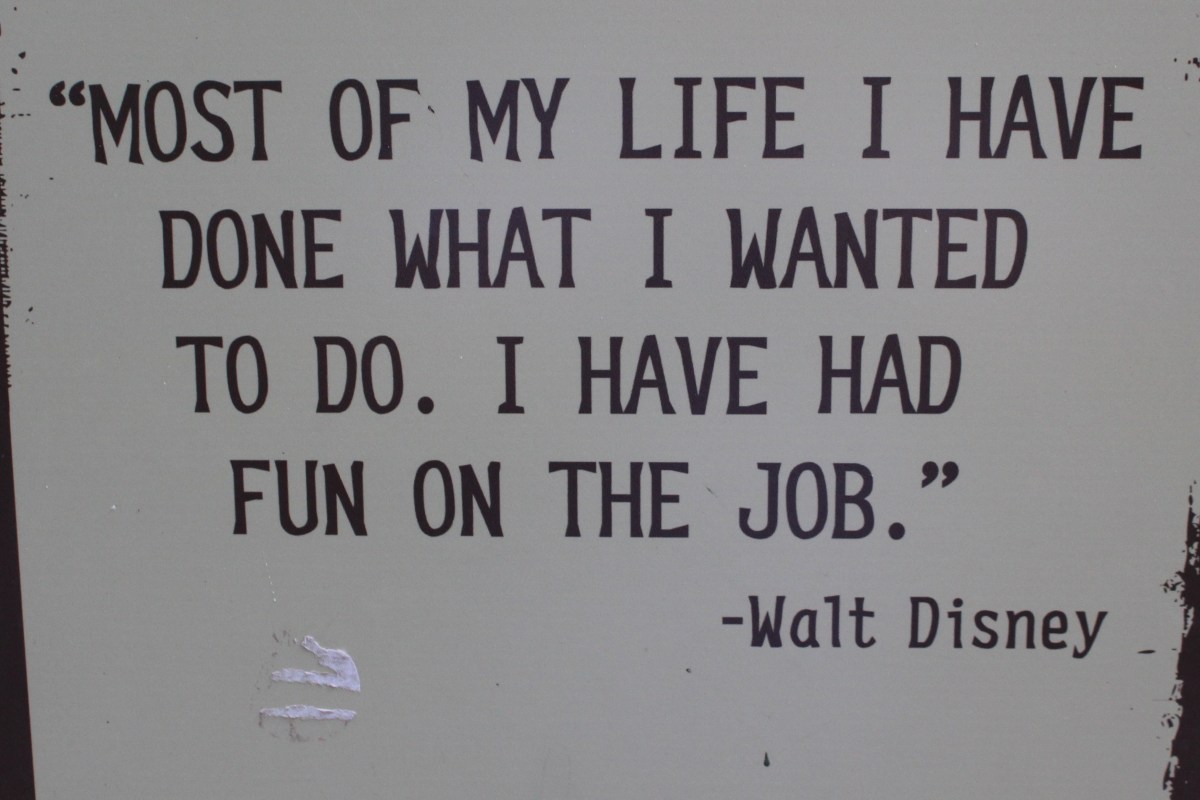
One that pays me for doing my work.  One that I am interested in.  If I could afford to live, I have always thought that I could be happiest selling popcorn on Main Street, USA in Walt Disney World.  I would be in the happiest place I know, making people happy, and I would never have to check email or voicemail as soon as I wake up and before I go to sleep.  I guess if I could become a VIP Guest Guide for Disney, that would be ideal.

I should have better answers for these questions, I know; but I don’t.

I lost my job after 11 years at one company.  True, it was a career that I didn’t go looking for, but it was a company that I was committed to, and I was good at it, so I had decided long ago that this was my career path.  Now that it is gone, I am leaving that career (for many reasons).  The marketable skill from that experience would most easily be translated to Sales in any field.  I am not a huge fan of the sleazier side of sales (see Why I Won’t be a Car Salesman), so of all of the applications I have sent out, sales positions probably represented a bit less than a third.  Today, I had an interview for an Events position.  For the past 20 years, I have been coordinating events on both a local and global scale, but if you just read what’s on my resume, that might be missed.  I was granted the interview for political reasons, but otherwise, I wouldn’t have been brought in.  Even if I explain in detail on my cover letter why I think I’m qualified for a particular job, there is no guarantee that it will be read or believed.  The interview is where my real skills shine through, not on paper, at least according to the last few interviewers.

So, I guess I’ll still keep searching and thinking about all this.  Maybe next time you ask, I’ll have answers for you.

But don’t feel like you have to ask.