As a member of Generation X, I was privileged to grow up with, among many other significant cultural touchstones, The Funtastic World of Hanna Barbera during my formative years (for me, age 9 through my teens). Two of my favorite cartoons from that series were the mix of syndicated and new episodes of both The Flintstones and their space-age counterpart: The Jetsons!*
Supposedly, we are watching the Jetsons living their lives in the year 2062, 100 years from the original series air dates (which means we are only 42 year away as of writing this in 2020). Of course, when I was sitting at home after school or on Saturday mornings watching these cartoons, I didn’t know what year it was supposed to be. It was just “the future.”
The Future
Growing up in the 70’s/80’s/90’s, the “Future” was always just around the corner, sometime in the next millennium. We made it past 1984 and that was doubleplusgood (of course, today in America is eerily similar…). Our parents kept us from watching 2001: A Space Odyssey until we were old enough to handle the suspense, but even as we approached the millennium and it’s Y2K scare, an unthinkably long-off year still grabbed out attention: 2020.
So let’s assume I was imagining that the Jetsons were flying around in 2020. It wasn’t that far of a leap, since in 1985, the movie Back to the Future promised us we’d have a Hoverboard as well as flying cars, in 2015. Five years seemed like plenty of time to build cities in the sky. Let’s compare the Jetsons vision with what we have today.
Video Phones
The video phone was certainly not a new idea, but the infrastructure and the technology of the 60’s (and event the 80’s in reruns) just didn’t make it practical. Video Conferencing technology bloomed in the 70’s and belonged exclusively to large multi-national corporations, the governemt, and the evening news. In the late 80’s the video conference began being marketed for personal use, but the technology required was very expensive, and you could only call someone who also had the same set-up. The advent and adoption of cellular telephones by the masses, and the freedom (imprisonment?) of always having a phone with you and always being available to be reached, superseded the wish for video phones. The first Smartphone came out in the 90’s, though they wouldn’t be connected to the internet until 2001. Around the turn of the century, cameras started being built in, though they acted as a single feature, like a Swiss Army Knife, not an integrated application. During this smartphone boom, video conference phones (hard-lined office phones with built-in screens and cameras) evolved and grew smaller, though they still required audio and data lines. It wasn’t until 2010 that FaceTime arrived and completely changed the way people spoke on the phone. We now carry video phones in our pockets and purses.
During this pandemic, those of us that work from home find ourselves on Zoom calls for 4-8 hours each day, causing “Zoom Fatigue.” In fact, it was a casual office Zoom meeting that started the idea for this post a few months ago. We were joking about having to shower and look presentable on screen, and I alluded to Jane Jetson’s face mask for the video phone. No one had a clue as to what I was talking about, so I pulled up the video clip above and made everyone watch it.
I wonder if, when we are all allowed to go back to the office, my colleagues will still call me on Zoom for a quick question, or if they will call. I hope they will choose to walk up to my desk: I do miss that.
With the technologies of Zoom, WebEx, and Facetime, we also get Telehealth or Telemedicine. I am not the first to recognize that The Jetsons foresaw this one, too. In some regions this practice has been going on for many years, but our current situation means that a lot more of us have experienced (or soon will experience) a virtual appointment with their doctor.
In both work life and medicine – do you think we will ever go back to the old ways, or will everything become a sort of hybrid of in-person & virtual?
Moving Sidewalks
Got ’em! They just haven’t moved from the airports to our living rooms, yet.
Smart Homes
Got ’em! And people who recall “Big Brother is Watching You” from 1984 are worried. Anyone who enjoys science fiction already knows the inherent and inevitable dangers of toying with Artificial Intelligence (AI). We can only hope that the creators of our future Robot Overlords will remember Isaac Asimov’s Three Laws of Robotics:
- A robot may not injure a human being or, through inaction, allow a human being to come to harm.
- A robot must obey orders given it by human beings except where such orders would conflict with the First Law.
- A robot must protect its own existence as long as such protection does not conflict with the First or Second Law.
Cities in the Sky
The Jetsons live in the Skypad Apartments in Orbit City. All the homes and businesses in Orbit City are built on columns that allow buildings to be elevated into the sky. The city is on Earth, but we never see the ground. I can find some theories based on one episode as to what exists below these columned platforms, but I offer my own here: water. The Earth in 2062 is flooded from global warming and the planet-covering ocean is polluted with trash and plastics. Any “ground” we see would be another platform that has been terraformed to be a park (all food is made of pellets that turn into food – I assume you don’t need real food to make those).
Bleak? Maybe.
Intentional? Absolutely not.
But pretty prescient, you have to admit!
Flying Cars
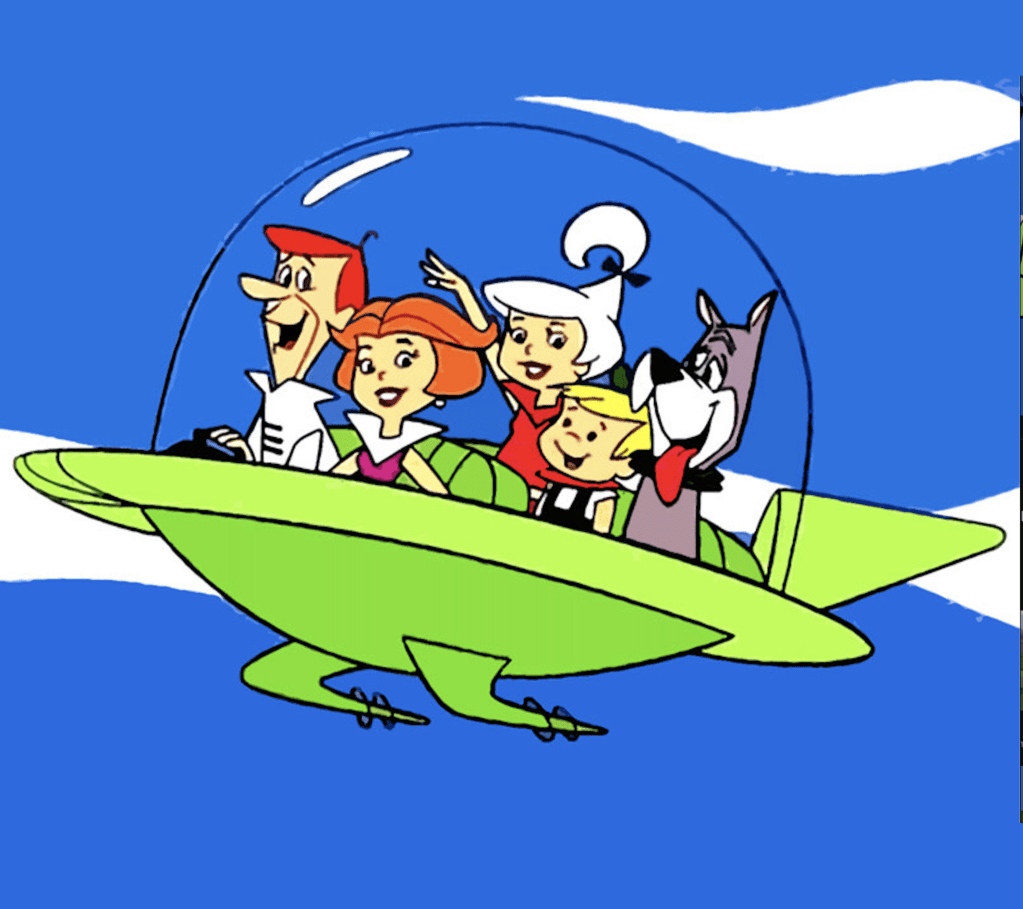
We may not all have flying cars, but we’ve been promised they are coming for some time without actually getting them. Maybe we have to wait to be living in the sky city, where they would definitely be needed, before they are a priority.
Utopia(?)
Some major and glaring problems with The Jetsons today is its lack of racial diversity and treatment towards women. The Jetsons were originally created by, and reflect the ideals of, those who held authority in 1962 America: white men. There are absolutely no discernible people of color to be found at any time – even in crowds. The show was the product of the post-war American Dream and tried to emulate that. Unfortunately, at the time, that meant excluding people of color – as they were systematically excluded from this dream (EDIT: I found this amazing article after posting this part!). In this current world of Black Lives Matter (BLM) and growing, yet still insufficient, visibility for People of Color (POC) in the media, The Jetsons are blindingly white. As science teaches, modern humans emerged dark-skinned from the cradle of civilization and we will soon evolve to be the same.
Jane Jetson’s profession is listed as Homemaker. The only socially acceptable profession for a woman in this era. As with most female characters written by men, she is a cookie-cutter character: she raises the children, is obsessed with shipping and gossip, and is overwhelmed with housework (see the Rosie video below for more on that). Jokes and gags revolve around her getting her hair done, going shopping, her bad cooking, etc. In a fully-automated, push-button world, why couldn’t she have a career? George is a “Digital Index Operator,” which means he turns a computer on and off with his finger. In the real world, we know that Jane is doing all of the work, and George is getting the credit for bringing in the money.
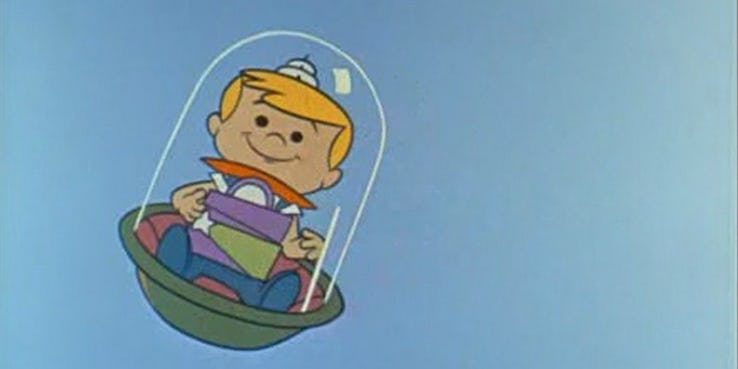
In the trailer, we see Elroy (the youngest) placed in his personal pod and sent off to school. This adorable post-war American Dream Nuclear Family vision grew out of the move of the populace from the cities to the suburbs, where Father, going off to work in the Big City, could drop his child off at school on the way. What a lovely, wholesome image. What do we have, instead, in 2020? Now we have children in cages.
Authority
Police brutality is such a systemic and global problem, that there is an entire section of the Encyclopedia Britannica devoted to it. In comedies and cartoons, the police are almost always portrayed as bumbling idiots or blowhards and in serious dramas, they are usually crooked. This has been the case since the advent of moving pictures and continues today.
When something becomes a trope, it means it’s moved beyond the agreement of the few and become an accepted, wide-spread belief.
Then there is this: https://www.ajc.com/news/nation-world/portland-oregon-mayor-tear-gassed-by-feds-during-police-declared-riot/BG7OJN3U2BAGXC52BAZQNX2ITI/
In Conclusion
Maybe our vision of the future has never been 20/20 (I know you were waiting for that pun). If 2020 were a person, I wouldn’t blame them for shutting down and sending coronavirus, murder hornets, jellyfish, and other plagues at us. We put too much pressure on 2020 to be the year of the future, and yet we seem, in some regards, to be reverting back to the past.
Please accept, on behalf of all of the humans, our humble apologies for expecting too much from you, 2020. Please sit back and relax with some trash TV and maybe some cookies, and call-off your plagues. We will set our sites on another future where Equality and Justice are more important than flying cars.
I hope this had served as an enjoyable distraction for you, and perhaps you learned something or were exposed to some new information. I’m sorry to end on such negative (though real) issues, so here is an Opus on the appreciation of Rosie the Robot:
I’d love to hear your thoughts on “Promises of the Future” that you envisioned for 2020 (or earlier) that have or have not come to life. Please comment below.
*BONUS: while doing research for the dates and links, I found out about The Partridge Family 2200 A.D. for the first time. The concept was began as a 1974 studio pitch for a reboot for the original Jetson family, but 10 years in the future. Some studio exec decided, instead, to create a spin-off of the recently cancelled Partridge family. Far out!
 Small Stuff