Like a Rhinestone Cowboy…

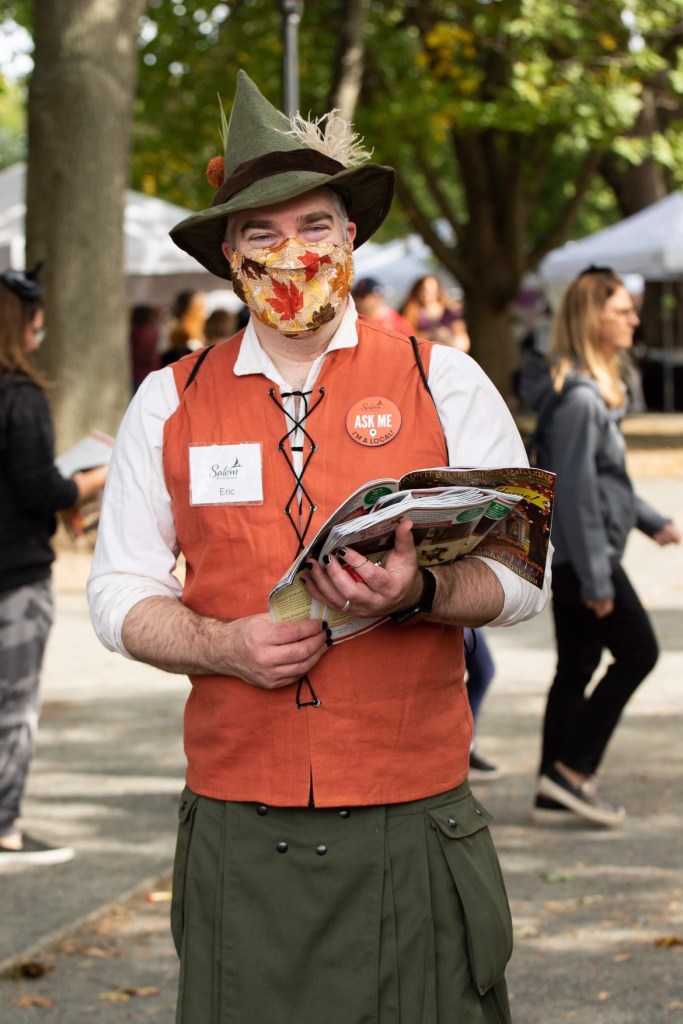
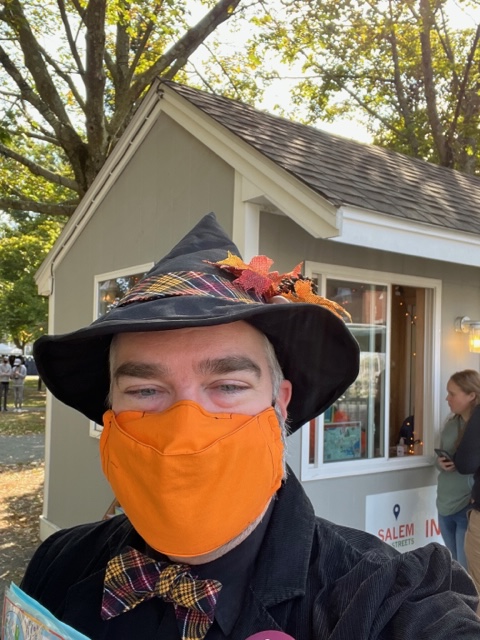
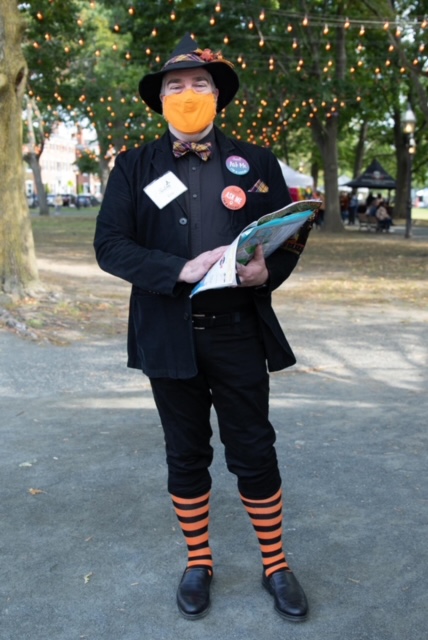
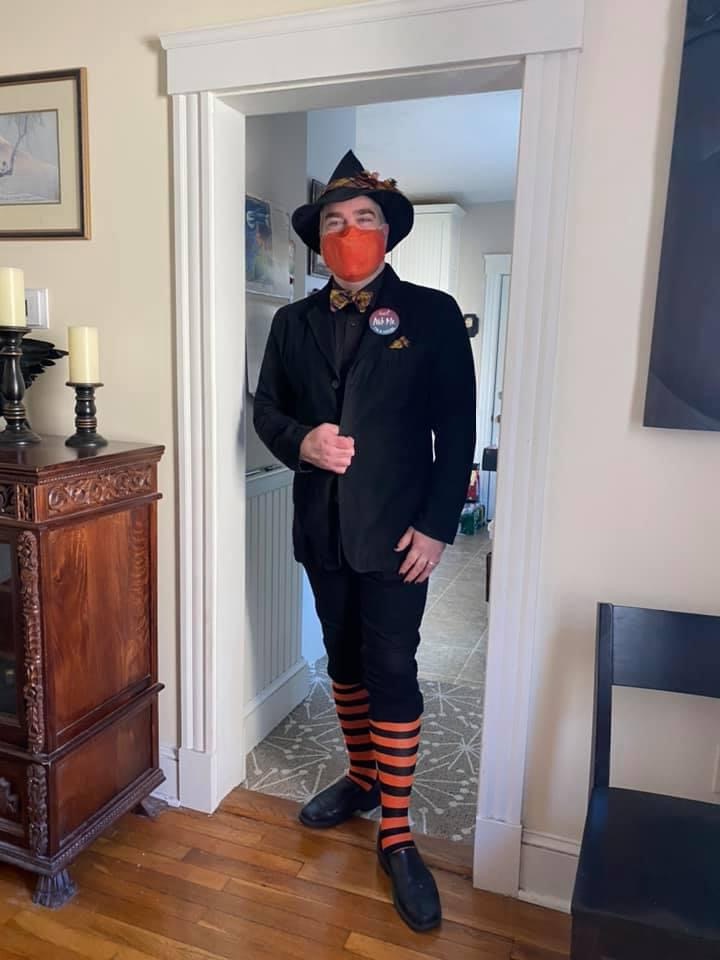
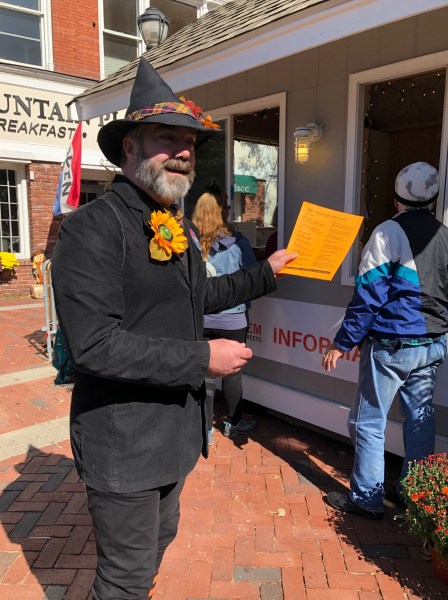
This is my 8th season volunteering at the Salem Haunted Happenings Information Booth (see past stories here). The first outfit I wore on my very first shift has evolved into my traditional, signature first outfit each year, now known as “Ambassador Witch.”
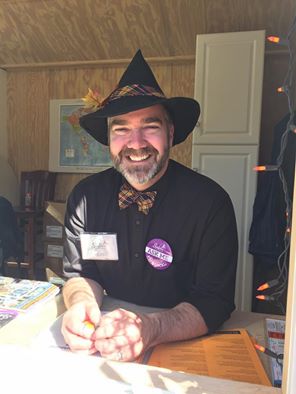
My very first shift, October 2016, and the birth of “Ambassador Witch.”

Does anyone still wear a hat?!
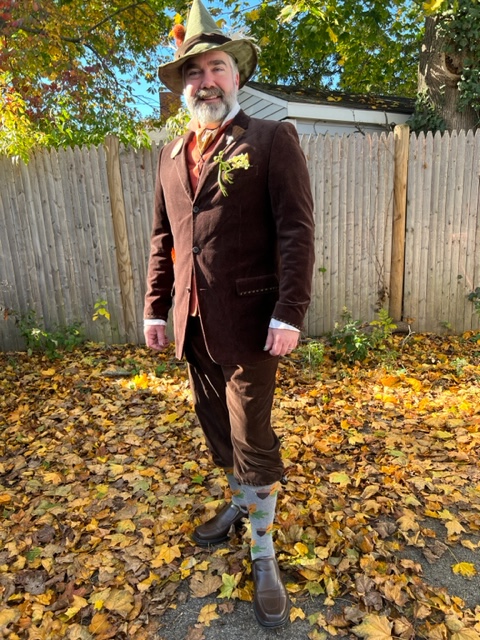
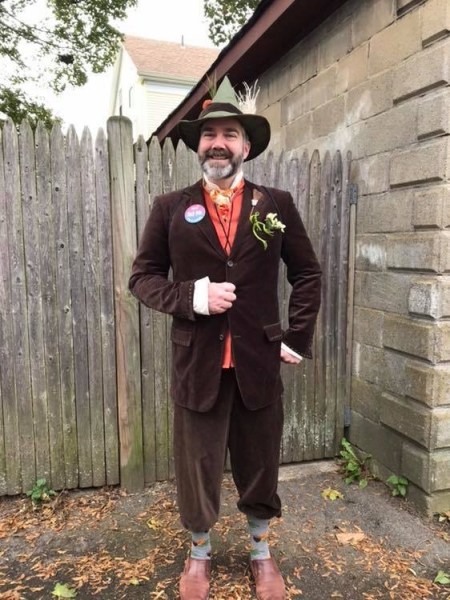
It all started with the idea of wanting a pointed witch hat, but one that had a more stylized, ‘masculine’ feel than the commercially available ones. I definitely wanted it to be part of an “outfit” rather than a “costume,” as if it were part of an everyday uniform. I also wanted to challenge myself, as I had no pattern, and had never made a hat before. What began with just the hat expanded to a matching hatband and bowtie (plus matching pocket square on days cool enough for the corduroy sport coat), then I found striped socks and realized I could slide my pants up to my knees to look like knicker and show-off the socks. Voila! Having been worn every year for multiple shifts, the jacket and hat are starting to fade and show some sign of wear-and-tear, and none of the blacks match, but it still feels like putting on an old friend or stepping back into a service uniform after retirement.

New year, new outfit
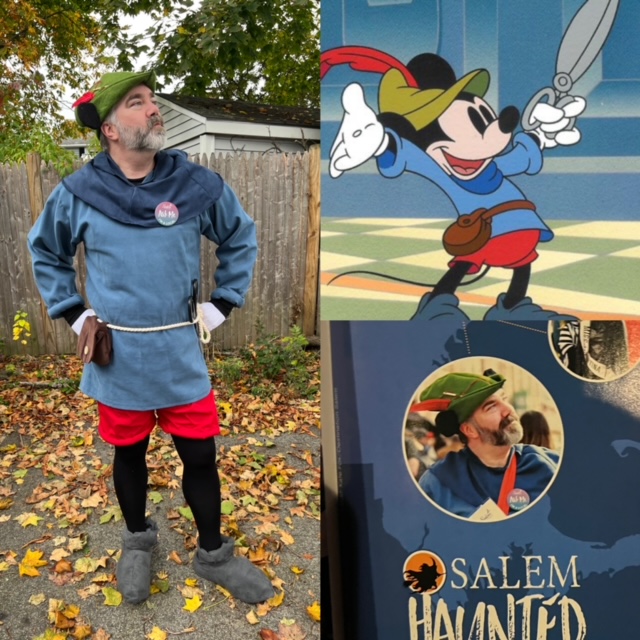
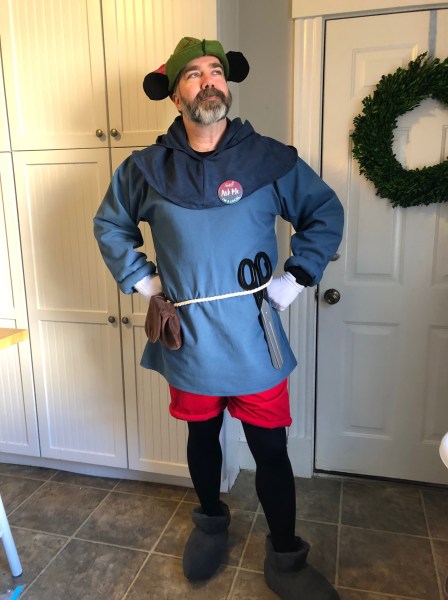
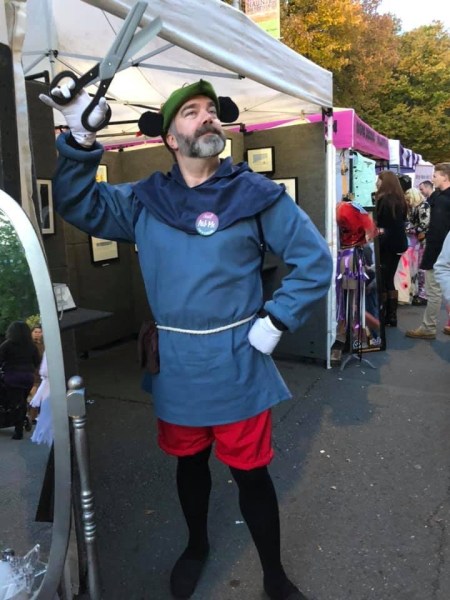
Each year, I try to add at least one new outfit to the roster, so I have options. Sometimes it is unseasonably warm, or rainy, so outfits were made out of necessity or comfort. Each time I create a new one, I try to push myself and learn a new technique or how to improve on what I have already done. I have three pointed witch hats now – the black one, a green tweed, and an orange flannel. Each one is nearly identical in shape and size, but more refined than the last. In 2021, I decided to finally make a “costume” by recreating Mickey Mouse’s Brave Little Tailor, which wound-up in the 2022 brochure!! Hundreds of thousands of people were walking around with my face in their hands. It was wild.

This year was a tough one, for many reasons you will soon hear about, and designing a new outfit was on the back burner. All of my planned sewing projects for this year were focused on the travel we had planned for the year (our first cruise, a trip to a mid-century-modern themed resort, and a Christmas cruise with my Mother-in-law). I made multiple shirt styles, fitted shorts, bathing suits, and bags for the cruise (cancelled – see below), cabana outfits and bowling shirts (that trip happened and was wonderful), and I began a tropical holiday sport coat that is now on hold, as that cruise was moved to next year. It wasn’t until I had time to breathe in late August that I realized I didn’t have anything new for the booth, and a very full schedule between then and October!

Anticipation and Loss
My husband’s coping mechanism for getting through the 2022-2023 school year was to plan our first cruise for June 2023. He spent hours and hours on research: blogs, message boards, websites, travel agents, booking and rebooking for deals, buying supplies, and planning our outfits. It would be a gross understatement to say this cruise was highly anticipated. As I said, I had made us multiple shirts, shorts, bathing suits, and bags in my free time. We thought we were going until 48 hours before our flight to Texas to meet the ship. That is when my brother, who had been battling cancer, moved to hospice care. We made the decision to cancel the trip (praying our trip insurance would reimburse us some of the cost) and go to Florida to say goodbye to him. We rearranged our luggage, booked new flights, and went directly from the airport to the house to see him, then to a fundraiser for him that was being held at his local bar. We stopped in again to see him the next day where I had a chance to tell him about the wonderful community that had rallied around his family at the bar, and that they would be taken care of – he could stop suffering and let go.

Our flight home was delayed and then cancelled, which would have stranded us in the Fort Myers airport for 3 more days. We were able to find flights out of Orlando for the next day, so we rented the second car of the trip to drive 3+ hours to Orlando to stay overnight. That night, my brother passed. Some other time I can tell you more details of how our 3 day trip turned into being stuck in Florida for 18 days (4 flight cancellations, checked baggage retrieval, 5 rental cars, 6 hotels, a wake, a funeral…. it was a lot).

Losing my brother, only 4 years older than me, was (and is) extremely painful for all of us.

Sign, Sign, Everywhere a Sign…
After my Father passed, his way of letting me know he was around was to play a song that had special meaning to us. I remember one really rough commute that made me ornery and angry. I walked into my go-to coffee spot and as I was steaming next to the bakery case trying to decide which muffin to get, Country Roads by John Denver came on. This was a popular spot with students near MIT and usually played more (shall we say) modern music. I immediately stopped fuming, took a breath and whispered “Thanks Dad.” Other out-of-place songs happen whenever I need him, and I know he’s with me.

My brother also had many songs that I immediately equate with him any time I heard them, most of them Neil Diamond classics. This became common knowledge for anyone that met him for more than 10 minutes. At the wake, there were only 3 songs played on repeat: 2 Neil Diamond songs and one that you can probably guess if you noticed the title. Cut to August: I’m frantically trying to think of something I can whip-up for the booth with no success, and out of the blue, this song starts playing in my head:

At first, I thought it was because we had been listening to it at the wake and singing it at the top of our lungs at the bar after the funeral, but it was increasingly insistent and immediately present whenever I thought about October. So thank you, Brother. I hear you loud and clear.

But First, Some History
The song Rhinestone Cowboy (and the movies Rhinestone and The Electric Horseman) would not exist if not for Nudie Cohn. This Ukrainian Jewish refugee is the unlikely father of the Western suits covered in embroidery and rhinestones that are still known as “Nudie Suits.” You can see some examples of his work in the Country Music Hall of Fame, or visit Nudie’s Honky Tonk bar in Nashville, where they have many of his suits on display, along with one of his custom cars!
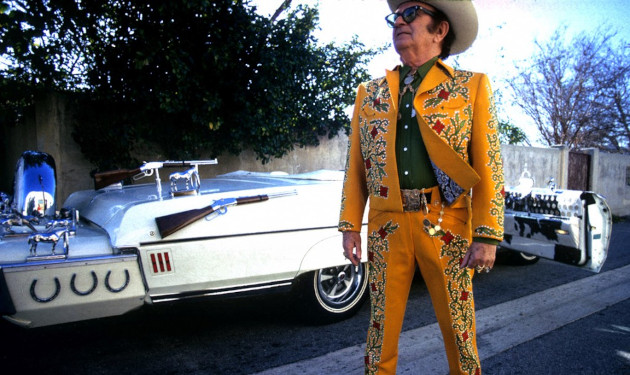
photo of Nudie Cohen by Raeanne Rubenstein borrowed from here.

My Dad was in a country-western band while I was growing up, and while he didn’t wear Nudie suits, he did have fancy Western shirts, ties, and white Chelsea boots that I loved (and wish I still had). We also watched Hee Haw growing up, and I was always drawn to those guest stars with the rhinestones and fringe. These days, I’m obsessed with both Dolly Parton and Brandi Carlile, two female Nudie Suit lovers. In fact, I have thought for a long time about recreating one of Dolly’s iconic outfits translated for a man… maybe next year? I am really looking forward to Dolly’s new book Behind the Seams: My Life in Rhinestones! Anyway…now we have our inspiration.

Getting a Base Color
I didn’t have enough time to construct and tailor a suit from scratch, and I wasn’t going to use one of my suits, so I went to the internet to find a (relatively) cheap suit in a deep, saturated color. While orange would have been an obvious choice for a Halloween-themed Nudie suit (again, maybe next year?), and my research had shown Nudie suits in mustard yellow, white, hot pink, gold, and black, I was drawn to a deep Royal Blue for my base suit.

King of Shreds and Patches
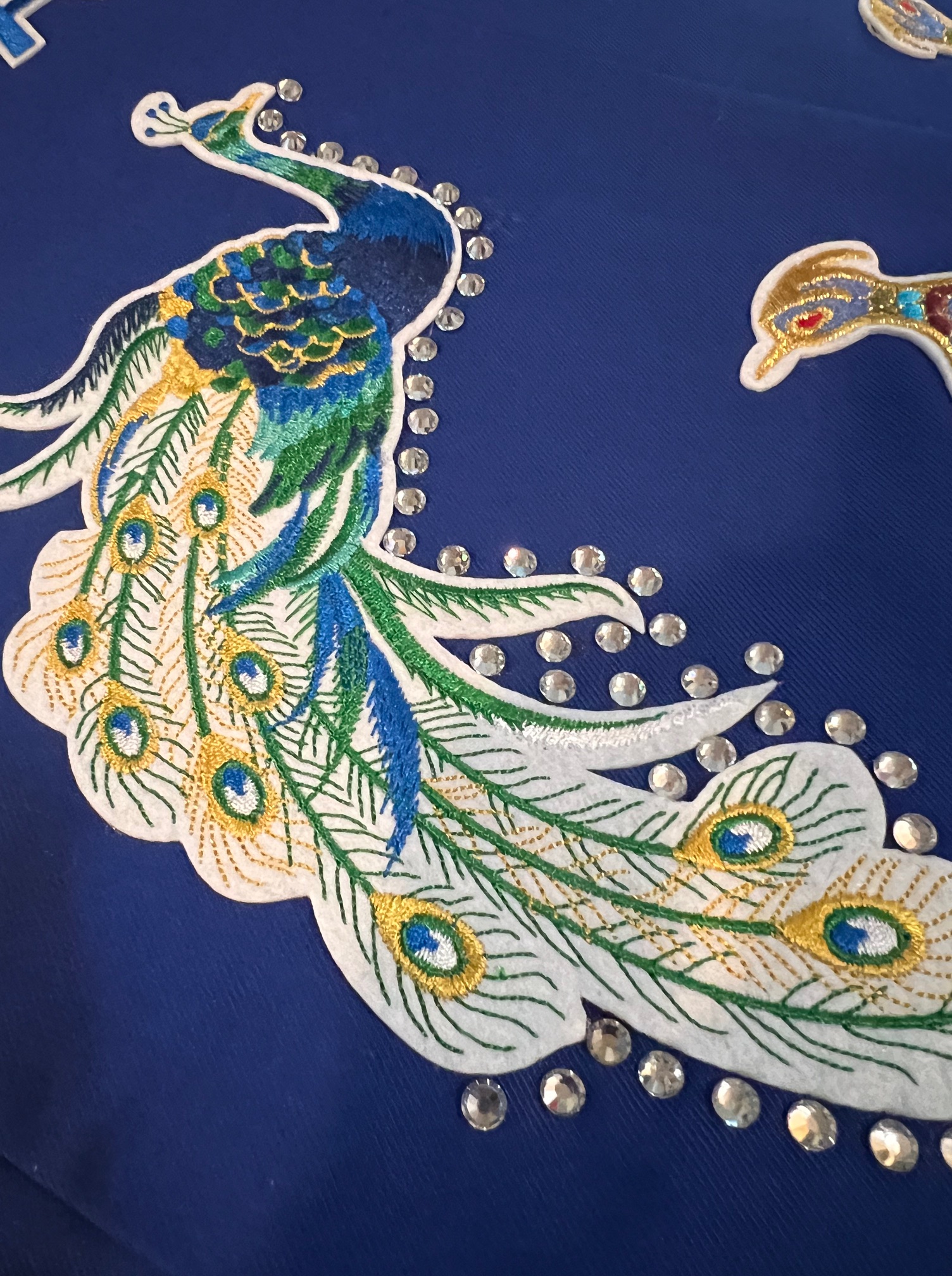
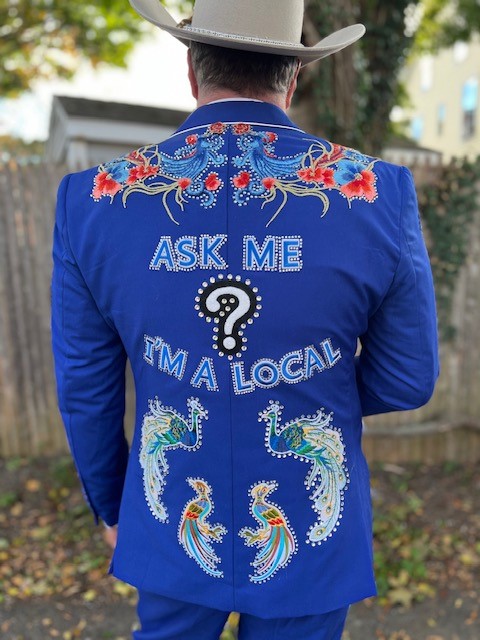
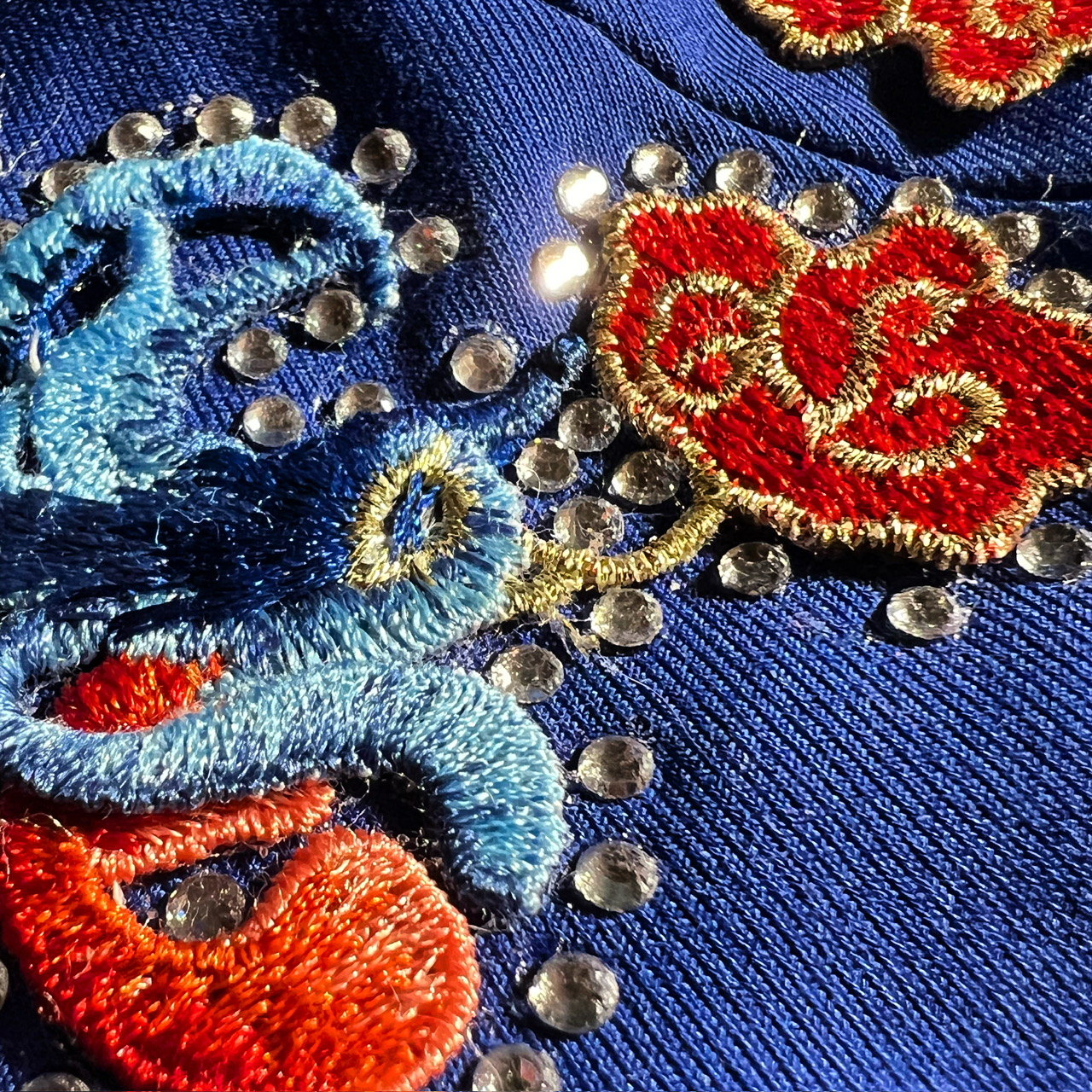
While I have some very basic embroidery stiches on my sewing machine I’ve used to embellish some of my other booth outfits, and my good friend has a proper embroidery machine, I knew that there wasn’t enough time to make sure it was done properly, so I decided that I would use off-the-shelf iron-on embroidered patches to achieve the right look. The only problem was: what theme?!? Vintage Nudie Suites had cohesive themes – music notes, cowboys, wagons, fire, gambling, even marijuana. I scrolled for hours through hundreds of patches online looking for inspiration. When the suit arrived, I tried it on and envisioned myself covered in patches and rhinestones. I already felt like a peacock.

Aha!

I immediately narrowed my search and grabbed as many different sizes and styles of peacock and peacock feather patches. I also grabbed some elaborate phoenix embroidery pieces and patches of other colorful birds. I bought anything that was a showy, colorful flying creature. I went to Joann’s Fabrics and Crafts and scoured the shelves for more, picking-up some flowered vines and some beautiful moths and butterflies in different colors and sizes. I even picked-up some patches that would be hidden from view. There is a small patch that says “a lil’ bougie” that I put on the left butt cheek of the pants (cheeky!) and “IT IS WHAT IT IS” on the inside of the jacket. During my brother’s time in hospice, his passing, and while we were dealing with travel issues, this last phrase was my go-to response when someone asked how I was doing or how I was coping. I know it’s there against my heart and it reminds me of the inspiration for the suit when I see it.

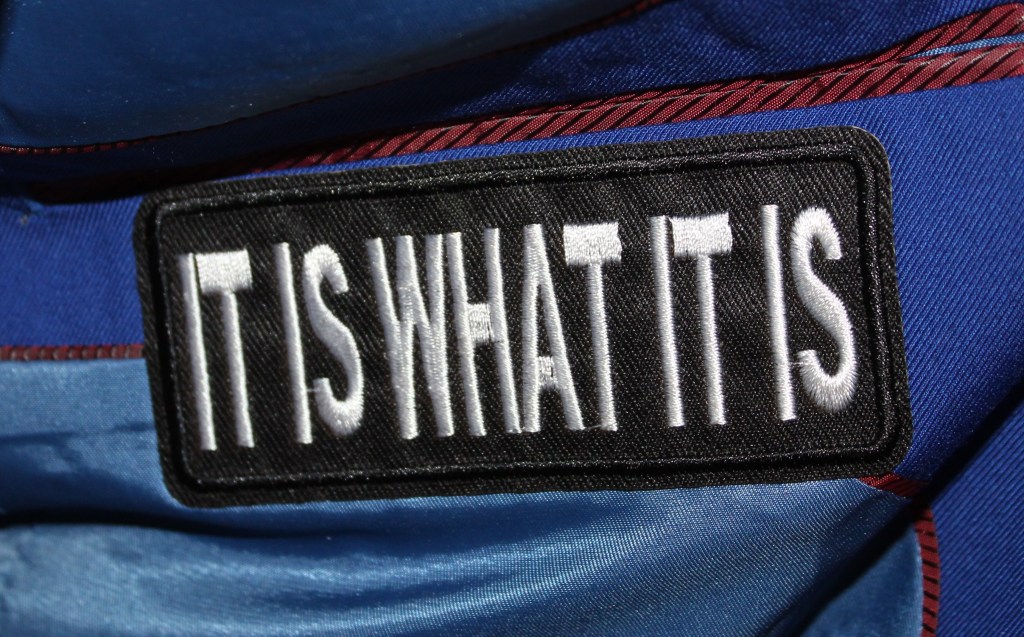
When I felt like I had more than enough patches, I laid the suit out and started playing with the placement until I was happy with it. When I asked a few friends for advice, I was told “More is always better,” so I got to work ironing and gluing all of the patches on.

One Can Never Have Too Many Shoes or Hats
While the suit was coming together, I knew there was one hurdle that still loomed ahead. Here in Massachusetts, there are not a lot of call for Western clothiers. I have a large head and pretty wide feet, so ordering a cowboy hat or boots online frightened me, especially with the limited time. I didn’t want to have multiple rounds of purchase -> ship -> try on -> return -> repeat. Thankfully, I found a Boot Barn about 75 minutes away just over the border in New Hampshire, and I had one day that I enough free time to drive up and try things on.

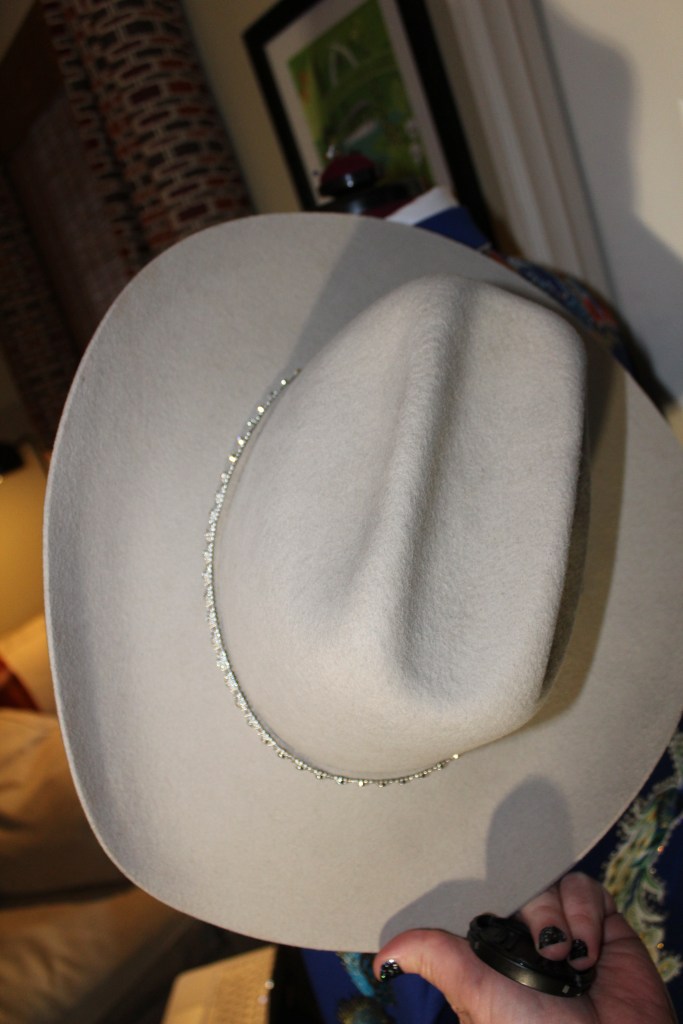
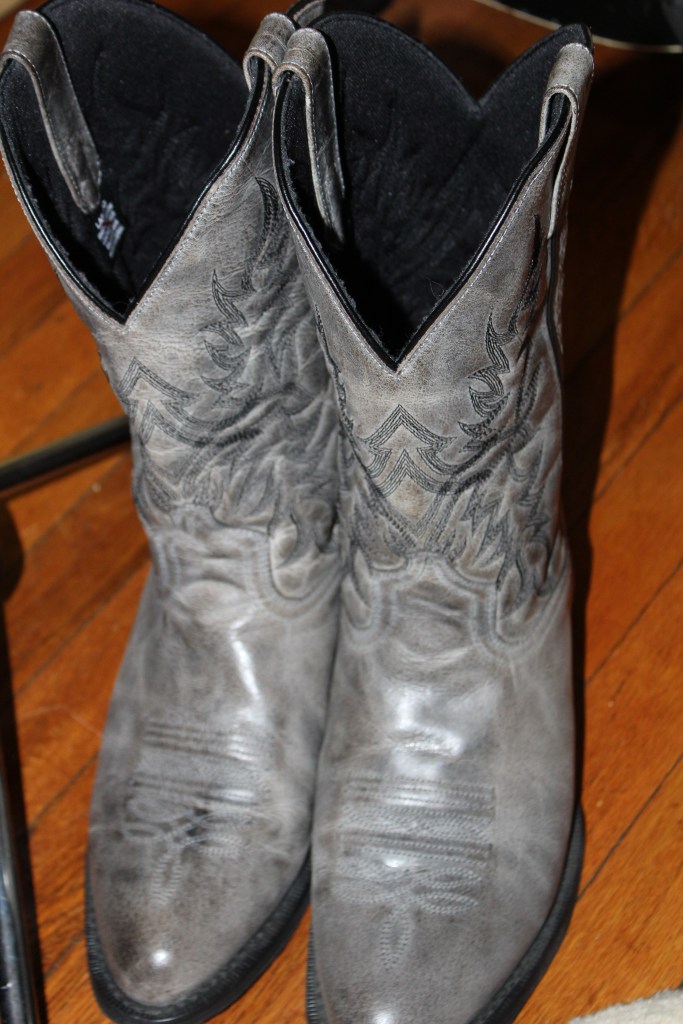
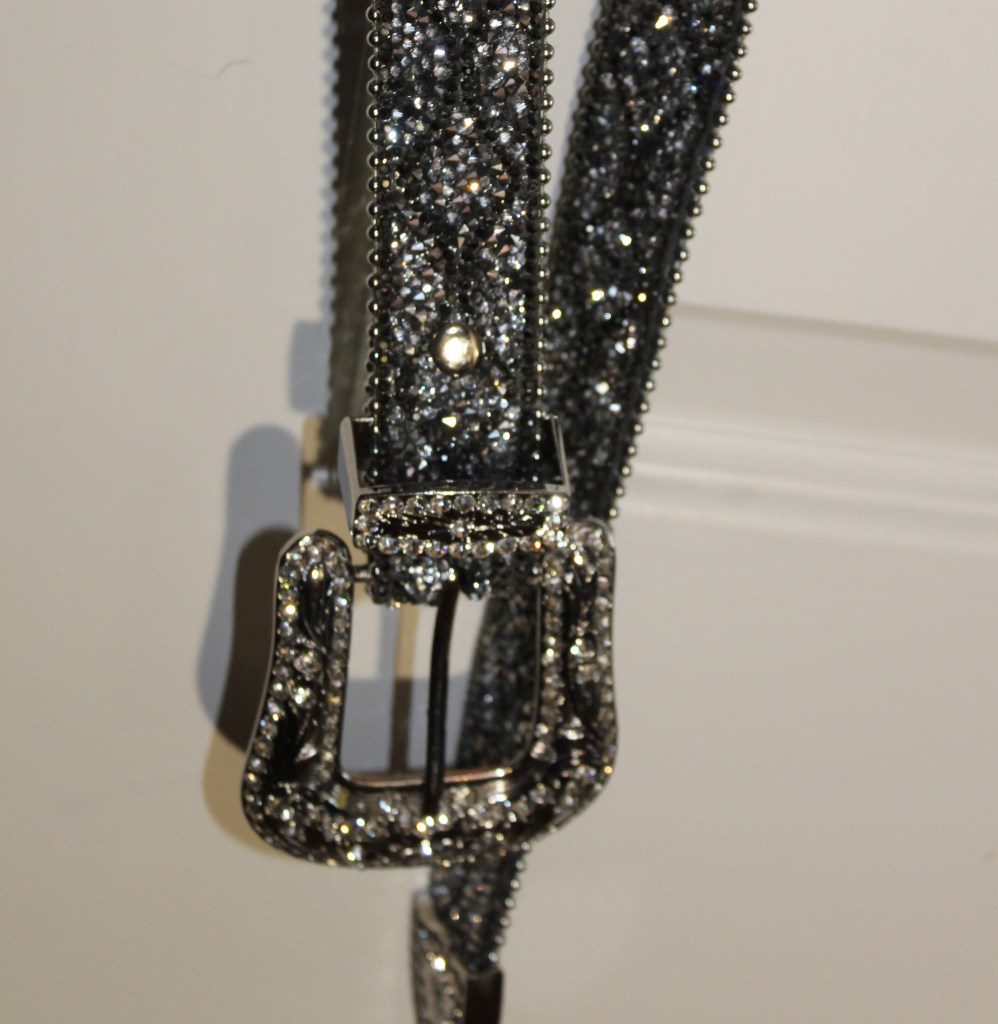
I bought the first pair of boots I tried on. They were the ones I was looking for, they came in wide, and they were so comfortable! The same with the hat. Both are a silvery gray color. White hats and boots aren’t truly stark white and would clash with the bright white of some of the patch edges, and I thought black was too somber or had too many bad connotations. I was done shopping in less than 15 minutes, but that 2.5 hour round trip was well worth my peace-of-mind. On the drive up, I had the thought that I should probably look for a flashy belt buckle while I was in the store, as it was something I hadn’t yet planned for. When we walked in the door, my husband turned to me and said “Why don’t you already own that?” walking over to a rack of women’s belts hanging just opposite and pointing to a belt that was ENTIRELY crusted in rhinestones. I obviously bought it and it is the perfect addition to the suit, as was the fancy white Western shirt with pearl buttons I picked-up.
It’s Hard to be a Diamond in a Rhinestone World
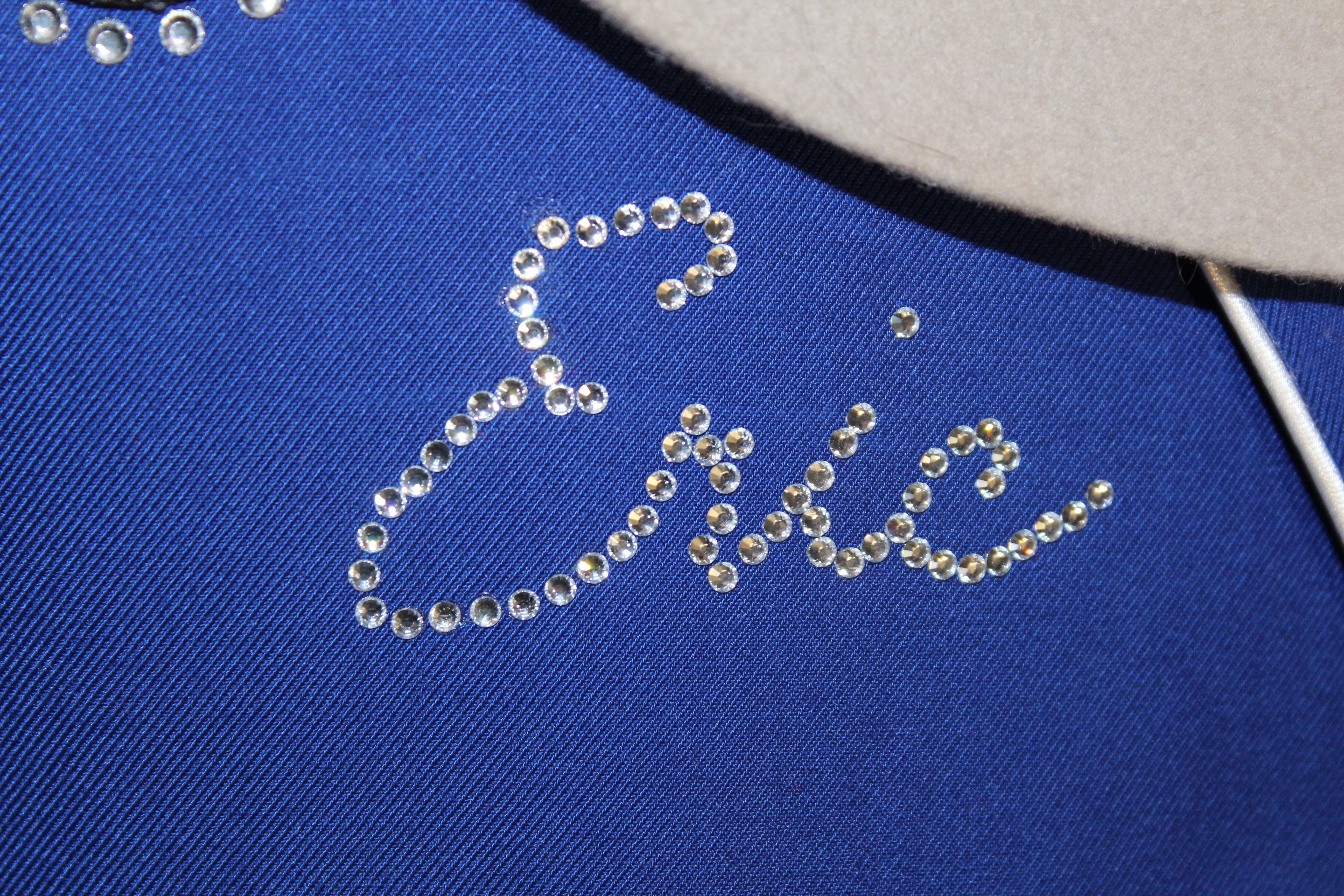
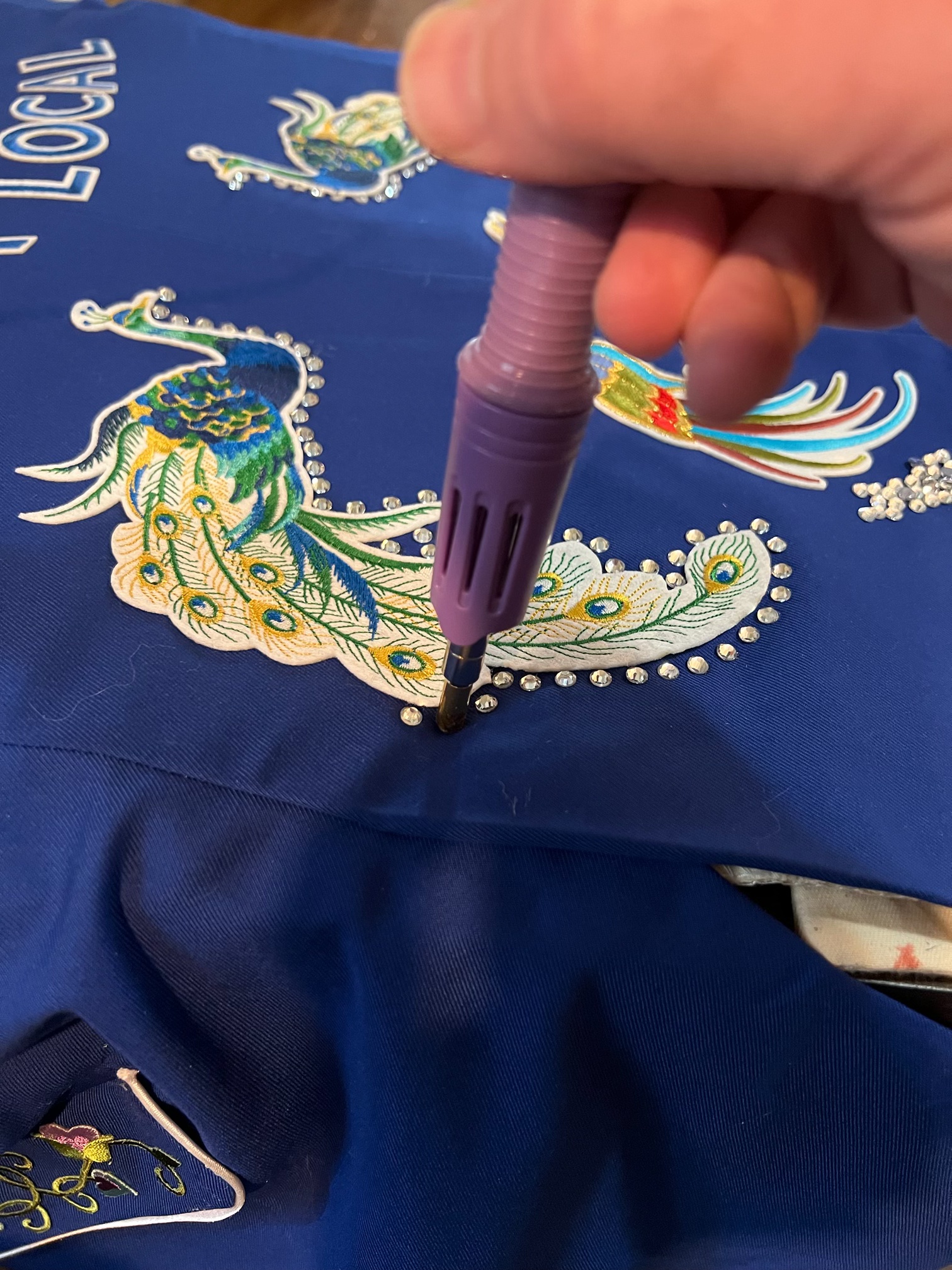
As I mentioned before, I’m always trying to learn new techniques, so I look for those opportunities when picking a project. My foray into adding rhinestones to anything was very limited. I quickly learned how to apply hotfix rhinestones a few years ago when my friend asked me to decorate her chemo bag with a purple tiara, and I do own a Bedazzler, though I don’t think I’ve every really used it. Hotfix rhinestones come with a glue already applied to their flat side. You use a special tool, like a wood burning or soldering iron, to press and heat the stone, melting the glue into the weave of the fabric to adhere it. Real Nudie Suits had hand-sewn stones or were typically fastened onto the garment by a pronged setting from the back side of the fabric, like the Bedazzler does. Since all of my patches were affixed with an iron, and because I was putting the stones on an already-constructed garment, I went with hotfix. They may not last forever, but that is OK.
Finishing Touches
Once the patches and rhinestones were set, something was missing. I went back to the source material to try to find what I had missed. In many Nudie Suits, the pockets, lapels, and cuffs are usually trimmed in a contrasting color. With such a richly colored suit, it helps to make these elements pop, rather than blend in, especially on stage, where they were meant to be seen. I found some white satin piping and edged the lapel and the two flap pockets on the jacket. With the white shirt underneath in the front and the white edging on some of the patches on the back, this really brought everything together better than I could have hoped.
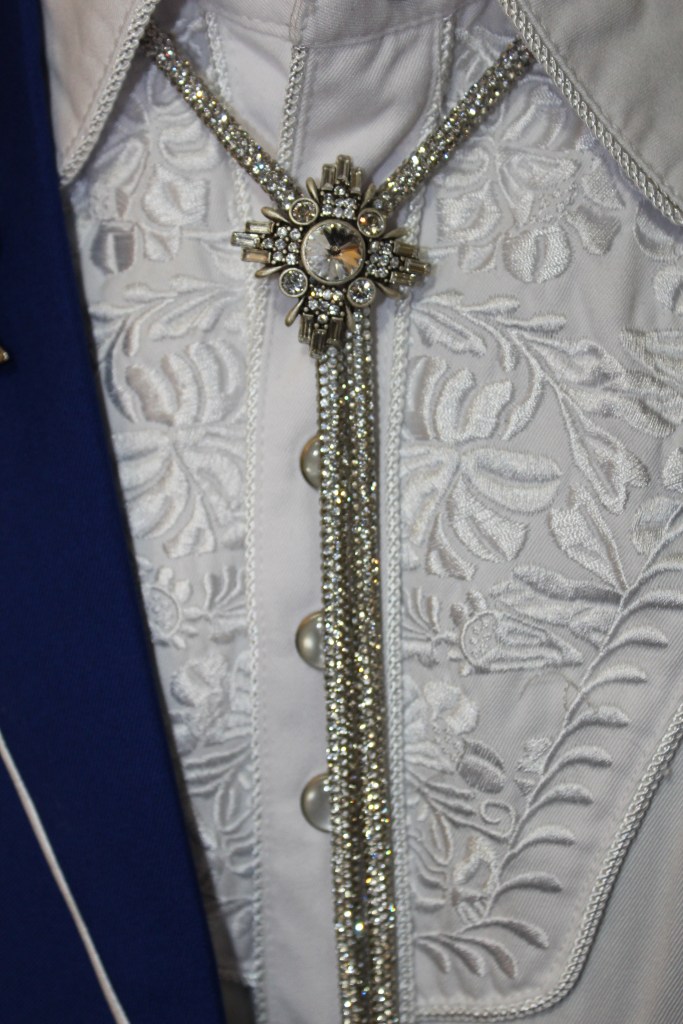
I had a hard time choosing whether to have the shirt open at the neck or wear a cravat or a bolo tie. In doing my rhinestone accessory shopping, I came across this rhinestone rope meant to be a hoodie string replacement, and decided to make my own ridiculous rhinestone bolo tie. I grabbed a brooch that looked thematic, glued it to a bolo slide blank, and voila!
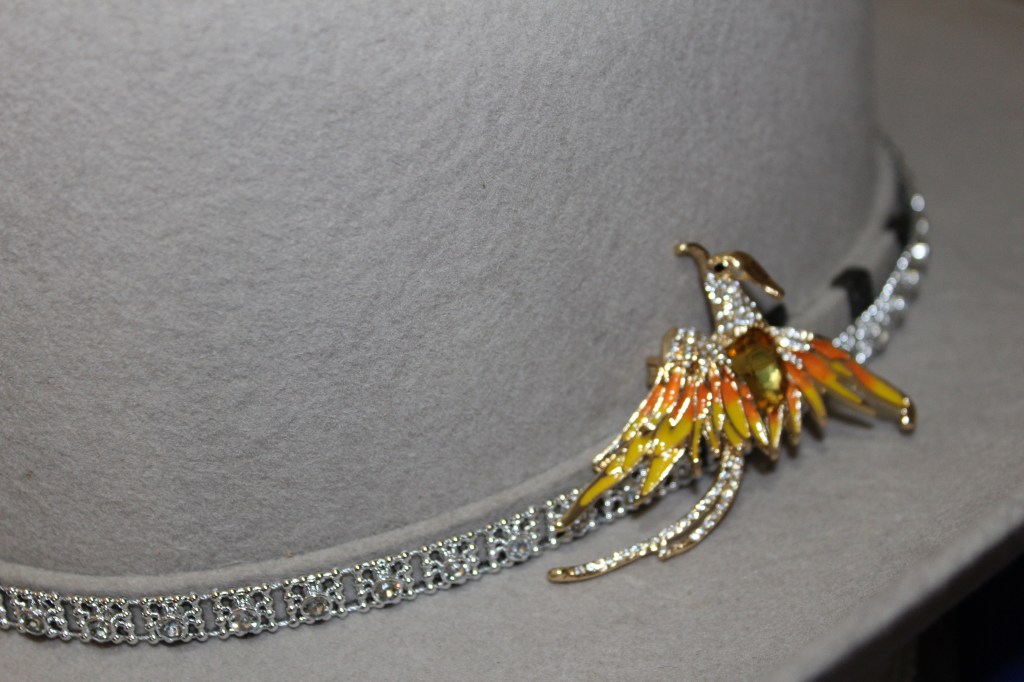
For the hat, I found a trim at Joann’s that I stuck on top of the existing band, and secured it with a phoenix brooch from my collection, bringing a little bit of color and theme up to the hat.
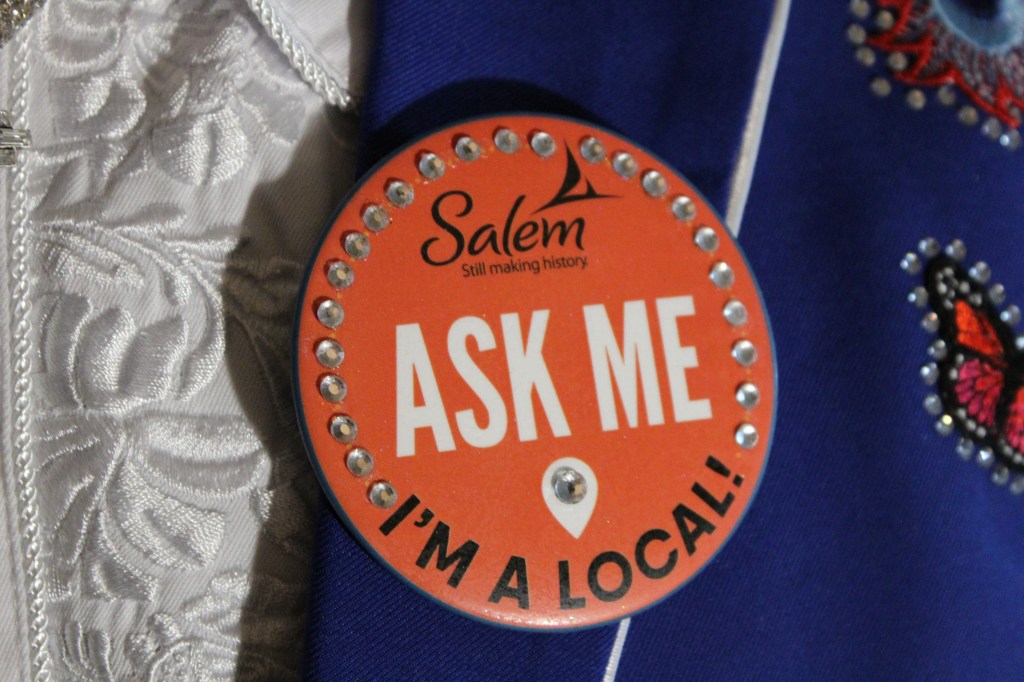
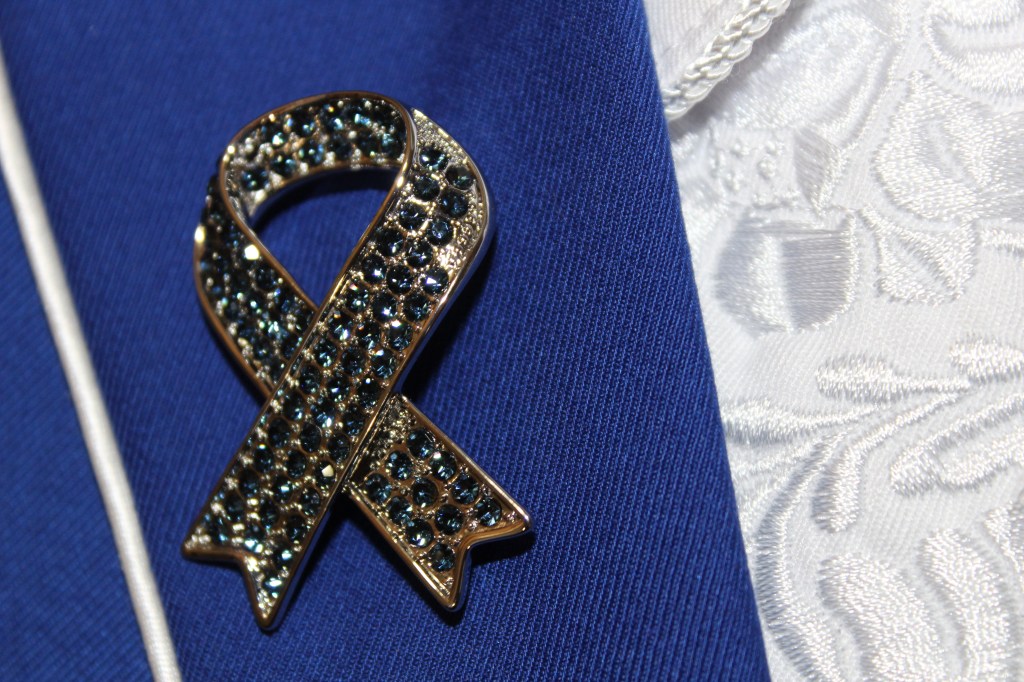
For flair (too late!), I sprayed my “Ask Me I’m a Local” button with glitter and glued some extra rhinestones around the edge and added the most important accessory: the rhinestone blue ribbon brooch in remembrance of my brother and his battle with Colon Cancer.

The Reveal
Do you feel like you’re on a baking site scrolling forever through someone’s ramblings and ads when all you wanted was a recipe?!? Sorry. If you’ve made it this far (or just scrolled through pictures), here is the payoff:
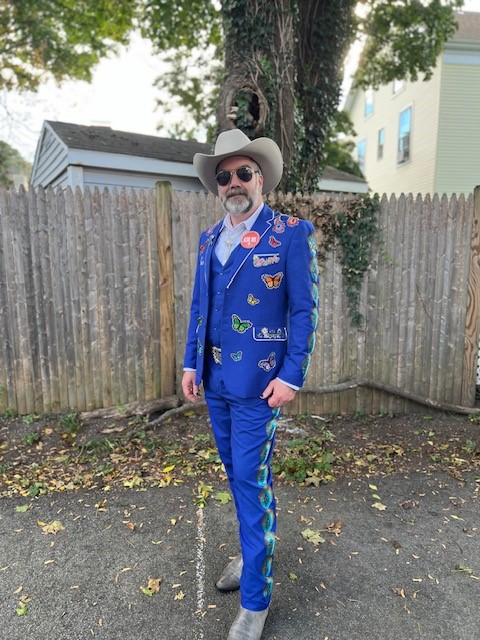
I am so happy with how this turned out. I had a vague idea of what it should be, but not a clear design. This is the first time I felt like I was winging-it and designing as I was going. It was freeing, in a way, but also frightening. I second-guessed a lot of my gut reactions and that delayed the process. I was having trouble committing to designs and layouts because I was afraid of messing it up. If I had sat down and drawn-out a fully-fleshed-out design before getting started (as I usually do), it would have been less stressful, and I wouldn’t have bought so many extra patches and stones!

I now have a custom Nudie-style suit and an itch in my soul to bedazzle everything I own…

Thank you, Brother. I love you and miss you.

Writing Prompt: Do you remember life before the internet?

Daily writing prompt
Do you remember life before the internet?

Yes. I’m Gen X.

Well that would have been a very short post…

In junior high school, I had typing class. There was a special classroom fitted with desks holding electric typewriters. Not word processors (my college essays were written on), but electric typewriters, with ink, paper, and satisfyingly clunky keyboards. On holidays, we made typography ‘artwork’ by following instructions (55 “X”, Return, 30 spaces, 57 “m”, etc) that, when finished, created a picture made of letters and symbols. I ended-up Valedictorian of my graduating class (#humblebrag), but typing and gym were my worse subjects by far. The typing teacher would put a piece of paper covering my hands so I couldn’t see what I was typing. I had to rely on the hand placement around ASDF JKL: and ‘feel’ my way to the other letters without peeking. I cheated more than I should have, and regretted it later in life. Today (34 years later), I’m more proficient and can type quite quickly without looking. I wonder what my speed is (remember Mavis Beacon Teaches Typing)? Maybe I could be a stenog!

“Speed Test” from the original Broadway cast of Thoroughly Modern Millie

When we moved up to the high school, there was a “computer lab” full of Apple IIe desktops with files and files of floppy disks (the actually floppy 8 inch ones – do you know how you keep them from being written over? you cut a notch in the side of them…). These machines were relatively new, but just at the end of their lifecycle. The screens were black and green, and the MS-DOS game of Math Rabbit required several floppy disks to be inserted to play. I remember a full screen of ‘code’ just for the machine to draw a square (<run>). By the time I was a senior, I was writing essays and term papers on a Brother Word Processor that looked a lot like the electronic typewriters of years before, but I could type and edit an entire page on a one-line green and black screen before it typed on the paper. It saved on ink and white-out, but today’s kids would have had a very hard time with it.

The World Wide Web went public in 1993, while I was graduating. My small town library didn’t have internet, and neither did the school. When I went to college, there was a more sophisticated computer lab, but you had to sign-up for time to use the computers attached to the World Wide Web, and you had to pay per minute of usage. By junior year (1995-1996), we had email, and all of the machines in the lab were connected to the internet. I remember printing out (on a dot-matrix printer) email from my college boyfriend. Personal computers were extremely expensive. I didn’t have my own until the 2000s.

If you followed-along on my post about my job experiences, the internet didn’t really change my life until I worked at the touring theatre production company. Out of college, I ran a dinner theatre. We didn’t have internet, we had tap dancing! I wasn’t even able to use the internet to find the touring production job. I saw it in the newspaper (in print!) and mailed (by post!) my application for the job. Then they called me on a landline (!!!) to set-up an interview. This all seems SO CRAZY when I’m writing it, but that’s how it was. I didn’t have my first cell phone until 1998!

Anyway, the next job was for a touring theatrical production company based in downtown Boston. There was a Cellular One store two doors down (later CingularOne, then AT&T), and on a lunch break I went an purchased my first Nokia phone (indestructible!) with the number I still have 25 years later. I still didn’t have internet. The phone made and received calls, and could keep my calendar. While we had computers at our desks, they ran DOS in a closed system that tracked reservations and ticket sales. After a year of being in the office, I discovered there was one computer in the corner of the office connected to the internet (dial-up). The owner had set it up because someone told her it was important, but no one used it. One day, she asked if I knew how to use this “web” thing. I went in every chance I got to look for discounted show tickets, travel deals, and venue research for her. A year later, they gave us email and connected all of our CPUs to the internet. They gave us a day to ‘get used to’ to internet and to play around. Our office manager, a longtime user of newspaper personal ads, found the online ads and loudly proclaimed; “They have ones for you!” As a gay single man in an office of young straight females, I was suddenly the center of attention as they all crowded around my computer to see what the gay ones looked like. I don’t know if you’ve experienced Yahoo personals in 1999, but they were…specific… and graphic. After 2 or 3 “Daddy looking for a pig bottom” and “CD for a…” they all ran away. I looked at a few more and one popped-out at me:

Life is a banquet and most poor suckers are starving to death

Auntie Mame

A quote from Auntie Mame? My favorite movie of ALL TIME?! Then it went on to say that they were looking for gay friends, wanting to explore the city, etc. I was living, at the time, in South Boston with three straight single women. Every night it was Will & Grace & Grace & Grace. If we went to a club or a party, they got free drinks from sleazy guys wanting to get with them, then I was the ‘boyfriend’ at the end of the night if they didn’t want to take them home. Sometimes they would all come home with someone, but I was always alone. Though the ad said “looking for 25 and older,” and I was technically months away from 25, I wrote to him, which started a months-long correspondence.

SPOILER ALERT: That man and I are celebrating the 24th anniversary of our first date later this year, and just celebrated 9 years of marriage.

There have been dark times brought about in my life because of the internet, but since I would not have the life I have now without it, I can forgive those moments. I use it almost constantly for work and for personal use, and you are using it right now to read this story. How insane is that?

So… do you remember life before the internet?

Translating Experience

Daily writing prompt
What jobs have you had?

The writing prompt is “What jobs have you had?”

You say “Jack-of-all-trades (master of none).” I prefer “Renaissance man.” One is a cut, the other a compliment (of a sort).

I started my work experience at the age of 15. After many years of obsessing over every movie musical that came on television, or I could get at the video store (we are talking 1989 here), I decided it was time to take tap dancing lessons. The local dance studio was only a mile from home, near my Aunt’s house. At the time, a family friend, her daughter, and my cousin all had 2-year old toddlers (yes, one was the uncle to the other, it was a surprise to everyone!). The grandmother/mother of two of them lived 2 doors from my Aunt. I became babysitter to one of them on several afternoons and all three once a week. I used that money to enroll in classes down the street. From this, I learned patience, entertaining a tough audience, perseverance, conflict management, and how to care for another human being.

At 16, I started work at a family-owned small convenience store and deli. Looking back, I cherish the time spent there. It was truly being in a second family, I got to know the regulars, I learned valuable skills in retail, point-of-sale, merchandising, cooking, customer service, time management, and working as a team. For some reason, this small store became a central hub for Swedish and Scandinavian specialties, especially at Christmas. The owners were not Scandinavian, but they embraced this niche. We sold lutefisk (frozen, I called them porcelain fish for the sound they made when they hit the counter), made spice bags for Glogg, sold Cardamom braids (yum!!!) and Lingonberries, and made Swedish meatballs decades before IKEA made it to Massachusetts. We were so busy that former employees would come in to help during the season, making it even more of a family reunion party atmosphere. The store has been gone for many years, but a few of us still wax nostalgic at the joy we feel when smelling cardamom when it gets close to the holidays, or we think of stealing cookie dough from the freezer.

The summer before I left for college, I joined the Avon Parks & Recreation Department as a counselor at the day camp run on the high school grounds. It was free for residents and included open play, crafts, and sports for most of the day on Mondays, Wednesdays and Fridays, with paid field trips on Tuesdays and Thursdays for certain age groups. Building on my babysitting skills, I honed patience, entertaining a tough audience, perseverance, conflict management, crafting, pedagogy, security in crowds, and emotional support/encouragement. The kids were 6-16 years old, and in this day and age, I can’t imagine them being left in the care of semi-untrained teenagers and young adults.

In college, I held two very different positions. For the first 2 years, I was a “Script Librarian.” We had a closet full of theatre scripts with a very small desk in it. Students could come and borrow and script, or set of scripts, for use in their classes or performances. I sat there and catalogued, itemized, and tracked them all. The copious amounts of downtime gave me ample opportunity to read through most of them, which came in handy when I was advising younger students on where to find an audition monologue or scene to stage. For my last 2 years, I was a “Safety Escort.” <hold for snickering> My college had a “boozer cruiser” – a 10-passenger van that drove students around the campus at night for free. You would call the dispatch (a lonely room in the campus police building) and the van would drive you wherever you needed to go on campus. Driving around was fun, because you got to be out and interacting with other students (even if they were drunk or high). It was always entertaining. Being in the dispatch office was creepy and lonely, but that’s when I could practice lines or dance steps. Being a theatre major, I had a lot of late nights rehearsing, then I would pick-up the 12-4am shift. When I was in the dispatch office, someone would call at 2am and I would answer the phone in a husky, sleep-deprived, sung-too-much-in-rehearsal bass: “Safety Escort, how may I assist you?” More than once, I had a drunk student (both sexes) purr at me and ask if I was the one picking them up. From this job, I further developed customer service, conversing with strangers, safe driving, dealing with difficult customers, how to save a drunk girl from getting into a dangerous situation, and using humor to diffuse tense situations. I relished the alone time in the van between pickups and at the dispatch office, but also the constant entertainment of the customers in the van.

For the summers between my Freshman and Junior years, I was a Meter Reader for Bay State Gas (now National Grid). My father worked there for over 40 years before he retired. I enjoyed commuting with him, and getting to know his colleagues those summers. Typically, the full-time readers would give us the worst routes, or a collection of unattainable readings over several routes (basically the sh1t jobs). Most of the time, I dealt with basements filled with dog poop, possible crack dens, lousy neighborhoods, and belligerent homeowners. Once in awhile, I would get one of the coastal towns of Scituate, Hingham, or Hull, where you walked along the beach to read the meters of cottages. Those were the best days. I remember reading the meter at La Salette Shrine one day, and sitting in the parking lot to eat my lunch. All of a sudden, a priest opens the passenger door and gets in, saying: “Hello my son, would you take me to the store?” This was strictly forbidden in the company truck (natural gas powered, of course), but I was raised Catholic and convinced my Mother would somehow know if I refused, so I took him on his errand. From this job, I explored a lot of the South Shore of Massachusetts, learned to deal with difficult people, to navigate the bureaucracy of a large corporation, that summer help are slaves, that unions are great, but sometimes protect those that shouldn’t be there, how to survive walking miles in the summer heat, how to cheat by saying you couldn’t get into a house that creeped you our or made you feel unsafe, and gave me an appreciation of all my Father did to take care of us.

Between Junior and Senior year, I attended a summer stock cattle call audition. Several local and regional troupes attended and made offers based on one 90-second song audition. I had some less than favorable offers, but was determined not to work at the Gas Company again. After turning down a troupe that paid nothing, a friend of my roommate called to say her friend needed guys that could dance. I drove out to Scituate (one of my favorite routes for meter reading) and auditioned for Showstoppers Dinner Theatre. Doug, the owner, producer, and sole employee, asked me to do a time step and sing a bit of a song, then hired me on the spot to be a sailor in Anything Goes. We would rehearse for 3 weeks and have 4 weeks of performances. During the first rehearsal in an unairconditioned church hall, we learned the choreography for the 88 counts of 8 that made the big dance number of the title song. That show kicked my ass and I lost all body fat and leaned-down to the best shape I’ve ever been in. Halfway through the run, I found out that 2 of the ensemble were here from Ithaca and that Doug had found them a place to live and a part-time job. I told him I needed a job, so he hired me to assist him for the rest of the summer. I painted and constructed sets, pulled costumes from storage, cleaned dressing rooms, worked in the box office, coordinated meal orders with the kitchen, acted as maitre’d, host, bus boy, and greeter, tour bus coordinator, usher, prop master, and sound and light engineer. On top of that, I was rehearsing and performing in every show. I was there at 8am every day and leaving at 2am most days. I was in heaven and I miss it so. The pay was below minimum wage, but I didn’t care. I assisted with choreography and vocal rehearsal for a children’s summer production of Joseph and the Amazing Technicolor Dreamcoat while also performing 3 of the adult roles and running spot light and front of house. I co-developed and ran an after-school program for kids in one of the local schools and still performed in 2 productions and a tours to New Hampshire, Colorado and Florida while still attending my senior year of college, and when I graduated, Doug made me Associate Producer full-time, where I ran most things on my own so he could spend time with his family, assisted with another summer kids production (this time only with one dance number to fill-in for), more after school programs, and more tours. At the dinner theatre, I would sell the tickets, greet the guests, seat them, bus tables, change into my costume, perform, change back to my suit to work the dessert course during intermission, go back to costume to perform the second act, then back into the suit to escort the guests out, or perform in the post-show cabaret in the lounge. The lessons learned here were myriad, and it would take too long to list them. Work ethics, loving what you do and doing it well, having fun while you work, building relationships with colleagues and customers, and hard work were the cornerstones. It was exhausting, exhilarating, and the most fun I’ve ever had in a job before or since. I was overpaid and underworked and I would do it again in a heartbeat.

After 2 years there full-time, Doug moved us to a new restaurant partner in a new location. Unfortunately, after less than a year, they stole money from us, locked us out of our theatre, and thus started a legal battle. I was out of a job while they went to court, so I went looking for something, anything in the arts. I landed at a theatre production company in Boston. Well-established in the educational theatre space, they specialized in producing touring theatrical productions geared toward middle and high school students. We offered them shows that included 5 short stories of American classics dramatized with a cast of 5 actors, full sound, lights and sets. My initial job was to contact and coordinate the technical and financial specs of the theaters and halls across the country to build the tours. I was there for about a year (2 seasons) when I was recruited to move up to assist the Artistic Director. In that role, I coordinated casting calls in NYC, Chicago and Boston, worked with the Producer on hiring the actors, negotiated contracts and temporary housing, scheduling rehearsals and playing referee/translator between the Producer and Artistic Director whose relationship was well established, yet strained and complicated. At the heart of the entrance to the office and the bullpen of reservationists, I was the de facto receptionist, back-up reservation coordinator, and back-up assistant to the Producer/Owner/Founder. Aa Tony-winning Broadway producer, she was difficult and not easy to please. Handling the two strong energies between them, and handling everything she threw at me, gained me a status that granted me a lot of perks and a lot of extra responsibility (with none of the compensation). She went through 4 personal assistants during the 7 years I was there. During that time, I was the backup assistant, and guided each of the new assistants through their training and pitfalls, called during vacations for inane tasks that could have been handled by her assistant, sitting in the car so her nanny could come use the bathroom without parking the car or waking the baby, screening calls she didn’t want to take – you’ve all seen Devil Wears Prada – it was similar. From this job, I learned how to deal with difficult people, how to deal with celebrities, copyediting scripts, the politics or Broadway, dealing with egos, dealing with actors, dealing with stagehands, dealing with Teamsters, booking travel, booking and re-booking discounts for millionaires when you can’t afford to eat… and the list goes on. I did get to see a lot of free shows in Boston, and made friends with a lot of the local critics and producers, but in the end, the tension and working environment was toxic and it had to end. I still talk to other ‘survivors’ of our time there.

After asking me to do something she had no right to ask, then firing me for mentioning this to her, then trying to take away my unemployment benefits (she lost, and tried and failed the same thing with everyone since then), I landed a job at a music booking agency because of the very skills I learned from the last job. This agency specialized in Jazz and World Music artists. They were well established in the US, and had a strong footing in Europe, though there were many boutique agencies in the US and Europe that they competed with. I was brought in to assist two female strong-willed agents that could not/would not work together in the same way – sound familiar? I was to assist them with their bookings and keep the peace/translate between them. Their styles were diametrically opposite and that exacerbated the disdain and frustration they felt with each other. It was toxic beyond toxic. They tried to play the outgoing assistant against each other and drove her away. Being well-versed in this behavior, I jumped in and kept it all afloat and sorted. After a year or two, one of them left (the nicer one, obviously), and I continued assisting the remaining one, eventually taking-over some of her territory as a junior agent. She was NOT happy about it and only relinquished the territories she didn’t want. When the owner gave me some of her “friends” (she thought that, they definitely did not) as clients, and they immediately warmed to me, she complained and demanded to take them back, giving me her other undesirables. I grew my territory and the owner gave me more and more responsibilities and territory. Her rough American pushy nature ruffled a lot of feathers in Europe, so many of her remaining clients preferred to talk to me to finish deals rather than listen to her “show me the money” demands. Artists’ managers called to talk to me when she wasn’t around. I was my own agent, but acting as her assistant because of her manner. She eventually screwed the owner by starting her own agency under his nose and stealing several clients. Suddenly, I was the only agent for Europe, Asia and Africa. We hired other agents that came and went, but over 11 years there, my territories shifted and changed to a rag tag disconnected collection of problematic areas. Wars, financial collapse, political upheaval, visa issues, and an aging clientele brought a steep decline to my carved-out territories. Having seniority (read: pay scale) and the worst-performing territories (read: low income) = a buyout to leave. Having been burned before, the owner’s stipulations included that I could not discuss my departure, and could not work in the industry for one year. I gladly accepted following one of the last shows I booked. Maybe one day I will tell that story here, and though the artist has passed on, there could still be implications if I made it public. Stay tuned….
From this job, the longest of my careers so far, I learned a lot about deceit, back-stabbing, pettiness, slavery (I was, literally, selling people), overpromising, and the Artist as a commodity (the finances of a world-renown jazz vocalist will break your heart when you work out what the contract pays vs. what she actually takes home vs. what her managers take home). It’s not all negative, I also learned a lot about contract language, copyright, international travel and visas, currency exchange, high-end performance technology, riders, working with difficult people, customer service (for buyers, performers and managers), conflict resolution, conflict mitigation, interpersonal relationships via phone, email, and in person, professional travel, trade conference presentation, marketing, sales, website and software design, and how to decompress/separate work from home life.

I started this blog during the transition from the agency to unemployment. I had received in the mail my first digital SLR camera on the same day I was bought-out, so my first post is a collection of photos I took trying out the features of the camera on my first day of unemployment. I stated at the beginning that I wasn’t sure what this would be, or where I would be going. Several of my Artists and Managers reached out to me to offer me positions and to ask my advice, and I had to tell them why I couldn’t. The truth was, I didn’t want to be in that world anymore. If I could tell you that last story, and you knew my family background, you’d understand. (Hint.)

After months of looking around for my third (5th?) career, I had an interview at Harvard Medical School that I had heard about from a friend (a former actor from the theatre company, actually). I had never considered academia – all of the positions I had been applying for were in the Arts, Event Planning and Customer Service. This job wasn’t a good fit for either of us, and both the interviewer and I knew it, but my husband happened to mention it to his colleague that I was there that day. His colleague’s wife worked in HR at MIT at the time, and asked why I hadn’t reached out to her. The truth is, I hadn’t thought of it. I thought I wanted non-profit in the arts, not in academia. While she had nothing for me, she suggested where I should look on the MIT campus. I landed at a very small office where…you guessed it… there were two strong women, slightly at-odds and not listening to each other, running the show. I met with the operations manager first, who grilled me on what I did and didn’t know. She brought me in to meet with the Executive Director, who loudly proclaimed “I don’t know why I’m meeting with this guy!” from her office (within earshot) only moments before sitting down to interview me. I was not hopeful, but after a month of silence, they offered me the job (after their first choices didn’t work out, I later found out). The HR manager, in my offer call, asked if I had any concerns. I told her that I was concerned that I’d be the stupidest one in the room. She assured me that the entire Institute was run by former theatre majors keeping the smart people running, and that I was desperately needed. I’ve been at this job for 6.5 years now, the longest of any of my colleagues besides my boss. She has since drastically changed her view of me from that first meeting to constantly proclaiming: “what would I do without you?!” While I did not have domain expertise (the US Healthcare System and all its flaws), I have had to tap into and hone nearly all of my previously learned skills of customer service, time management, working as a team, navigating bureaucracy, patience, resilience copyediting, contract language, copyright, travel, working with difficult people, customer service, conflict resolution, conflict mitigation, interpersonal relationships via phone, email, and in person, trade conference presentation, marketing, sales, website and software design. To that, I used my theatrical production skills for event planning, event material production, front-of-house management, A/V needs, and run-of-show planning for our highly complex multi-dimensional workshops. I also have become proficient in PowerPoint, as it is a tool used daily in our work, The domain content is slowly seeping in, but only enough to keep me from not being completely lost in conversations. I know the history, the players, and where all the bodies (files) are buried, so I’ve also become a repository of the things that may have fallen through the cracks.

Things are constantly changing in this job. I don’t know which previous experience gave me the ability to nimbly switch from one topic to another, or to completely change course on a plan at the drop of a hat, but it’s there, because that is the nature of the position I’m in now. Was it babysitting toddlers? Was it the dozen-or-so positions I filled every day at the dinner theatre? Maybe it’s inherent in the non-linear path of my work life?

I know this is a rambling post, but the prompt intrigued me, especially when I looked back at the strange, seemingly disconnected path that lead me to where I am now. I hope you will take a moment to look back (or forward!) at your career path and see where your experiences can be knit together to make you the ideal candidate for any job you want, regardless of how the requirements of the position are worded. Translate your experience into skills needed for that job, especially if it’s not obvious from what they see in your CV.

So… what jobs have you held?

Salem Visitor Information Booth 2022

Visitors helped per shift:
10/8 (10am-12pm) – 231
10/8 (4-6pm) – 244
10/9 – 233
10/15 – 220
10/23 – 287
10/29 – 259
10/30 – 218

I helped 1,692 people out of the 30,619 reported in the booth.
That’s 5.5%, though we had over 100 volunteers all season. Personally, I was disappointed in these totals compared to past years, but I guess it’s still a healthy amount.

One highlight of the season was that I was featured in one of the brochures! Right on the foldout map! Of COURSE I had to make sure that the Brave Little Tailor made it into rotation. Every time someone grabbed one of the small brochures, I would point out where the map was and hold the page up to the side of my face. I signed more than one autograph! Hahahaha.

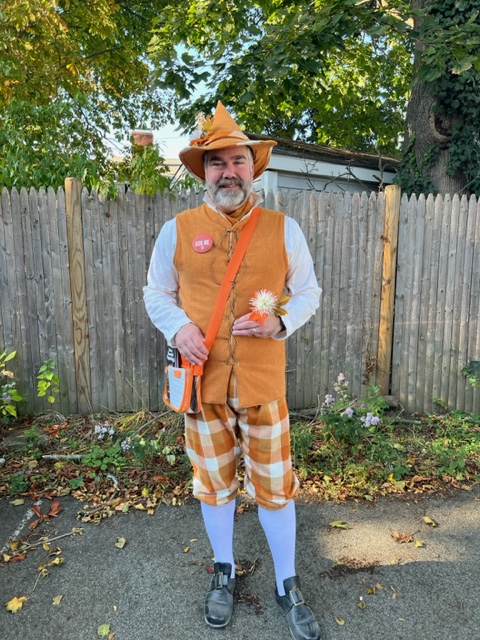
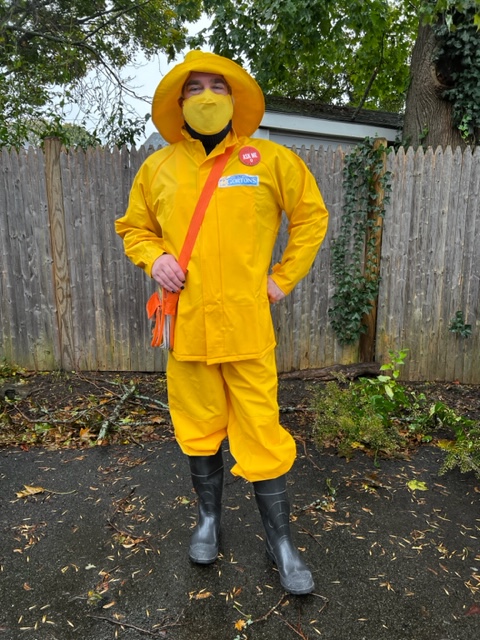
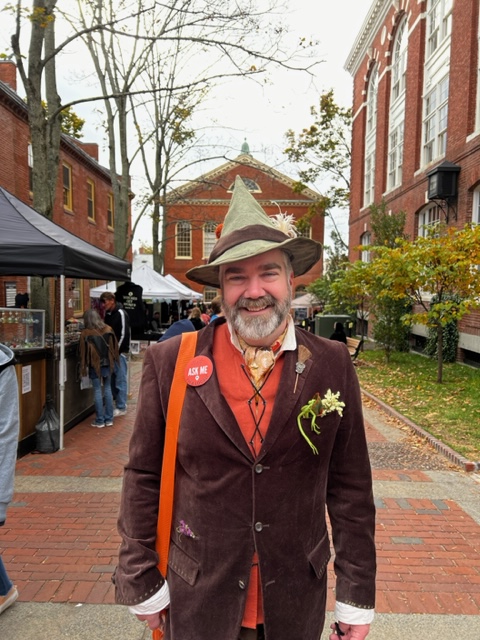
Some more photos of the outfits from this year:

Did I help you?!? Let me know in the comments!

Salem Visitor Information Booth 2021

This year, we were split across town. We had the Info Booth at the Salem Common with shifts of 2 inside and 2 outside, and a tent in Lappin Park (by the Bewitched Statue) with shifts of 2 people.

By the numbers – here are the visitors I helped per 2 hour shift:
10/2 – 186
10/2 – 164
10/9 – 218
10/15 – 165
10/16 – 189
10/17 – 446
10/22 – 116
10/23 – 268
10/29 – 213
10/30- 154
10/30 – 46 (Flooding rain!)

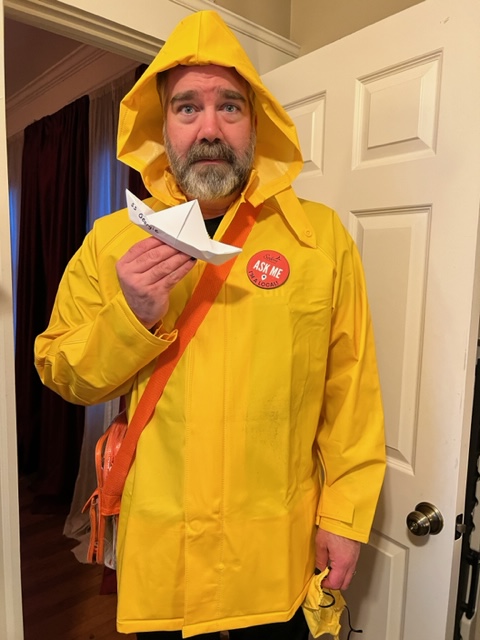
All total, I helped 2,165 people. That 446 on 10/17 was because I was alone at Lappin Park. The last shift of only 46 was due to a MONSOON of rain that flooded the common. Thankfully, I had planned ahead a few years before. In a reverse Murphy’s Law, the idea was that if I planned for a costume that could handle the rain, it would never rain! So I put together the Gorton’s Fisherman outfit in 2019 (I had a Gorton’s nametag and a fake fish finger box in my brochure bag). Finally, on the 30th, I wore it during the day shift (light rain) and then switched to the kid from the movie IT for the evening shift (flooding). I had a ton of people recognize the Gorton’s Fisherman and ask for photos, many of whom had family that worked there (they are based up in Gloucester, MA, a 20-minute drive north).

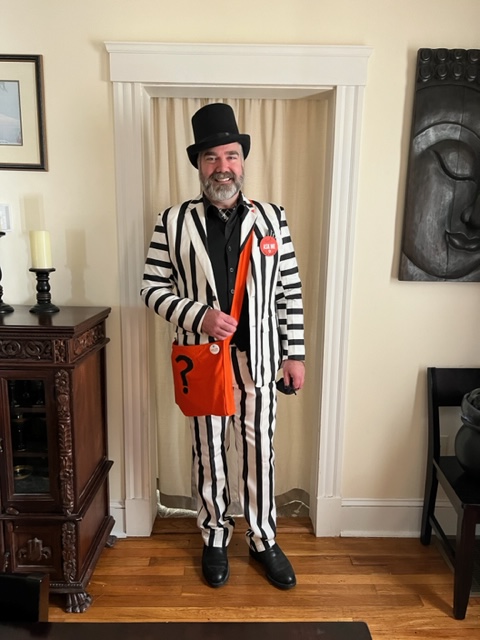
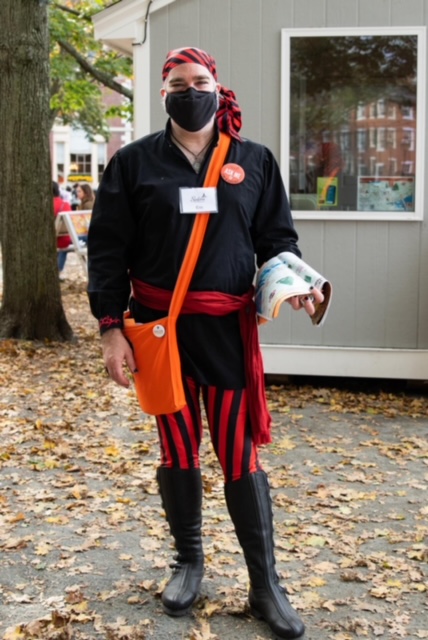
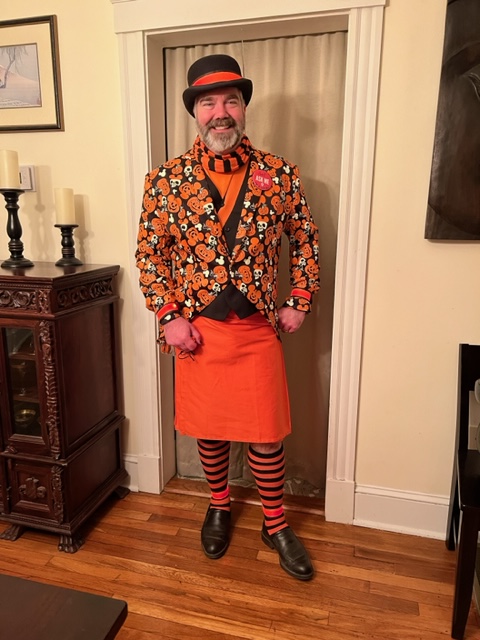
A big challenge this year was the weather. It seemed it was unseasonable warm every weekend. I pulled-out a lot of kilt-based costumes and lighter things like the Beetlejuice suit and the pirate for those shifts. And, of course, there was the issue of matching masks for each look:

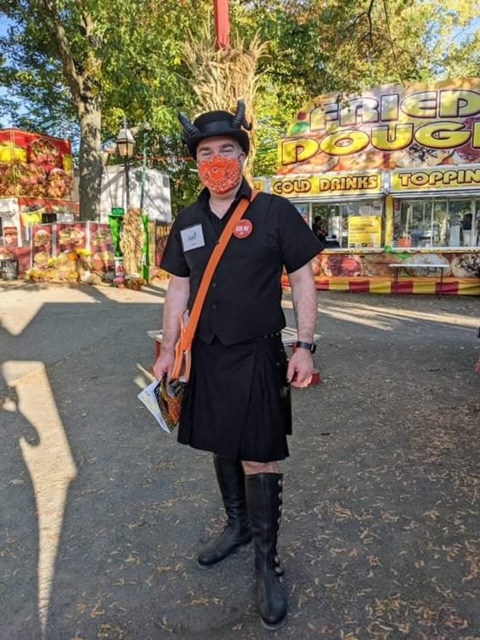
The orange kilt outfit was new, based around a glow-in-the-dark Disney Halloween jacket. I found the bright orange kilt online, and added a few light-up slap bracelets (meant for nighttime runners) to add to my ankles, wrists, and bowler hat. That was a fund one for a night shift! A few of the old standbys (Herbology Professor and Salem Ambassador) made it into rotation, only because I had SO MANY shifts. Here, at the downswing in the pandemic, people were still wary of working with the public and putting themselves at risk. I was careful, and never got sick.

You will notice the COVID weight gain pushing the limits on some of these costumes… Let’s hope by the time next year comes around that that will have been fixed.

Happy Halloween!

Did I help you?!? Let me know in the comments!

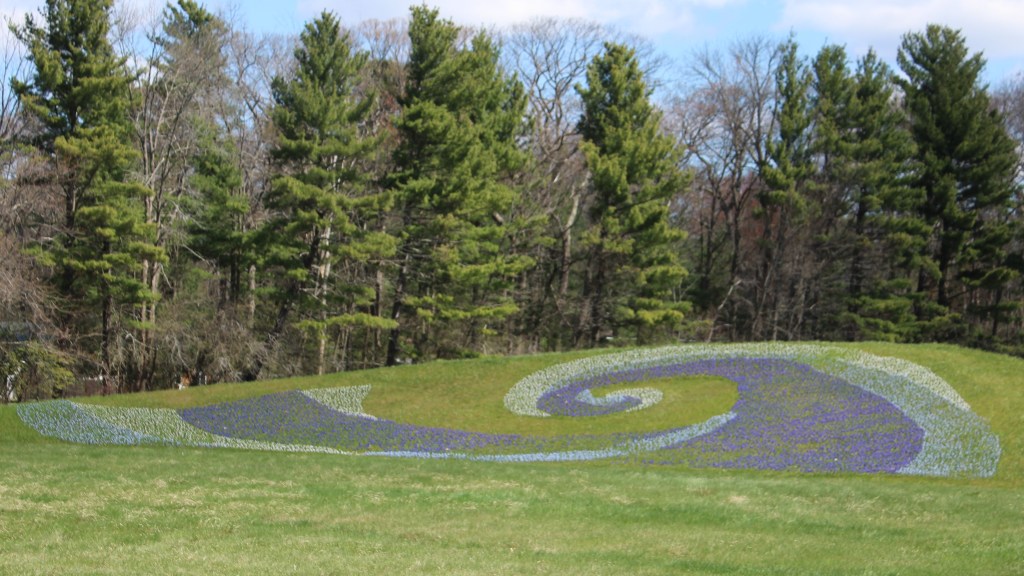
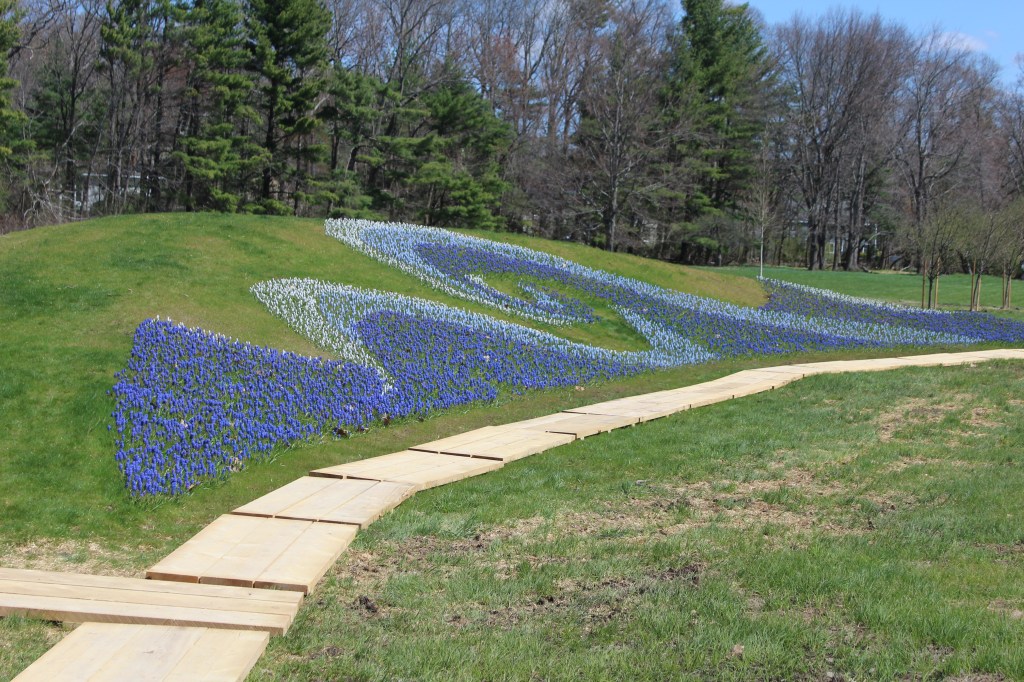
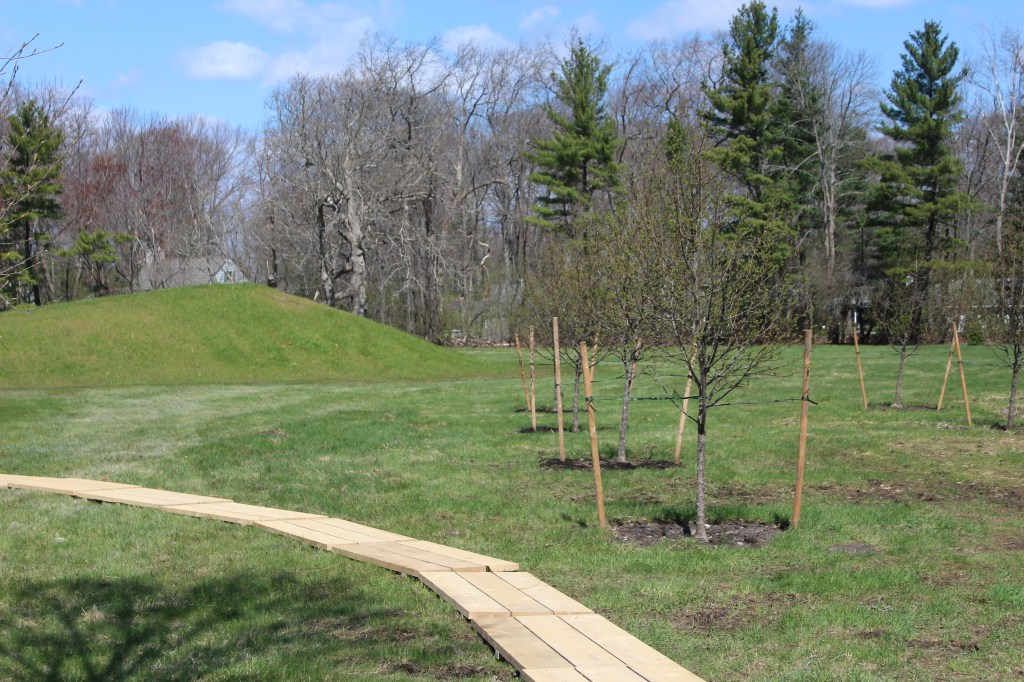
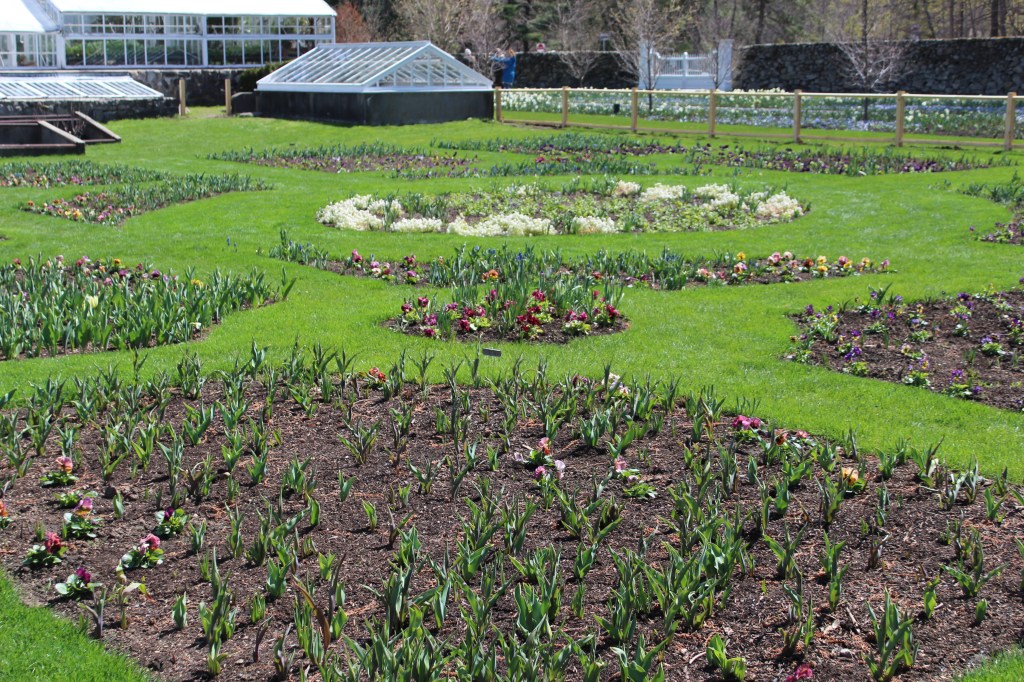
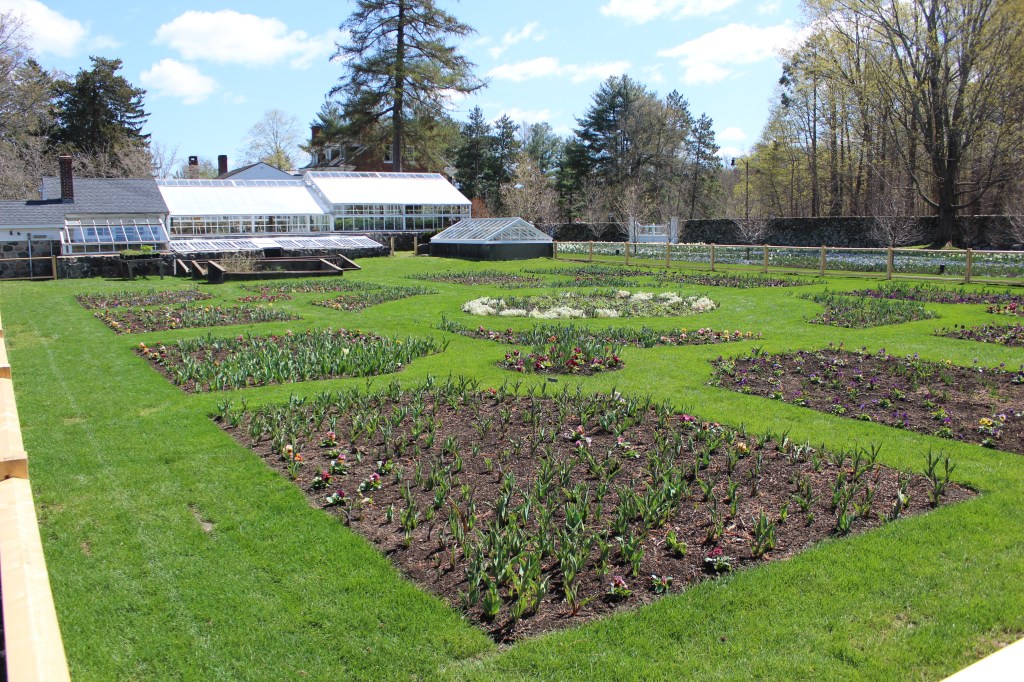
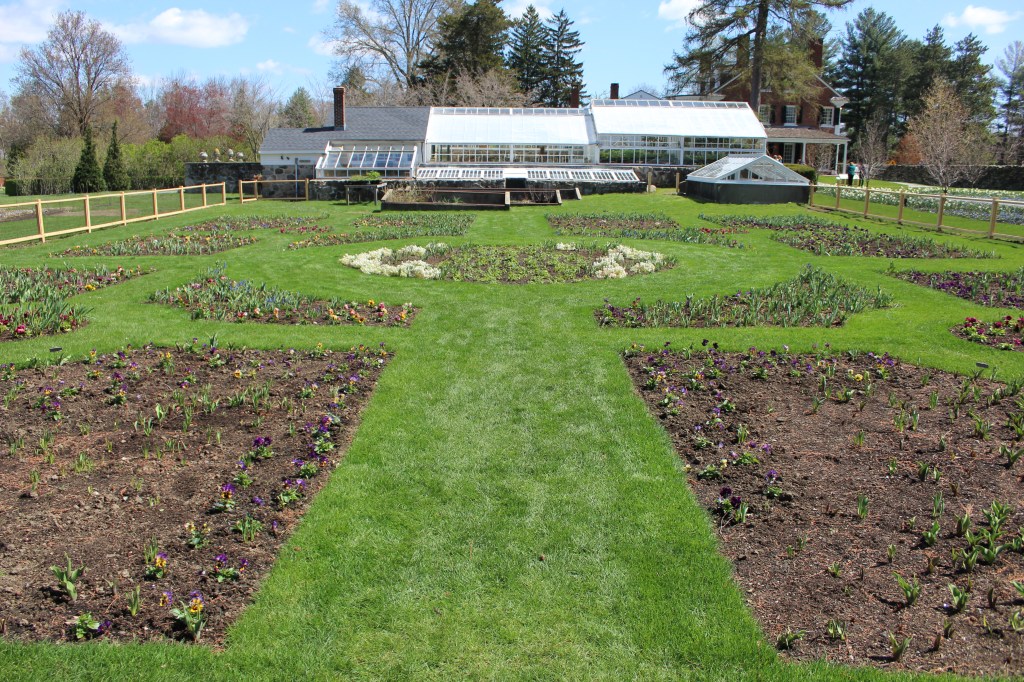
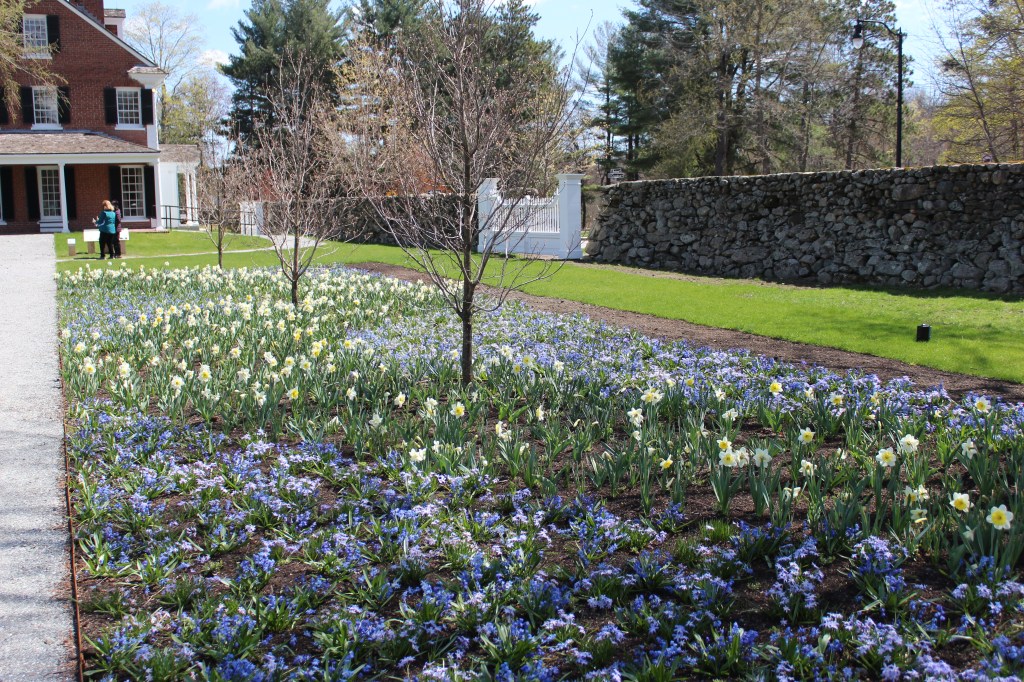
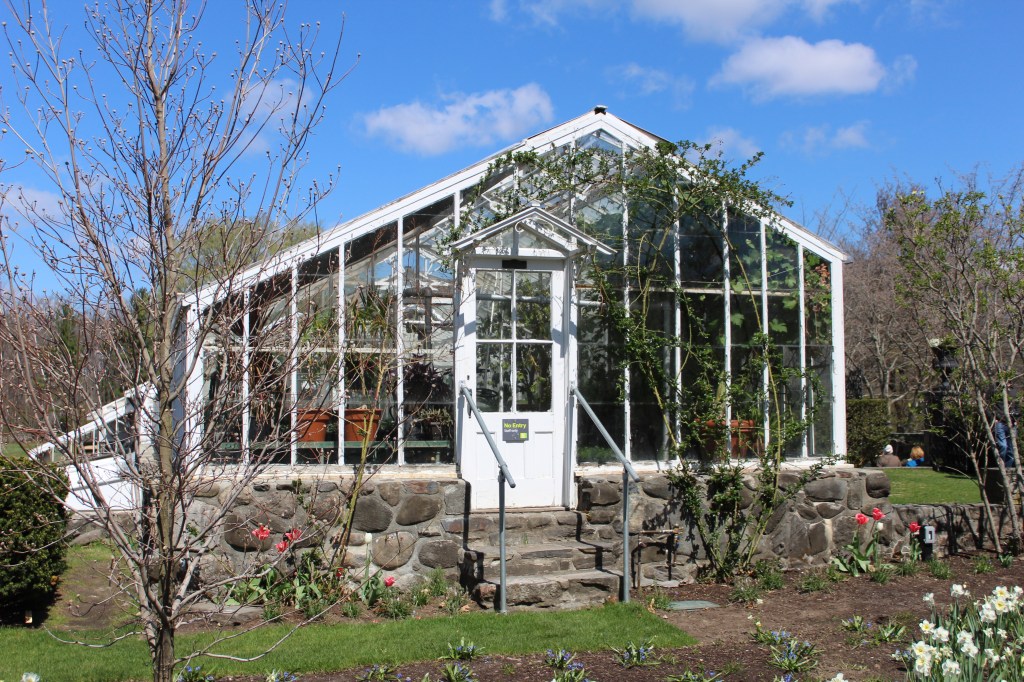
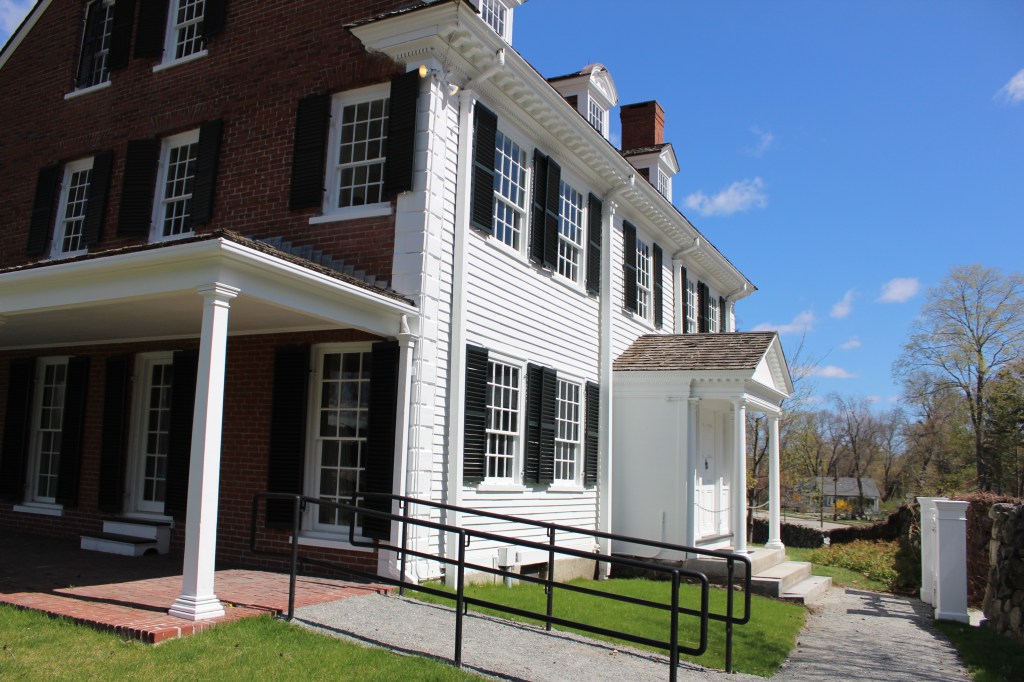
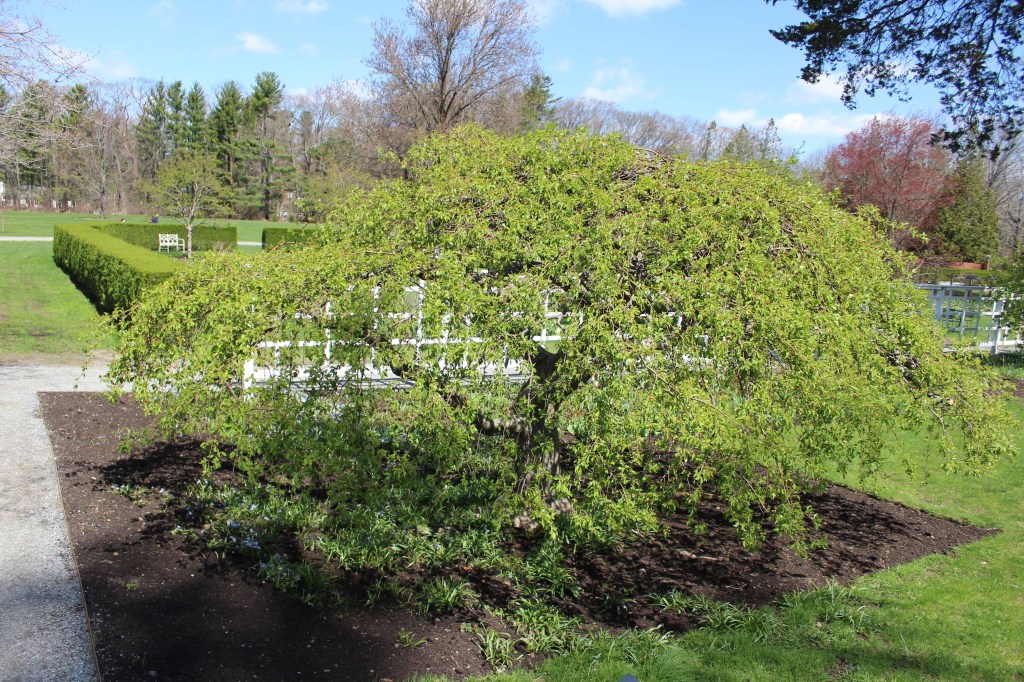
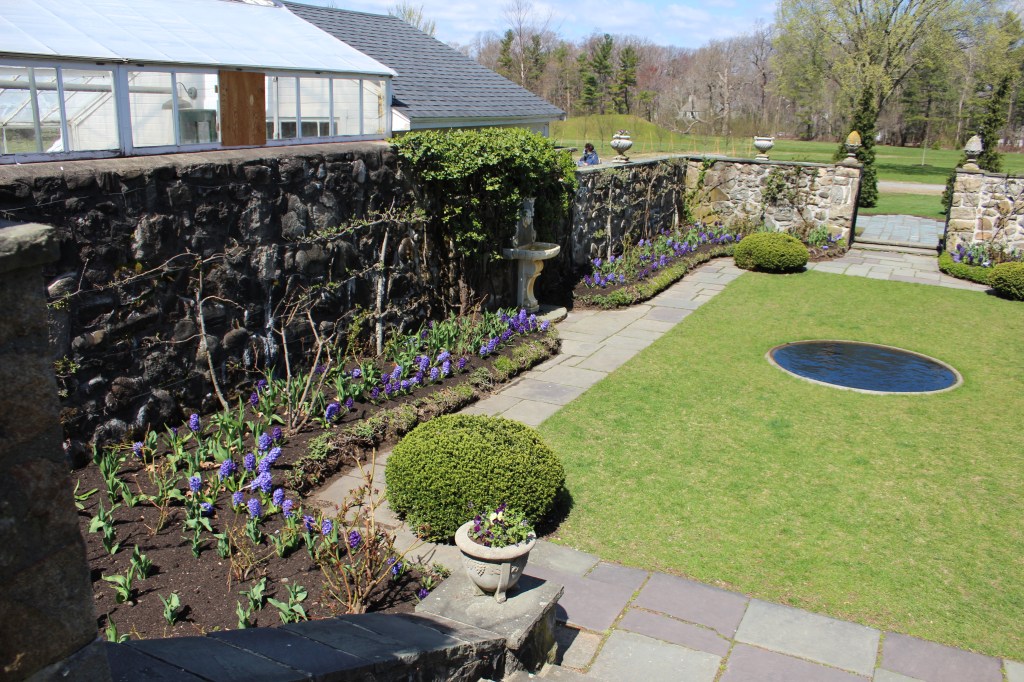
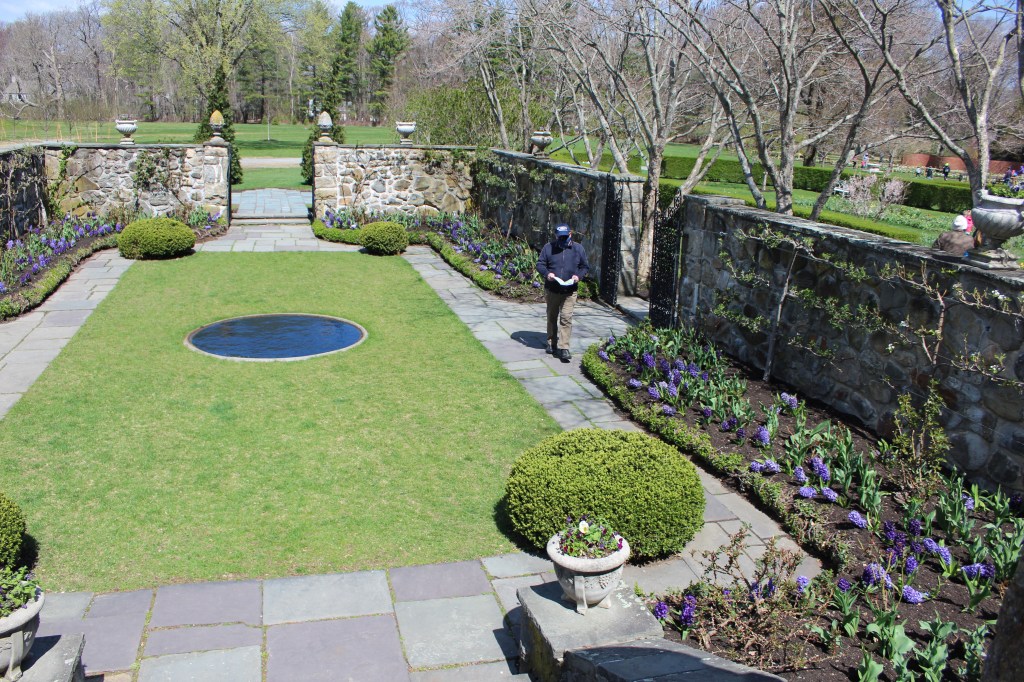
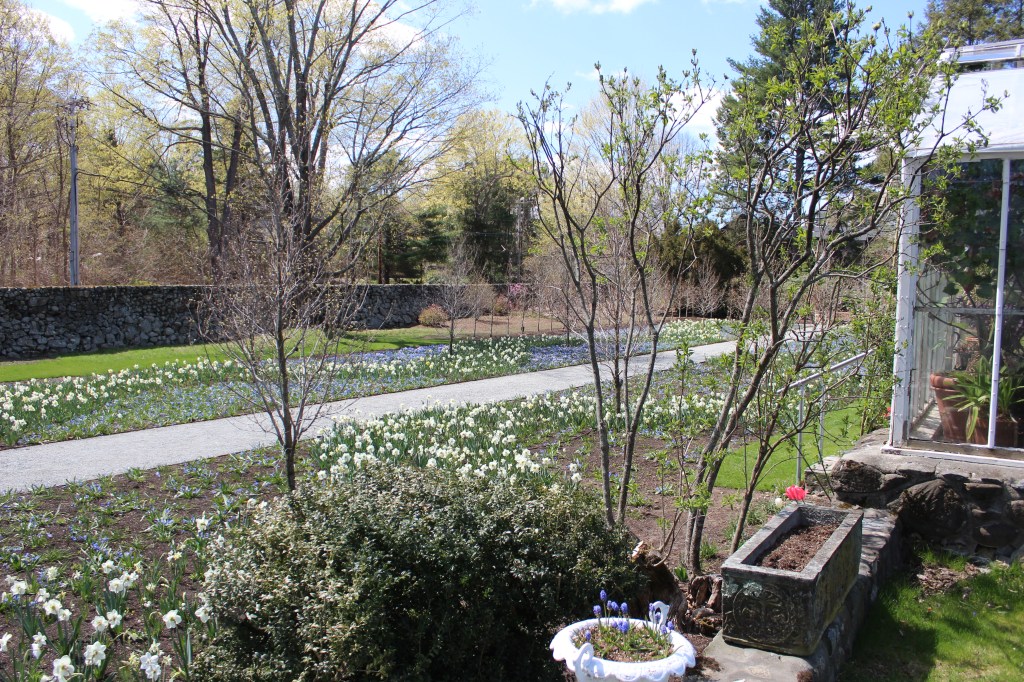
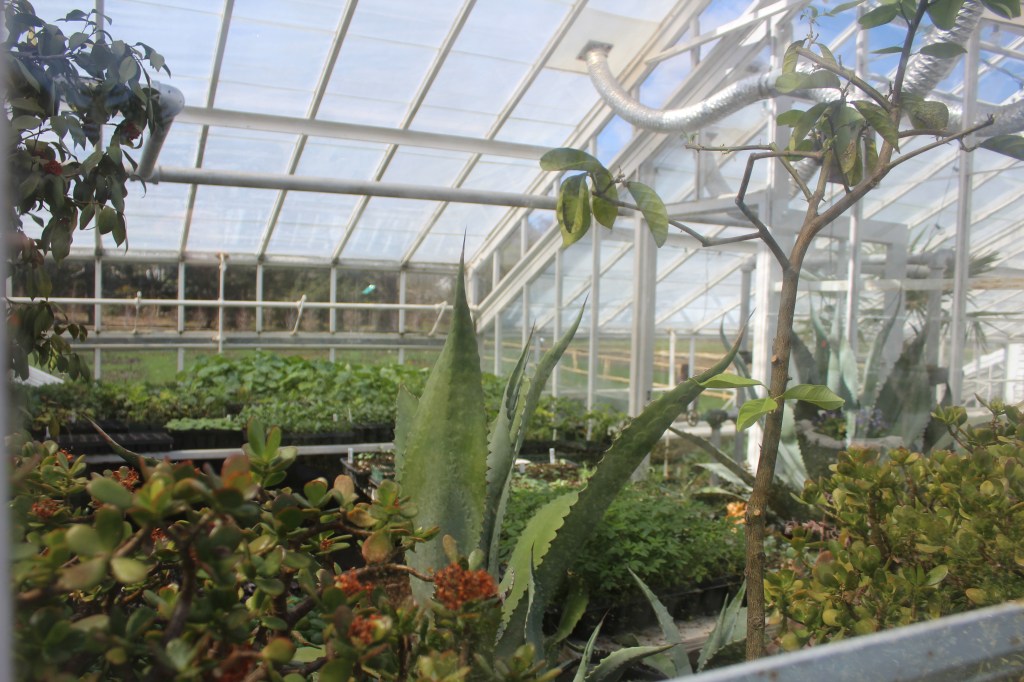
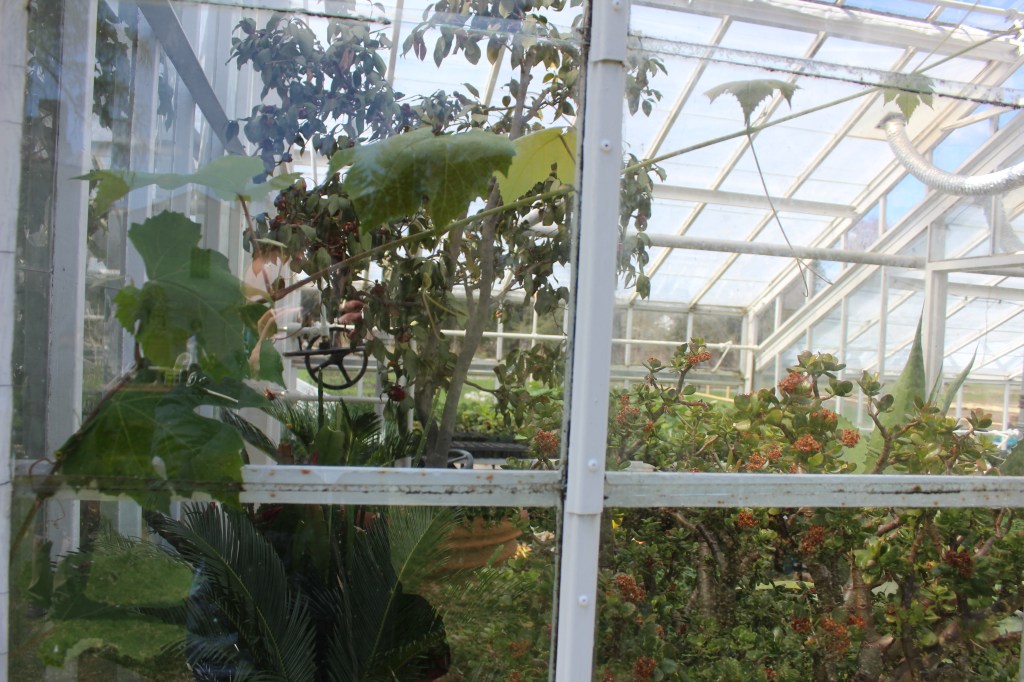
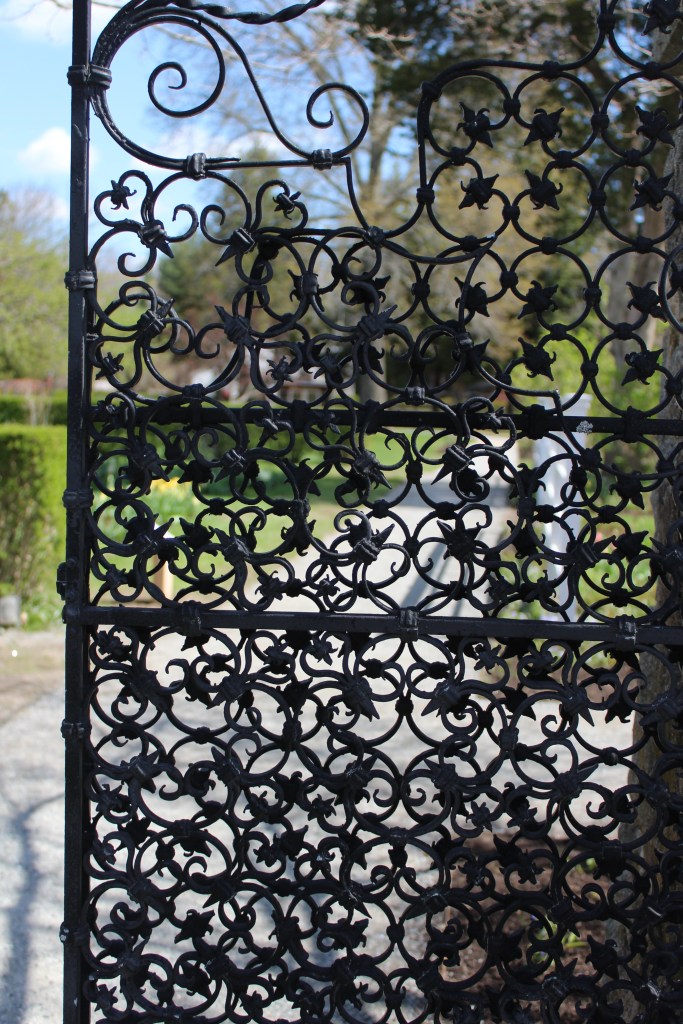
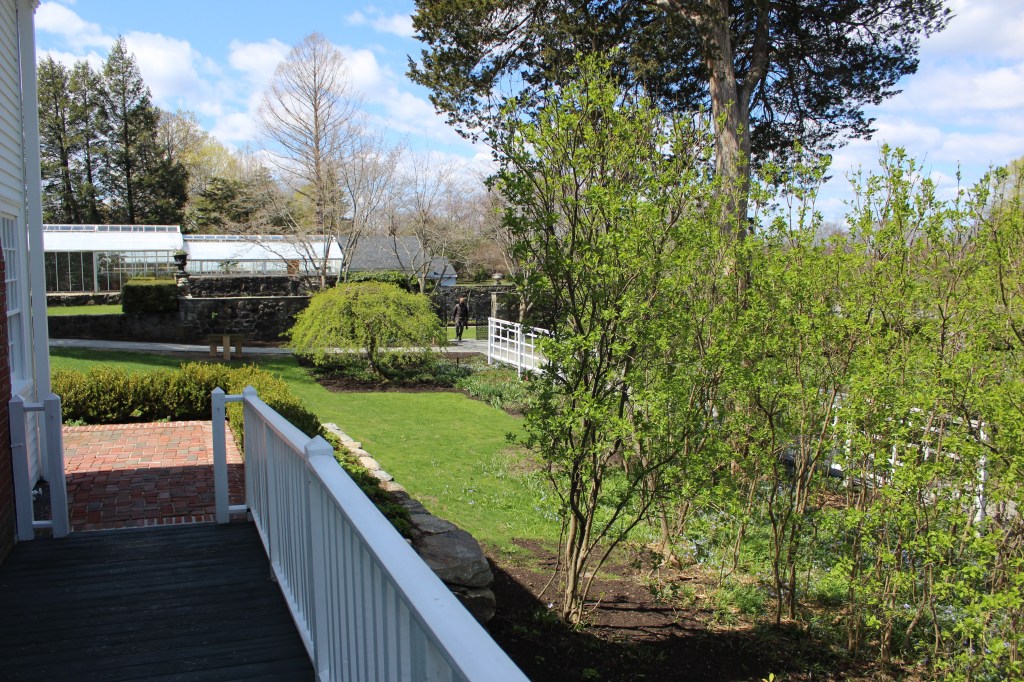
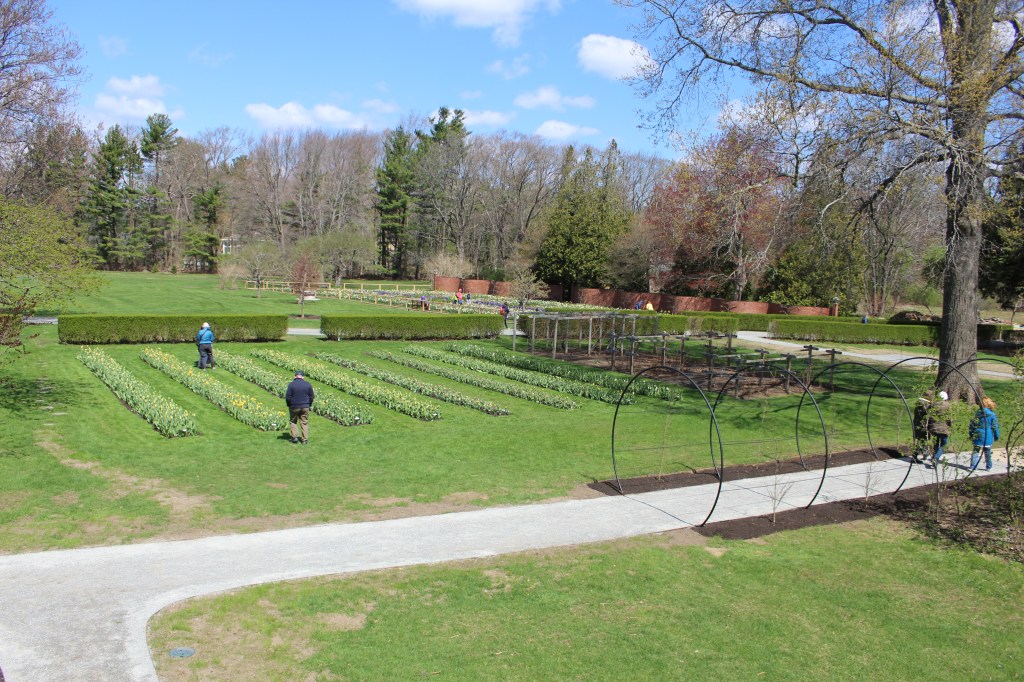
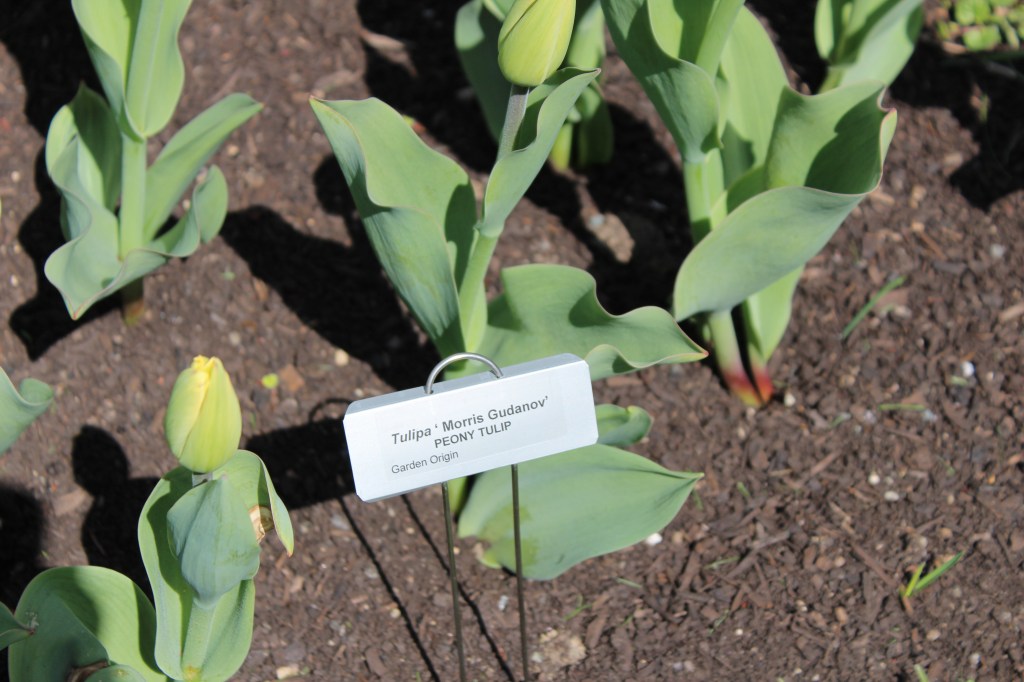
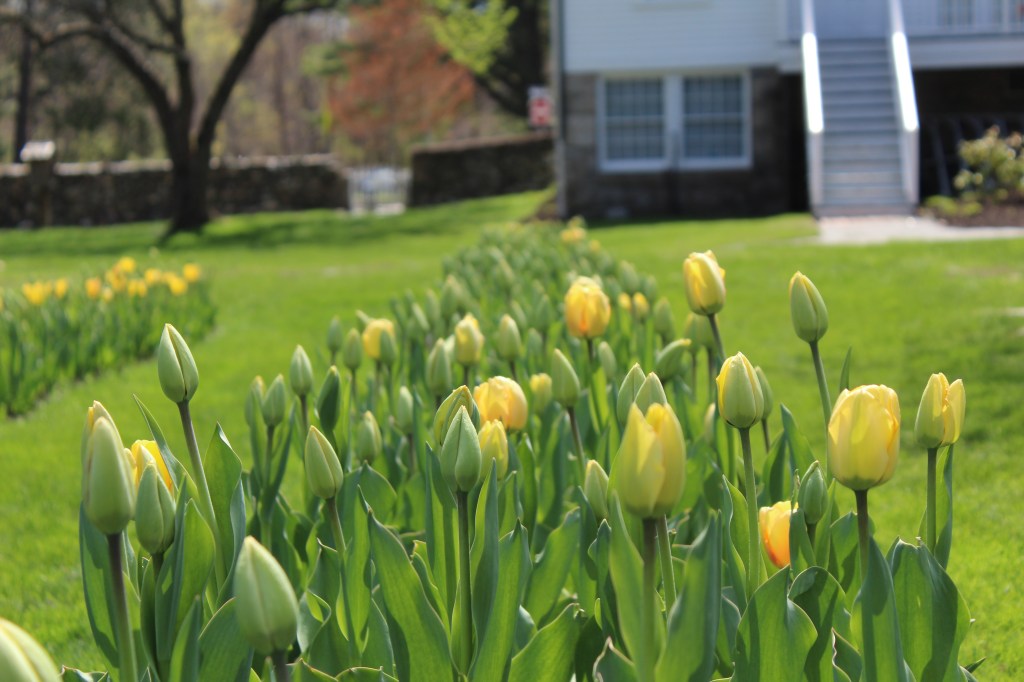
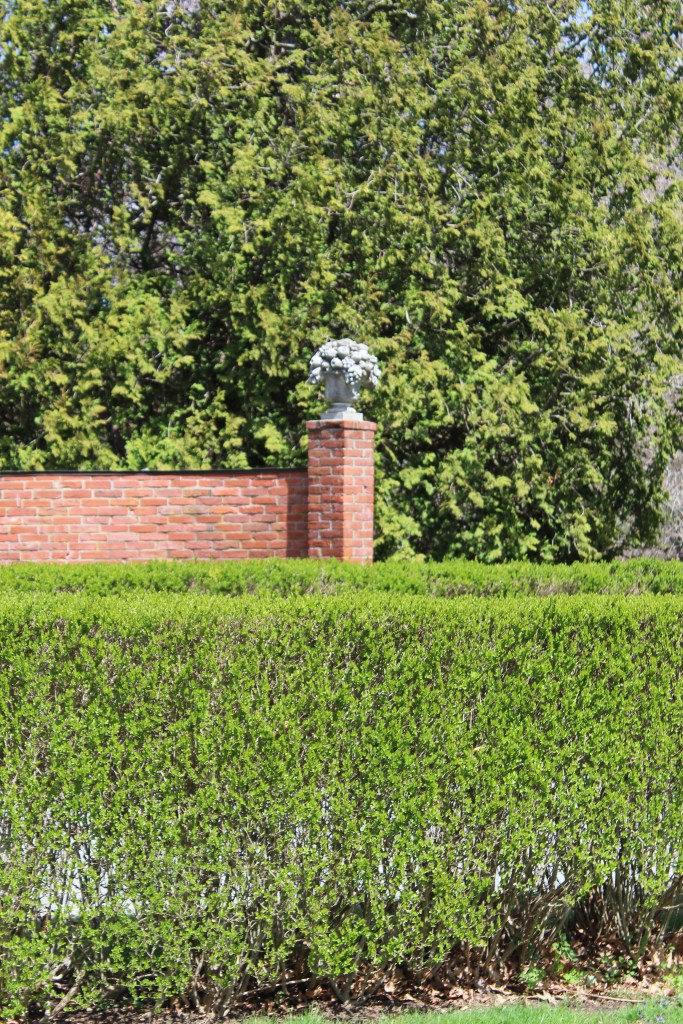
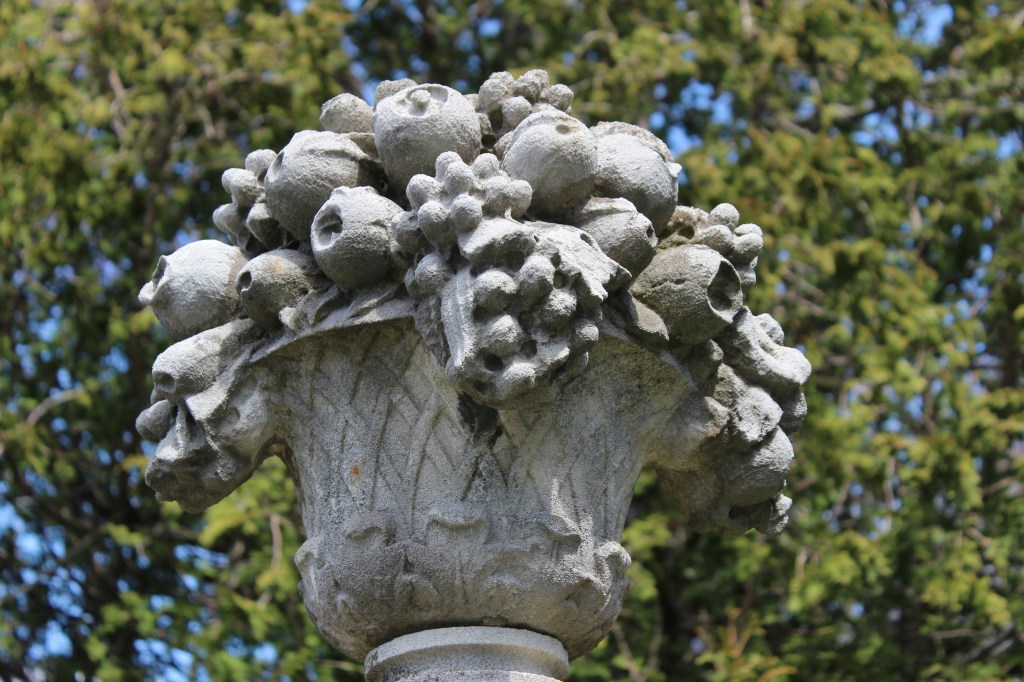
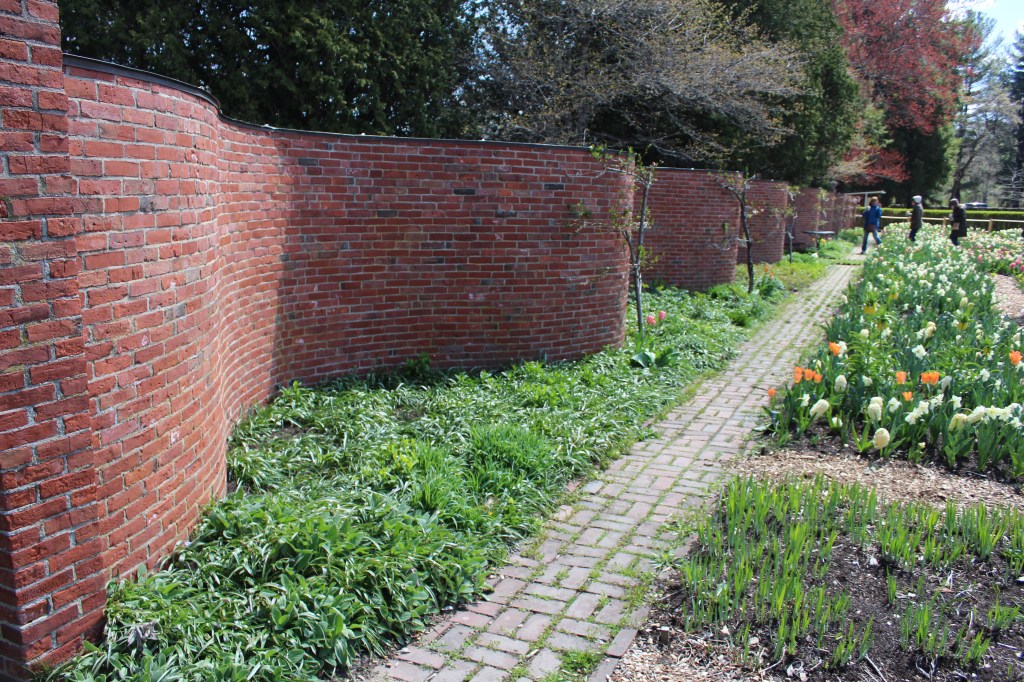
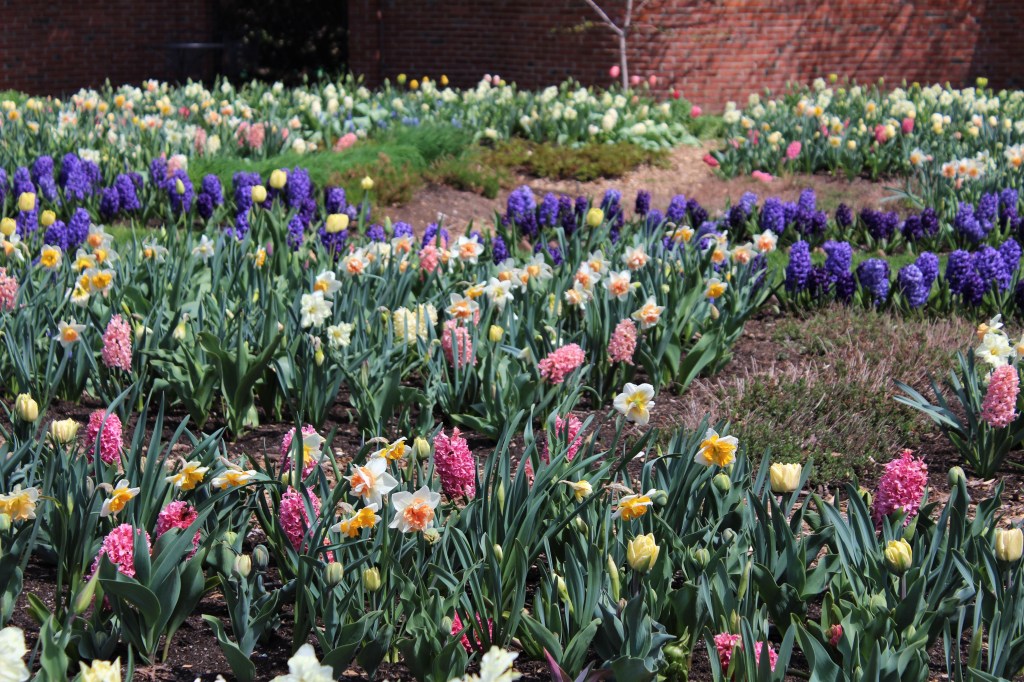
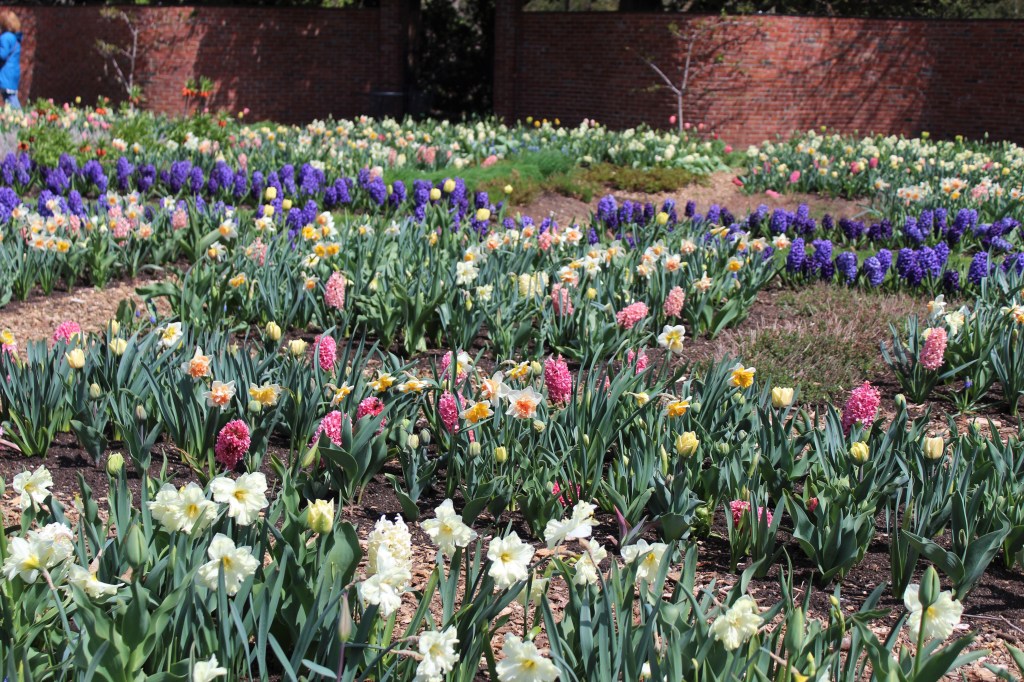
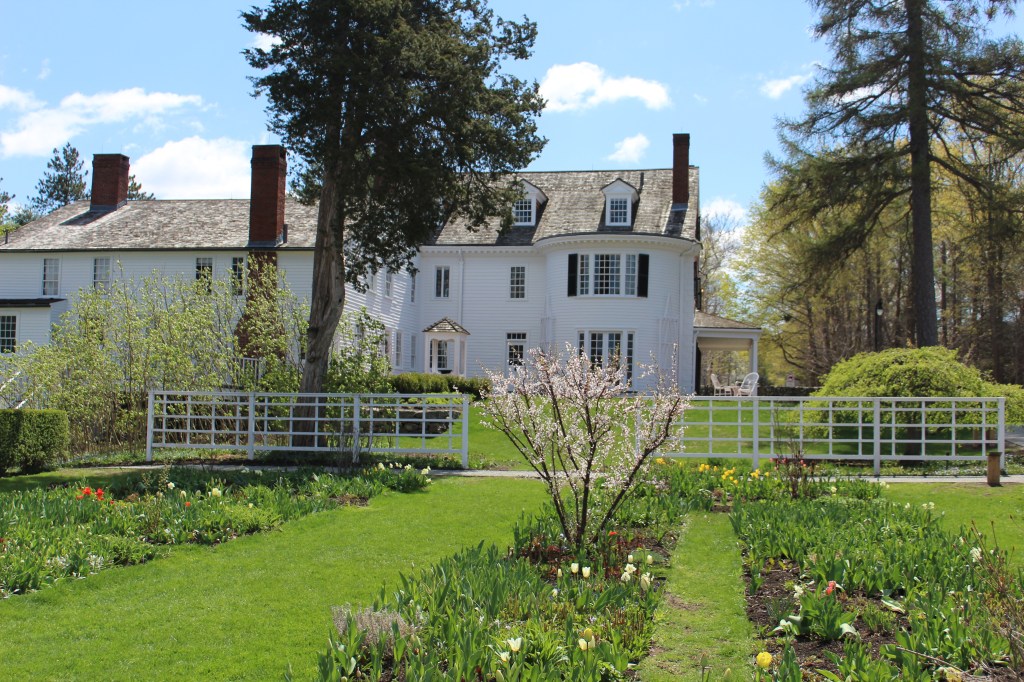
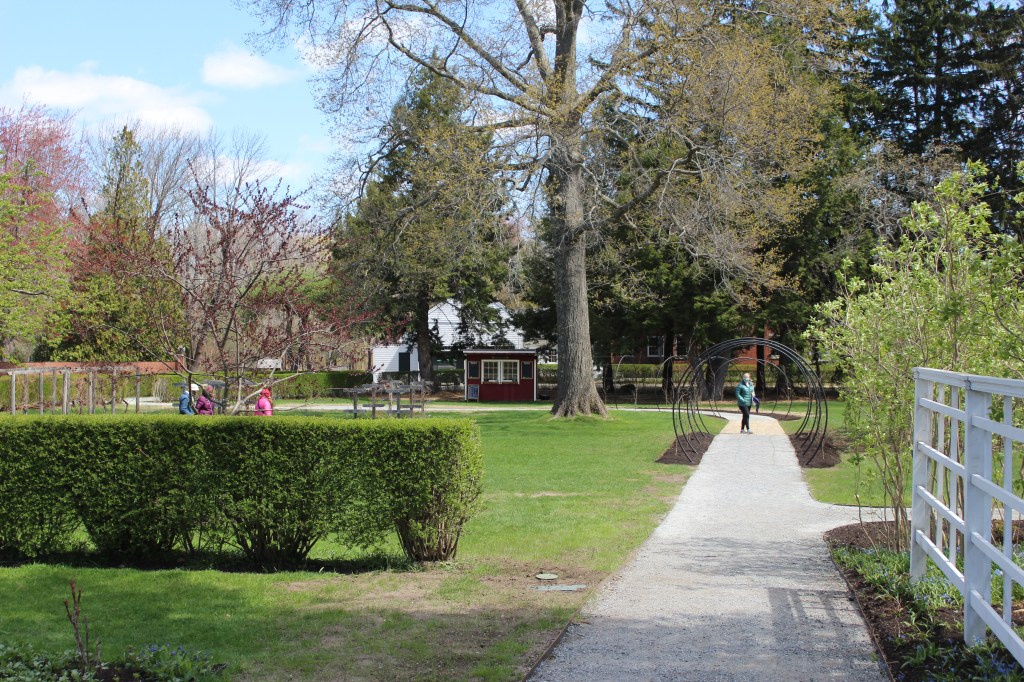
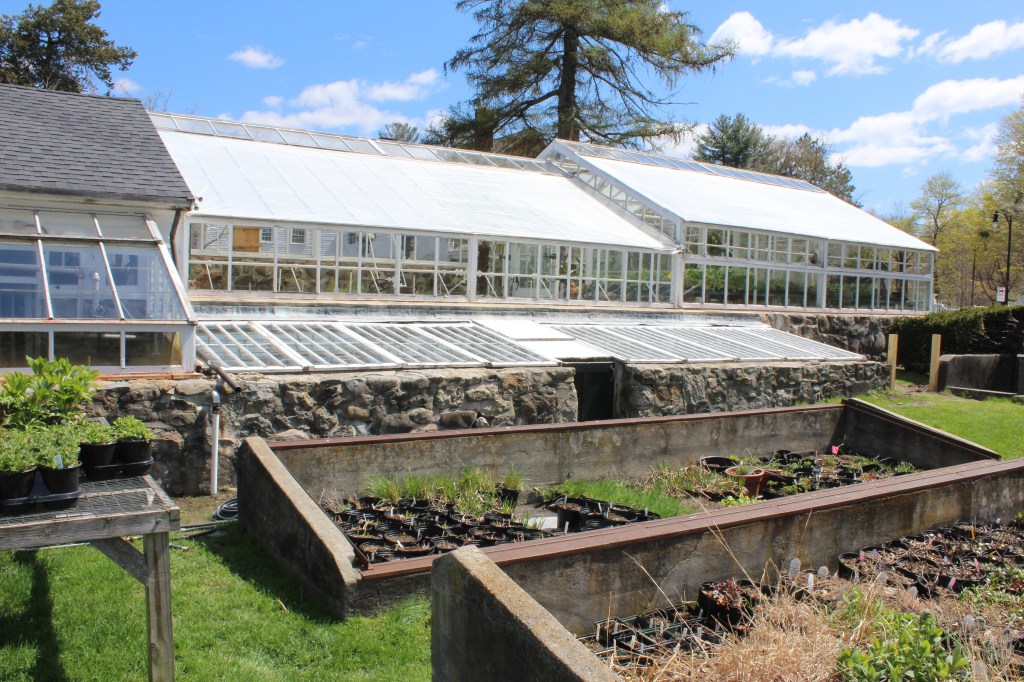
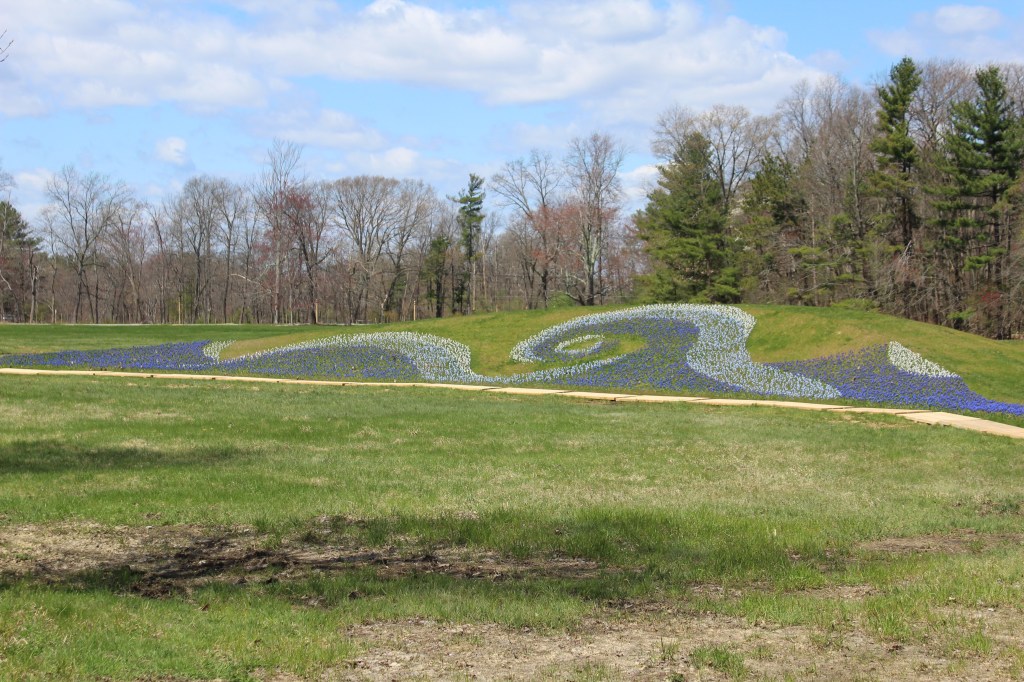
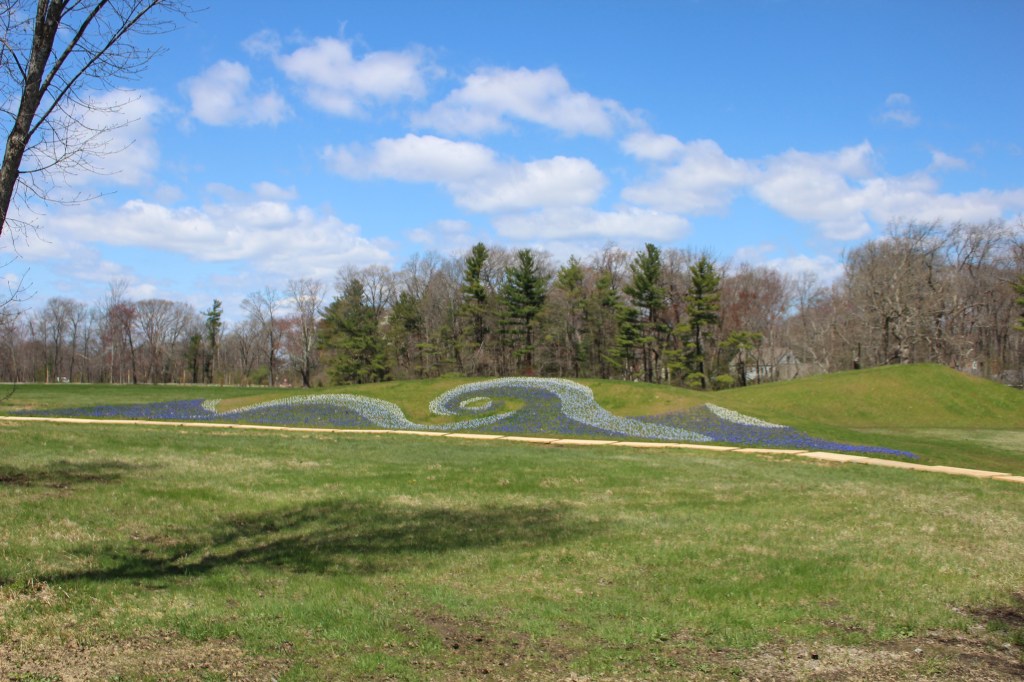
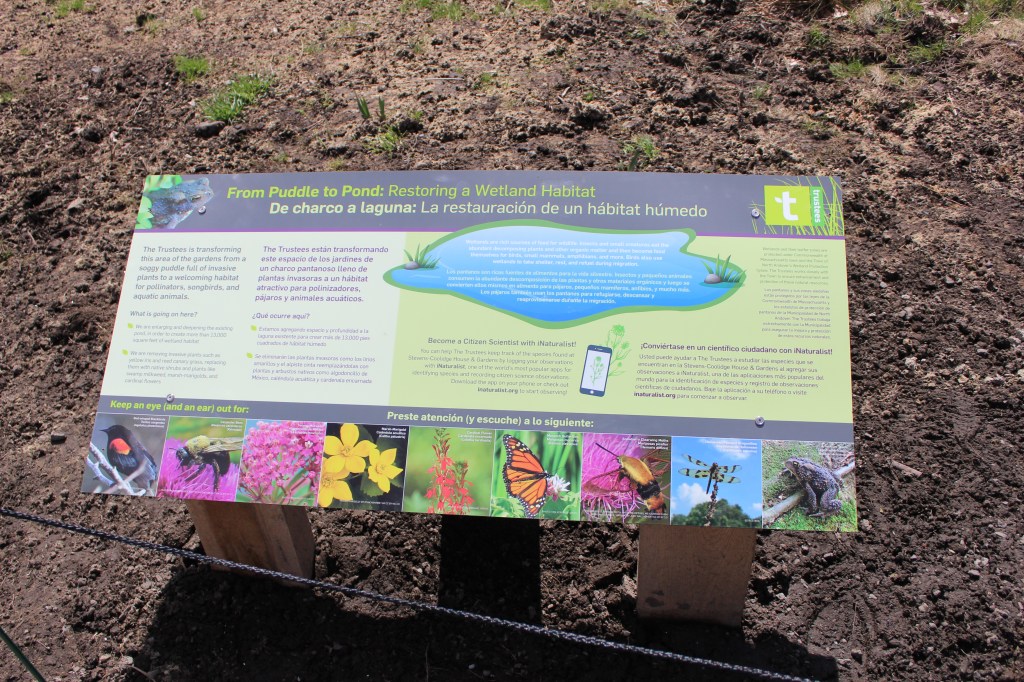
Photos: BloomFest @ Stevens-Coolidge House & Gardens, April 23, 2021

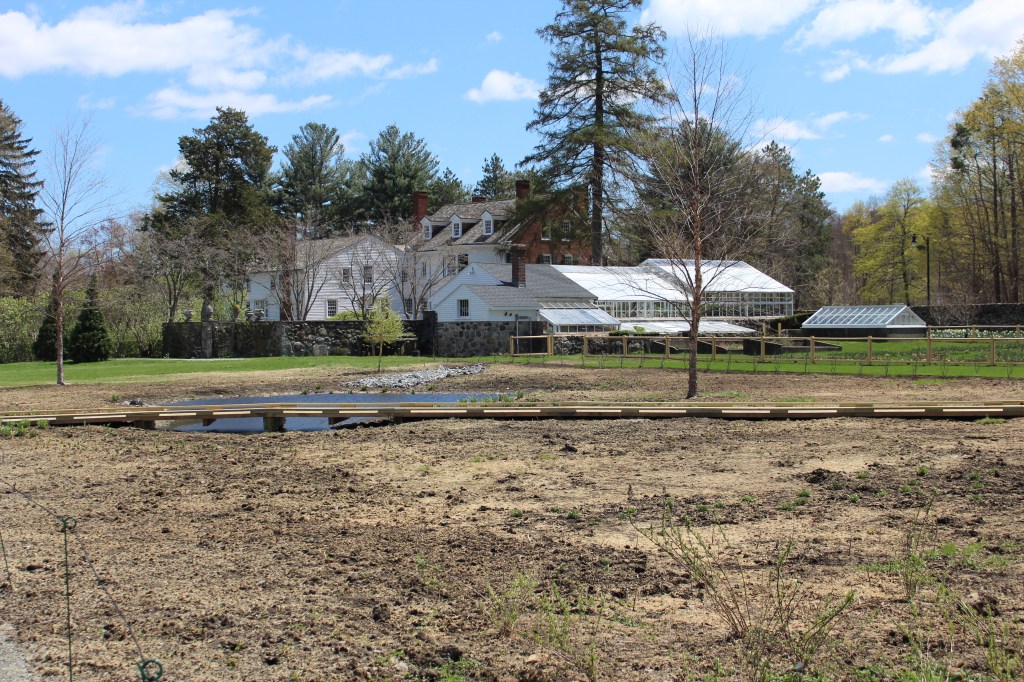
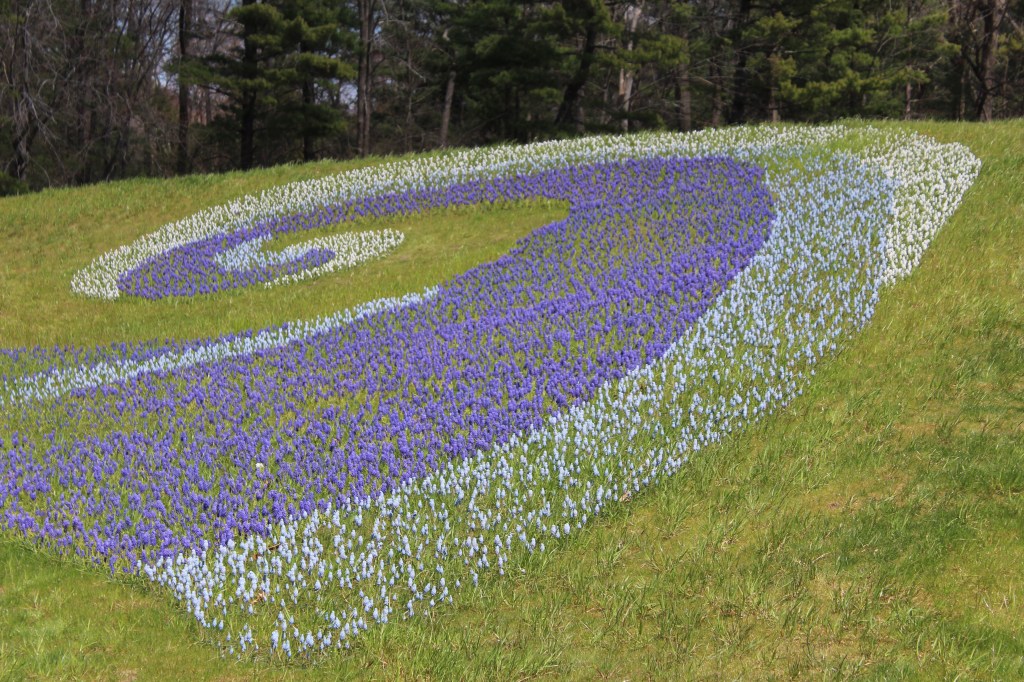
The Stevens-Coolidge House & Gardens in North Andover, MA is situated on a former farm that became a summer country estate in 1914 to one of Isabella Stewart Gardner‘s nephews, John Gardiner Coolidge, and his wife Helen Stevens-Coolidge. They vacationed and entertained at the estate until Helen’s death in 1962, when she bequeathed the house and the land to the Trustees, a non-profit that has been working for over 125 years to act as “a steward of distinctive and dynamic places of both historic and cultural value” across Massachusetts. Spring BloomFest is an annual celebration of the flowering of 165,000 tulips and various bulbs, ornamental trees, and other plants that come alive in April and May. Due to the pandemic, they had limited availability and were only allowing guests in who had purchased timed entries. I reserved our spots for today about a month ago in a member pre-sale. They are completely sold out (22 days, with 18-20 slots per day). At this early stage, the Hyacinths and Daffodils are blooming. We are told that the Tulips begin to open next weekend, so make your choice on what you want to see when making your reservation for next year. I hope you enjoy these photos:

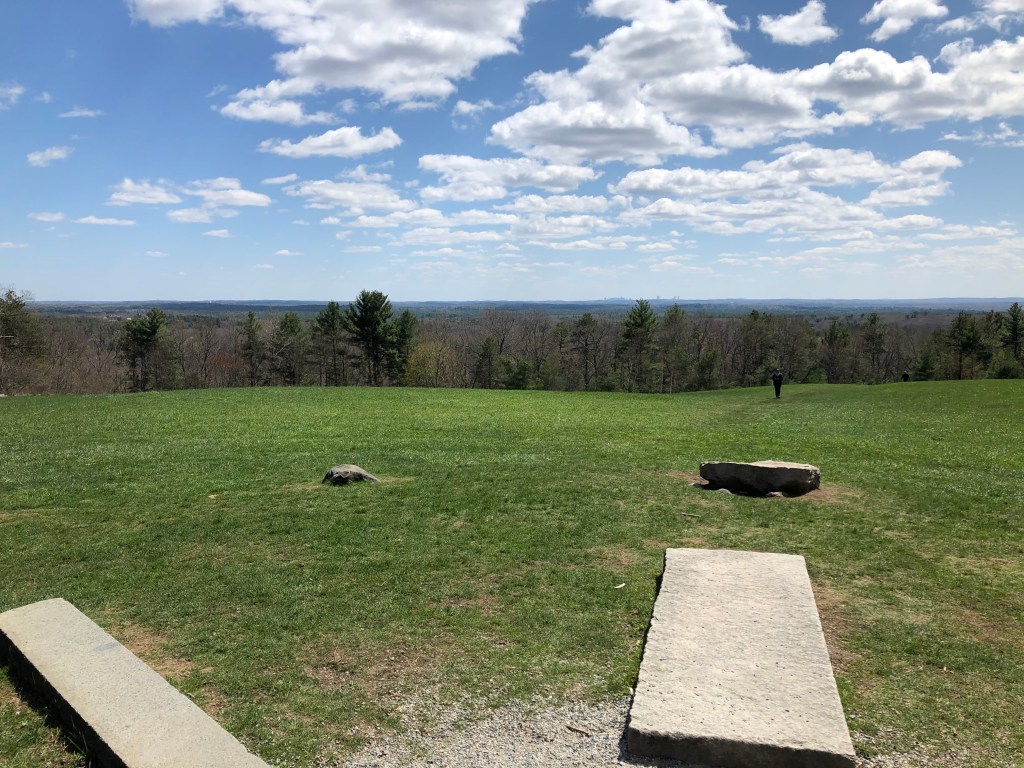
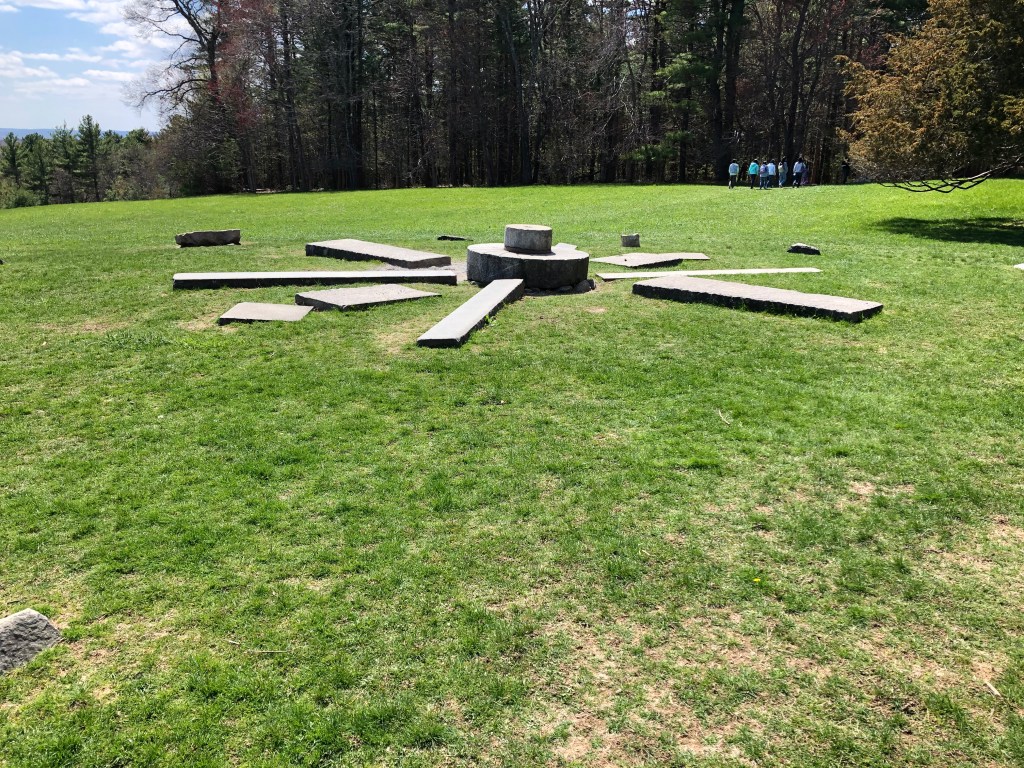
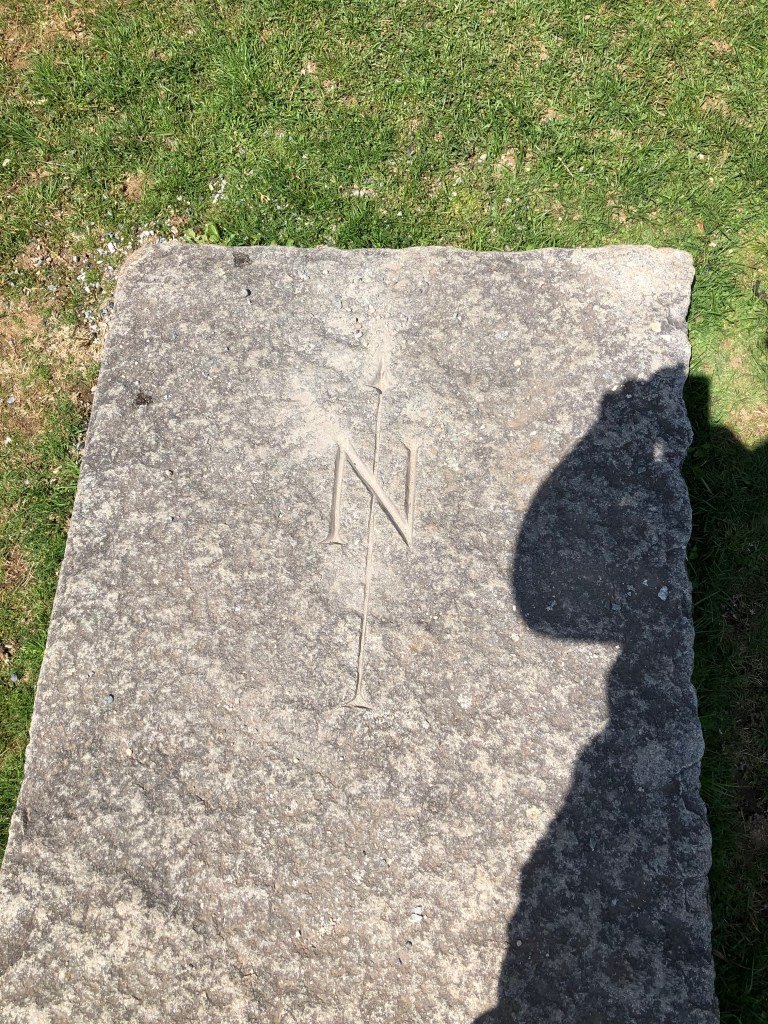
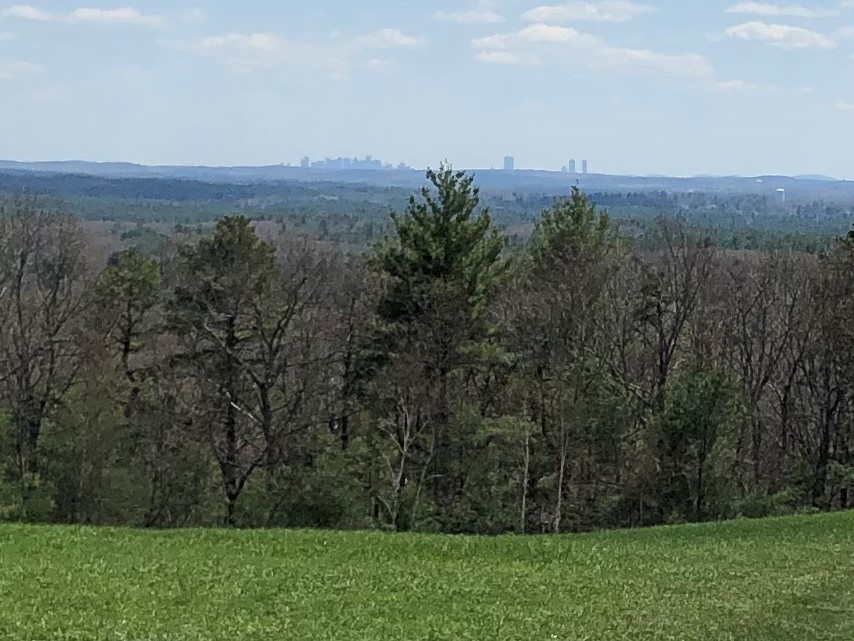
On the way home, we also stopped into the Charles W. Ward Reservation, another Trustees property just a few miles south in Andover. We took the shortest trail that wound up the hill through some gorgeous old-growth forest to a grassy green opening (420 foot elevation) where you can see the Boston skyline 30 miles to the south. Having visited Stonehenge, the former owner of the land decided she needed her own stone compass to mark the sunrise and sunsets on the Summer and Winter Solstices as well as the Vernal and Autumnal Equinoxes. She also added Zodiac stones around the edge, many of them with ties to the local history. One of the stones is from the doorstep of a historic pub, there are two fossilized/petrified tree stumps, and several of them are local puddingstone. The center of the “compass” is an old granary grinding stone, whose etched curves mimic the sun.

Salem Info Booth During the 2020 Pandemic

If you’ve seen any of my previous posts on volunteering at the Haunted Happenings/Salem Main Streets Visitor Information Booth, or this hopeful post from 2019 exclaiming how Halloween 2020 was going to be epic (5 weekends AND a Full Moon on a Saturday Halloween?!?!?), then you can probably guess that my depression grew deeper and deeper as October came closer and the cases were increasing.

At the end of August, our Mayor cancelled the October 1st Haunted Happenings Parade and the Halloween Night Fireworks (the official beginning and ending of the season, respectively). The weekend street fairs then were cancelled and moved to online marketplaces. Businesses were given strict regulations on capacity inside their stores as well as their outdoor queues, and all restaurants had to serve guest outdoors at distanced tables. Given that many Salem businesses rely on the October Tourist money for a majority of their annual earnings, it was a difficult time for everyone. We even canceled the Info Booth.

In an effort to keep the city safe and keep the crowds away, the city cancelled all outside advertisements and promotions, however, the crowds still came and stood in line to visit shops and restaurants. Attractions and walking tours had to go to a timed reservation model, many of which sold out within minutes of going live. Destination Salem launched an app they had been developing to help tourists navigate the city. It proved invaluable, especially since it sent notifications as soon as attractions or tours sold out.

Destination Salem app ad
I highly recommend downloading the app if you ever come to visit Salem – at any time of year – you can filter the maps to whatever it is you are interested in, and it links directly to event, attraction, restaurant, shop, and tour websites.

It became clear that people would come, no matter the circumstances. Massachusetts had a travel ban on several of the surrounding states, and there were strict rules about travelers flying in, but still we had people driving up from New Jersey and New York for the day without any plans or reservations. The Mayor and Haunted Happenings staff made the media rounds declaring that Halloween in Salem was cancelled and to please stay home, pleading with people to postpone trips until another time or for October 2021. Still, the crowds came. Attractions that went online for reservations at midnight, were sold out within minutes, or had their websites crash with all of the sudden, concentrated attention. The city closed all public parking garages at 10am on the weekends leading up to Halloween. With sidewalks being used for outdoor seating at the restaurants, or for the queues to get into shops, many streets were blocked off or temporarily made to be one-way, even the pedestrian street. Still, the crowds came. The city mandated that all downtown businesses must close at 5pm on weekends, with restaurants allowed to stay open until 10pm. Still, the crowds came.

This image appeared on billboards along the routes into Salem, and made the rounds on local news stations.

Because people were showing up and facing long wait times, sold out attractions, and uncomfortable crowds, it was decided that the Info Booth should be reinstated, but in an altered form. We set-up an awning outside the National Park Service Regional Visitor Center (which had to close it’s exhibits, screenings, National Parks Info Desk, and restrooms for safety, so was only open as a shop with limited hours), and worked in shifts of 2 (typically, we would have 4). Using the app, we would update a dry erase board with a list of sold-out attractions. We had maps and “I wore my mask in Salem” stickers, as well as hand sanitizer and posters promoting the app. I refused to hand anything out, or to touch anyone else’s map, so I brought a pointer that I had attached a small pointing hand to. Other volunteers brought laser pointers or used a pen.

Tourists would walk up, see the board of unavailable attractions, and they would all ask the same thing:

What ISN’T sold out?

The first thing to sell-out every weekend was The Salem Witch Museum, so I would tell them this story:
One of the most popular questions during a normal season is ‘Where is the Witch Museum?’, to which we all like to respond: ‘Which Witch Museum? You see, we have several. The Salem Witch Museum is sold out, but we also have the Witch Dungeon Museum, the Witch History Museum, the Salem Wax Museum, and the Salem Witch Village. In addition (in normal years), Cry Innocent at Old Town Hall is a live reenactment of one of the witch trials, the Peabody Essex Museum is currently showing a special exhibition of artifacts from the trials (through April 4, 2021).

The other popular one this year (typically from the NY and NJ families that drove up without any plans):

We just got here. What should we do?

My favorite response to that was: “Well, what are your expectations for today?” I didn’t come up with that one, but I used it a lot, and it was very effective. I could usually steer them in the right direction finding out what they were interested in. I can see using this question during normal years as well.

Alongside having a knowledge of Salem, a friendly, approachable attitude, and a willingness to deal with the Public and all their foibles and demands, the most important part of the gig is the Costume!

I have amassed quite a collection of costumes, so I can easily grab one, but a lot of them are dependent on weather. Some are nice and warm for those chilly October days, and some are thin and cool for those Global Warming October days. I try to rotate my costumes throughout the season, so I’m not wearing the same thing each shift, and I try to add a new one to the rotation each year. Each year, I find myself working during a rain storm, and each year, I struggle to find and outfit that works. I had an epiphany during a cold rainy shift in 2019 – one of those days that the rain blows sideways and umbrellas turn inside-out. I could be the Gorton’s Fisherman! I’ve had the yellow overalls, jacket, and Sou’wester hat in my “buy later” list for a long time. I could easily whiten my beard and stick a box of fish sticks to my bag or something. When it looked like Halloween wasn’t happening this year, I didn’t go through with it. Maybe I will for 2021.

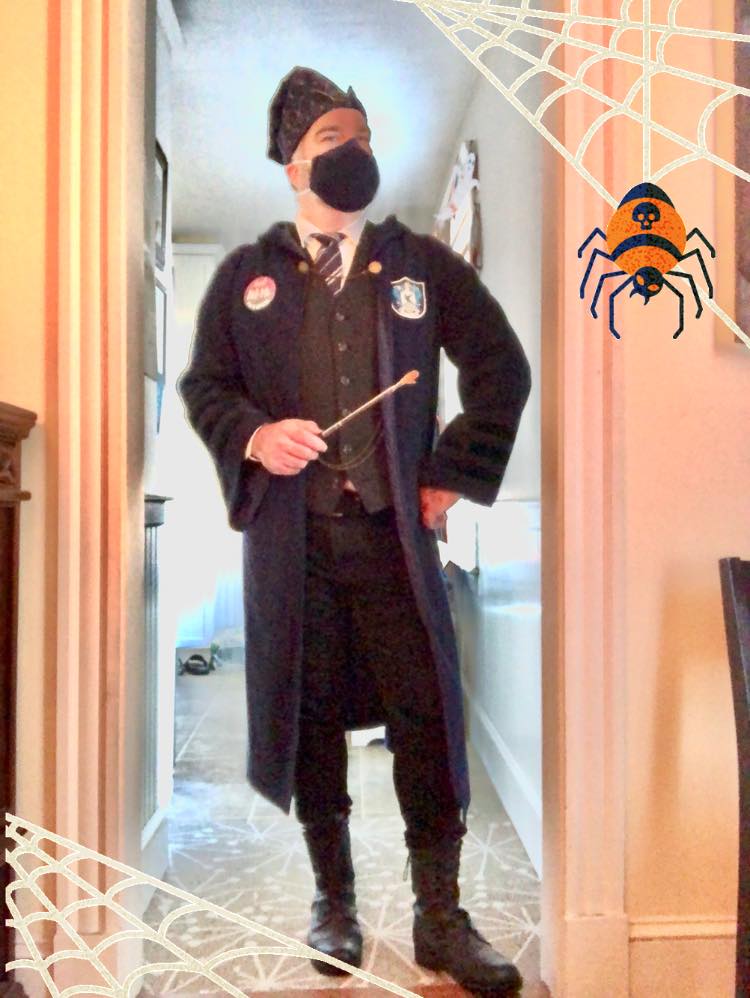
The first shift’s outfit is traditionally what I have come to call “Ambassador Witch” This was the first costume I put together for the Info Booth, and it now feels like my uniform (this year with the addition of a mask).

Ambassador Witch (2020 version)

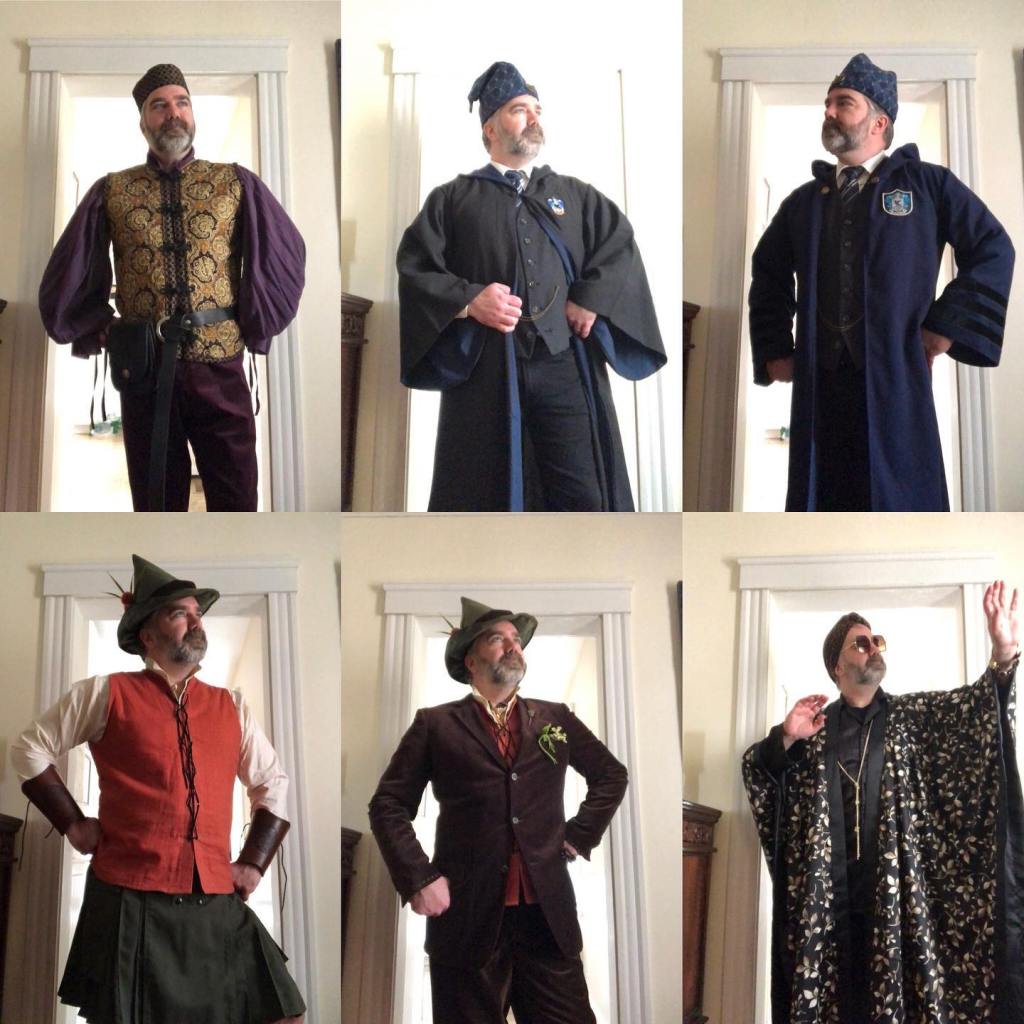
Since this year’s shifts were so last-minute, and I didn’t want to repeat, I went to social media to ask my friends to vote for the next outfits:

6 Variations in Search of an Answer:
(l to r, top row) Trade Merchant, Ravenclaw Alumnus (modern), Ravenclaw Alumnus (vintage)
(l to r, bottom) Kilted Autumnal Ren Faire Mishmash, Herbology Professor, Norma(n) Desmond

I told everyone that I would wear the outfit that got the most votes (with a caveat about the weather). Norma(n) Desmond got the most votes (obviously), but that outfit requires a cool, dry day, so I had to go with the runner-up:

It was a VERY warm day, so the “natural air conditioning” really was the best choice

While I did not make the boots, kilt, bag or belt, I did make the vest, shirt, hat and mask.

Because there were not a lot of us that were willing to volunteer, I was scheduled to work on Halloween day. It was my hope that I could wear Norma(n) Desmond (I made a much better matching mask and turban than in the above picture), but the day started with rain and it was very chilly, so wearing satin pajamas, slippers, and a satin kimono* that dragged behind me didn’t seem like the best idea, so I went with one of the Ravenclaw outfits:

Forgive the spooky frame and low quality.

The only things I made on this outfit were the hat and the mask. The blue Vintage Ravenclaw robe is based on the Fantastic Beasts movies. I purchased the robe and the tie at Remember Salem. My “wand” was the telescoping pointer with tiny hand I used each shift for pointing out all of the Hocus Pocus film locations on the guests’ maps. It was a big hit. What you can’t see is the Marauder’s Map backpack I made filled with disposable gloves, bottled water, extra maps (for walking to/from the booth), stickers, and a carabiner bottle filled with hand sanitizer.

Halloween Info Booth by the Numbers:

For those of you who are new to this, each shift is 2 hours long, and we have a clicker to count guests. If you are asked a question, or offer help to someone, you click it for the number of people in their group. So one easy question for a family of 8 or a dance troupe of 20 can really add up. Each of the numbers below are the totals for each shift. There are 2 listed on the 17th because someone called-in sick, and I didn’t want someone to handle the second shift alone, so I pulled a double.

October 3rd: 137 (Ambassador Witch)
October 17th: 277 (Black & White Beetlejuice Suit, top hat, black shirt, cravat & pocket square – seen here)
October 17th: 215 (ditto)
October 24th: 301 (Kilted Autumnal Ren Faire Mishmash)
October 31st: 301 (Ravenclaw Alumnus, vintage)

Total for 2020: 1,231 people helped over 5 shifts (10 hours).

In comparison:
2019: 1,388 over 5 shifts (10 hours).
2018: 1,967 over 6 shifts (12 hours).
I don’t have the 2016 and 2017 numbers. Also, these are all the “official” numbers. I wear my “Ask Me, I’m a Local” button anytime I’m walking around Salem, and because I am aggressively helpful, I stop to help loads of people on my way to and from the booth (hence the extra maps and stickers in my bag), so add a few dozen to each of those numbers.

You will notice that the numbers are not that far off 2019 to 2020, considering we were in a pandemic. Given the nice weather, the extra weekend, and the Saturday Full Moon Halloween, it is clear that this would have been a Haunted Happenings for the record books, had things been normal.

All-in-all, I am glad that I was able to get out and help people, especially since my free (to Salem residents) Covid-19 tests all came back negative.

Fingers crossed for a safe 2021 Halloween!

*I made Norma(n) Desmond on a lark. I had been working from home since March 12, 2020, and hadn’t left the house to do anything, so I remarked to a friend (on Zoom) that “If I’m forced to live like an eccentric recluse, I’m going to start dressing like one!” When my quarantine hair was out of control, I watched a video to learn how to tie a turban as a joke. I had already made a cotton kimono out of some Hawaiian fabric I had, and had designed and made a caftan just to learn how to do it. So, when I saw this video of Glenn Close, I knew I HAD to make that outfit (or something close to it):

I wore it one night (slightly drunk) while watching the original movie and once on Zoom as a surprise for a friend’s birthday. Since then, I’ve added gloves and a ring and upgraded the turban, so if you come to Salem in 2021 or beyond, maybe you’ll see it in person…

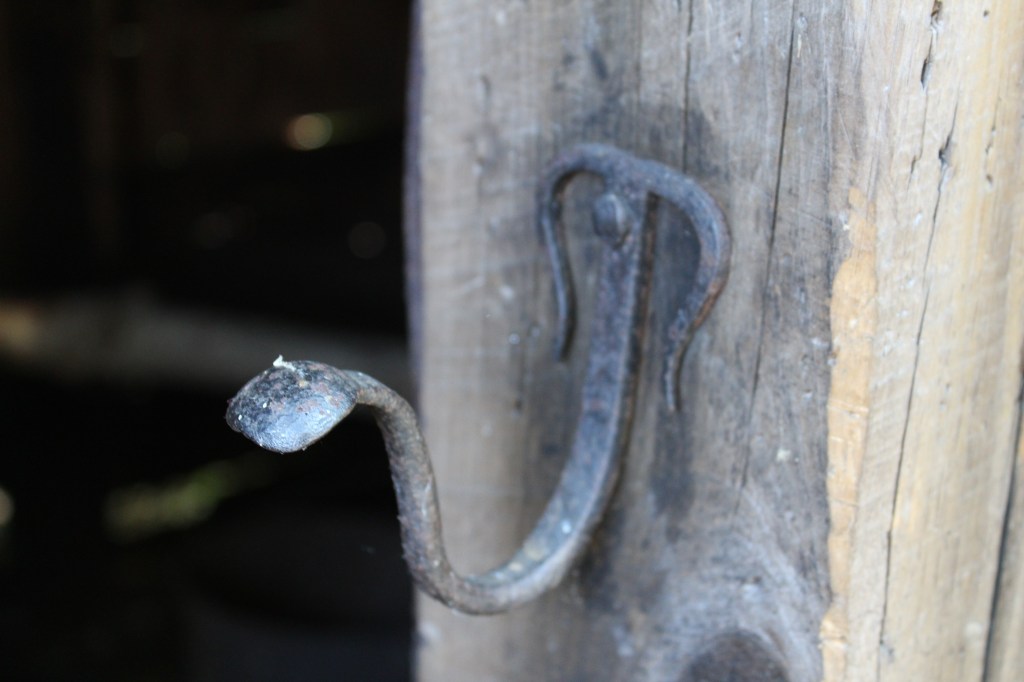
Day Trip: Pioneer Village, Salem, MA

PLEASE NOTE: At this time, there is an Emergency Order in Salem where masks must be worn Downtown or in City Parks. Pioneer Village is located in Forest River Park, one of the mask required zones.

Constructed in 1930 to mark the tercentennial (300 year anniversary) of the arrival of the Winthrop Fleet in June of 1630 (Salem was founded in 1626), Pioneer Village is America’s first living history museum, predating the nearby House of the Seven Gables, and inspiring the much larger Old Sturbridge Village and Plimouth Plantation museums.

“The village sits on three acres of land and contains various examples of colonial architecture: dugouts, wigwams, thatched roof cottages, and the Governor’s Faire House. Culinary and medicinal gardens and a blacksmith shop further interpret early 17th-century colonial life. “

from the Pioneer Village website

The construction, while not using historic tools, did rely on local materials and historic design elements. It is also not a recreation of an actual village, but an approximation of how one from that time may have been laid-out. There is definitely the feeling of a movie set about the place, and there is very good reason for that: It was built specifically for a live performance to coincide with the celebrations being held across the city for the anniversary. A man-made pond was added for verisimilitude and so the actor’s voices would carry across to the park beyond.

Speaking of movie sets – Pioneer Village has famously been featured in Hocus Pocus (1993) and Mass Hysteria (2019), as well as numerous television productions, most recently in season 2 of Hulu’s Castle Rock (2019). A full list of productions filmed in Salem (not just Pioneer Village) can be found here.

Back to the performance: Audience members sat in the park and watched the re-creation of what Salem may have looked like in June 1630 when the Winthrop Fleet arrived. A replica of the Arbella (long since disintegrated and sunk) sat nearby in the harbor (or maybe actually sailed as part of the pageant?). When the scheduled performances were finished, the public was so enamored with the village that the City of Salem decided to save the site from redevelopment and has committed to preserve it in perpetuity.

Not much else is known about the pageant content, as far as I could find. One could guess that it included Winthrop repeating passages from A Model of Christian Charity (a sermon he gave before departing England), interactions with the Naumkeag, and the daily life, professions, and struggles of the villagers. The village’s creator, historian George Francis Dow, must have written the script, having written extensively on daily life in the Massachusetts Bay Colony.

Pioneer Village has had many iterations and stewards over the years, including historic reenactment troupes, a local college’s drama department, local Preservation Societies, and the city government. Today, it is run by The Witch House (we could spend a whole post just on that building and its name), where, in non-pandemic times, you could purchase a dual attraction ticket that includes admission and guided tours for both. While the two attractions are 1.6 miles apart from each other, they are easily accessible via the Salem Trolley.

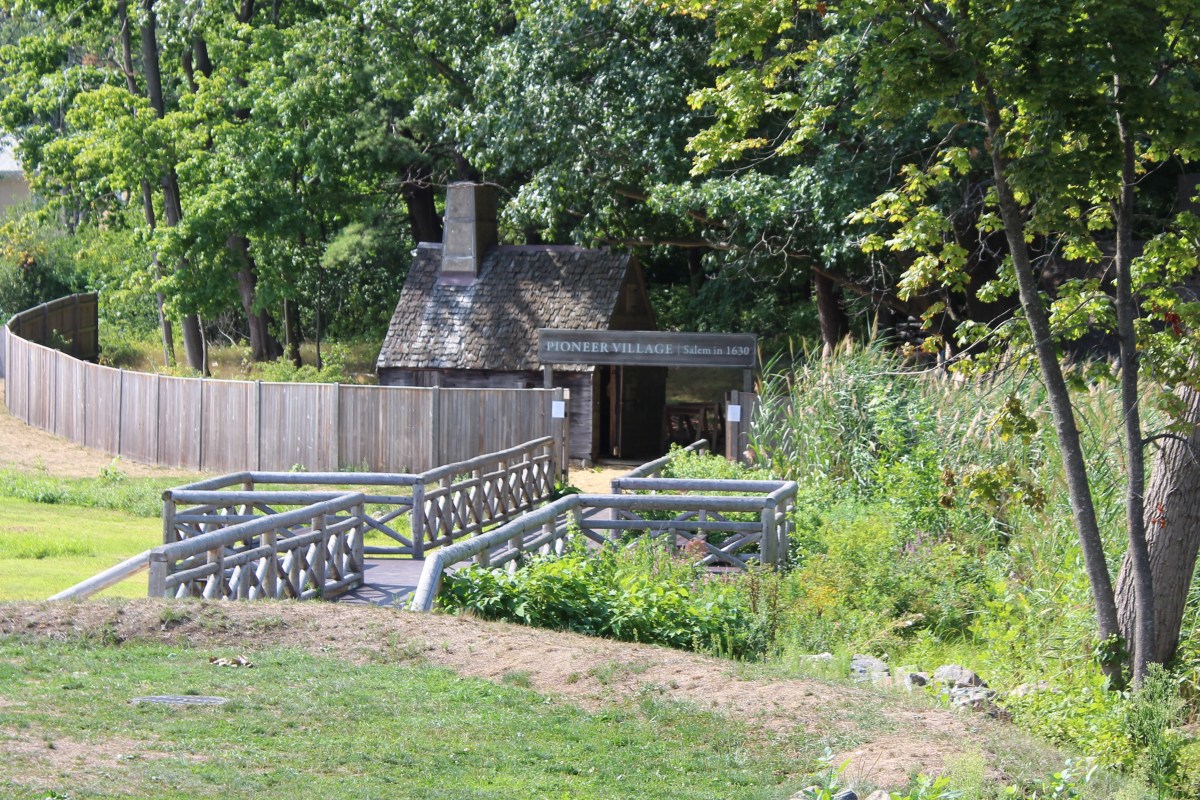
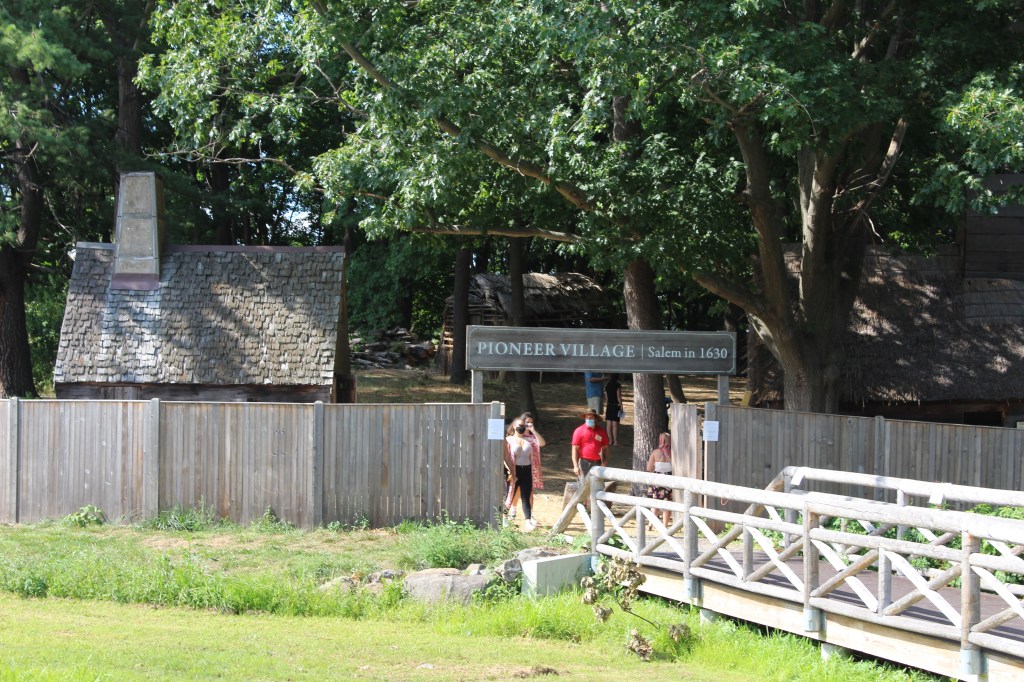
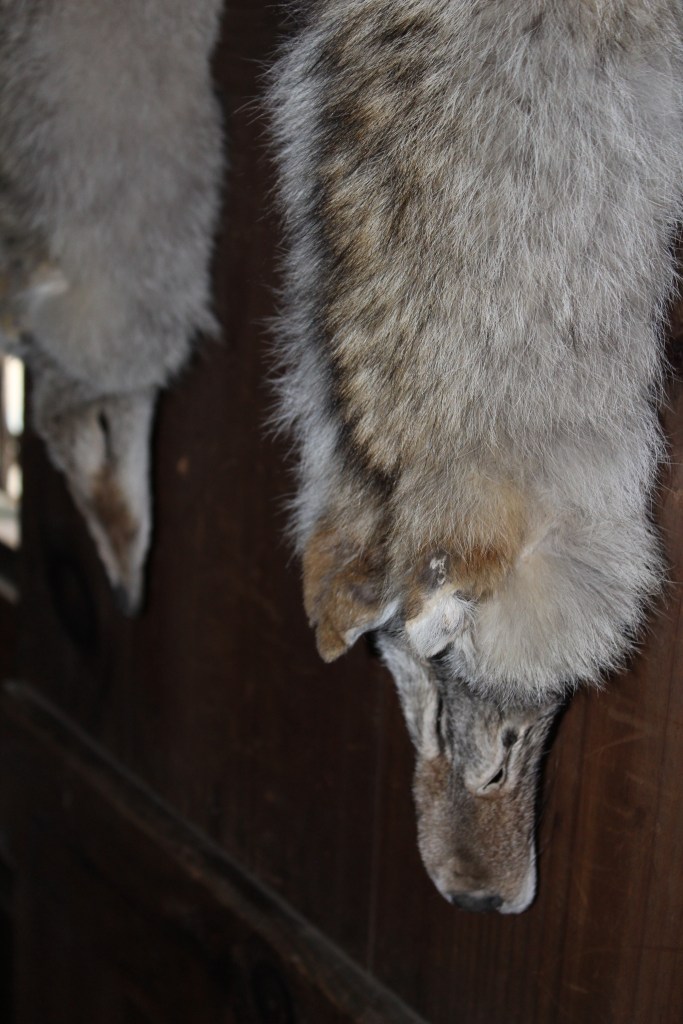
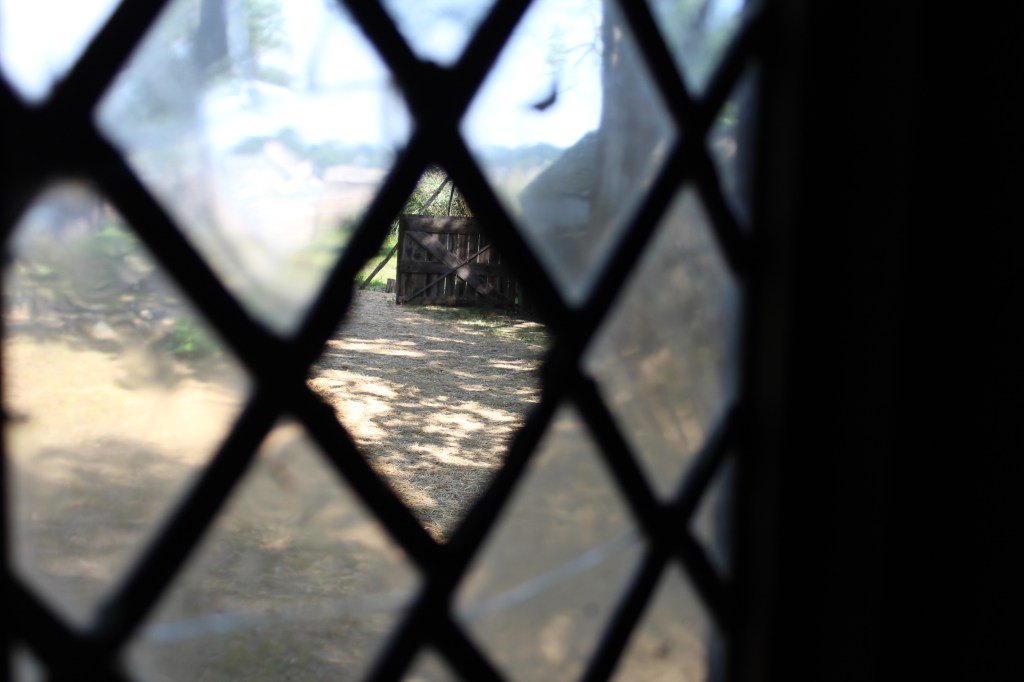
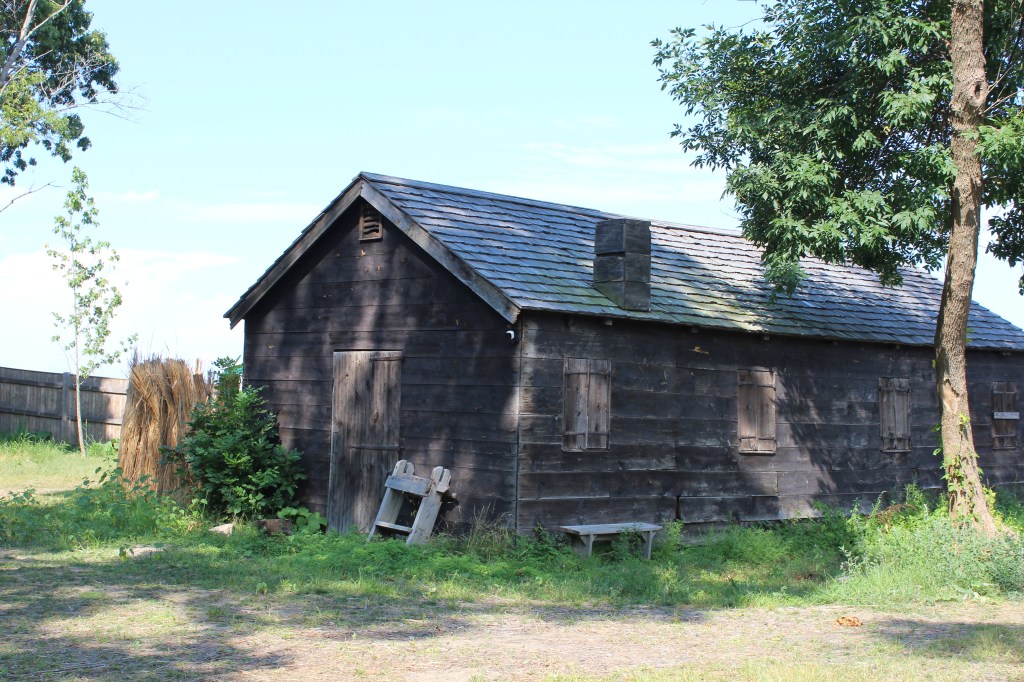
Today, the pond is now almost entirely hidden by reeds – the quacking of ducks the only indication there is water there – and the reeds hide most of the village from view. From the parking lot (currently free of charge), there is a newly-constructed (2019) walkway and bridge brings you through the reeds up to to a gate that reads “PIONEER VILLAGE: Salem in 1630” (see top photo). During this pandemic, the attraction is open limited hours for self-guided tours only. Entrance admission is a suggested donation of $5. I was happy to see that the cauldron was full of cash.

Using the free printed Self Guided Tour (one double-sided sheet of paper), you could wander around at your leisure, but since there were other groups in the village on this day, we had to follow a specific path, so our first stop is the Gift Shop (typically the last stop on any tour):

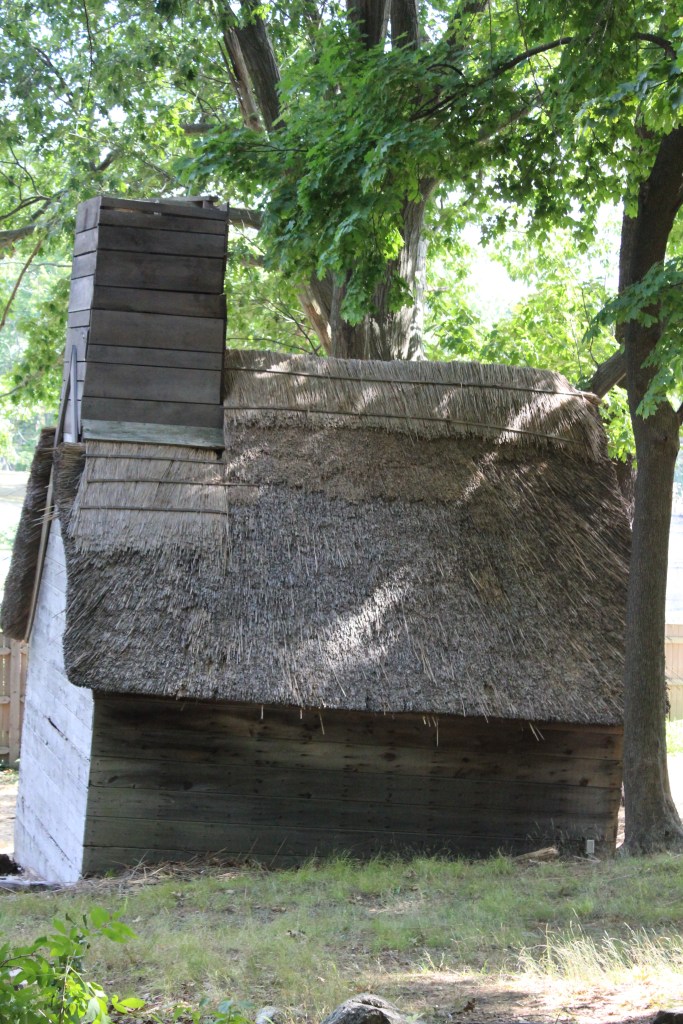
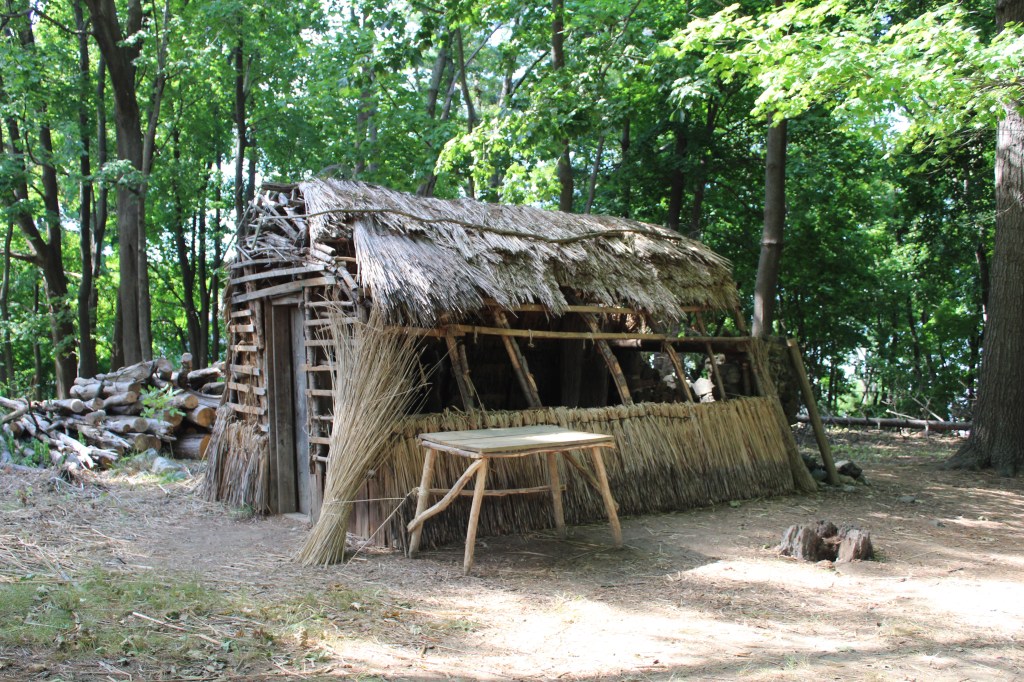
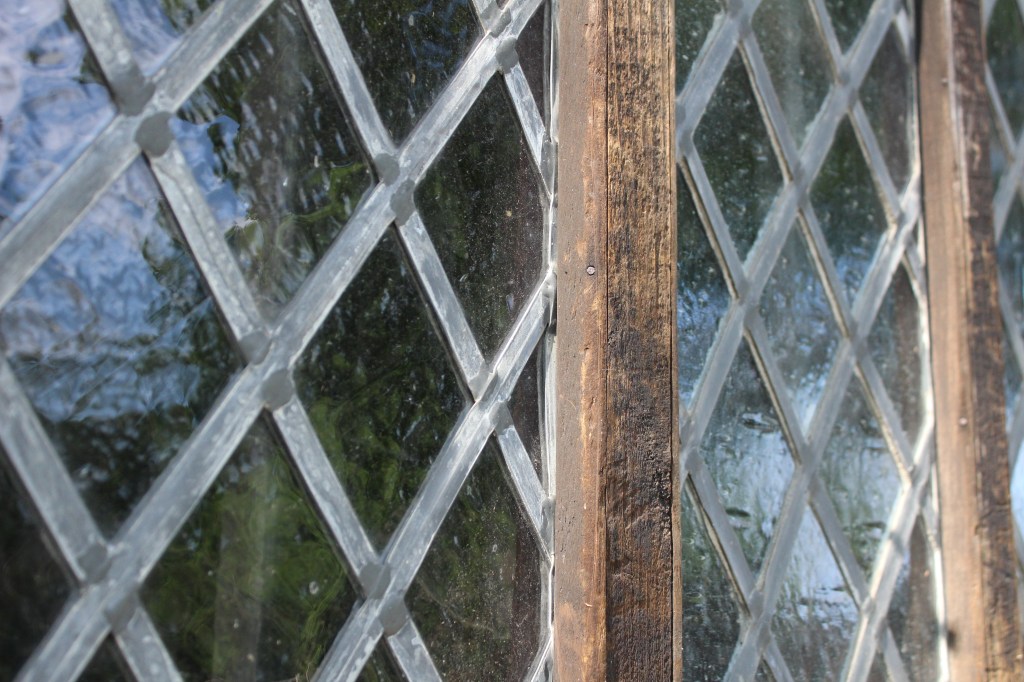
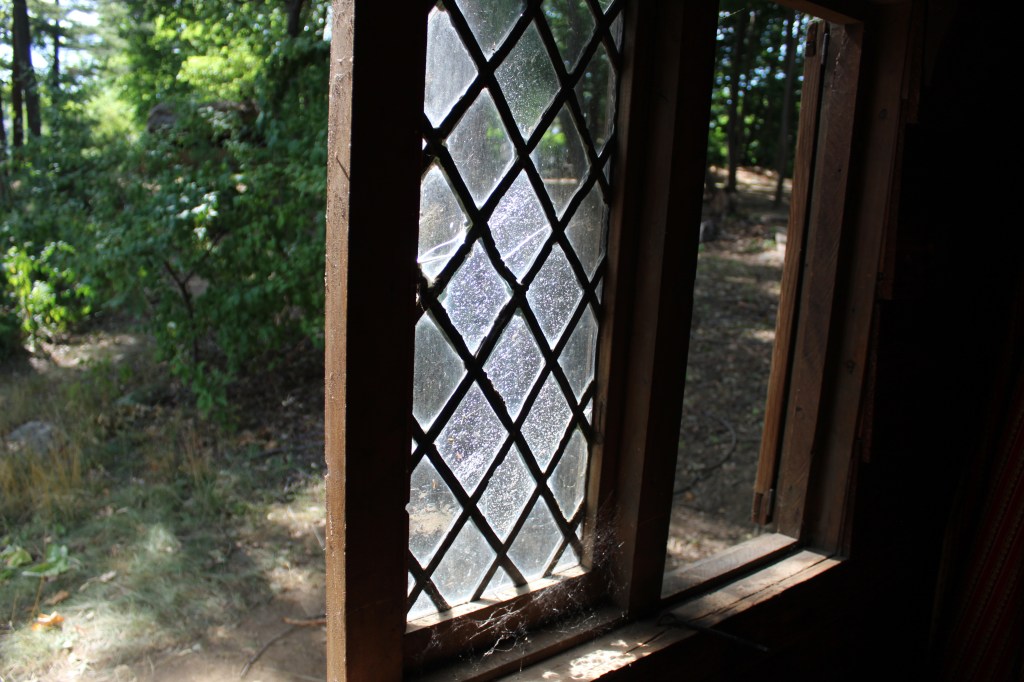
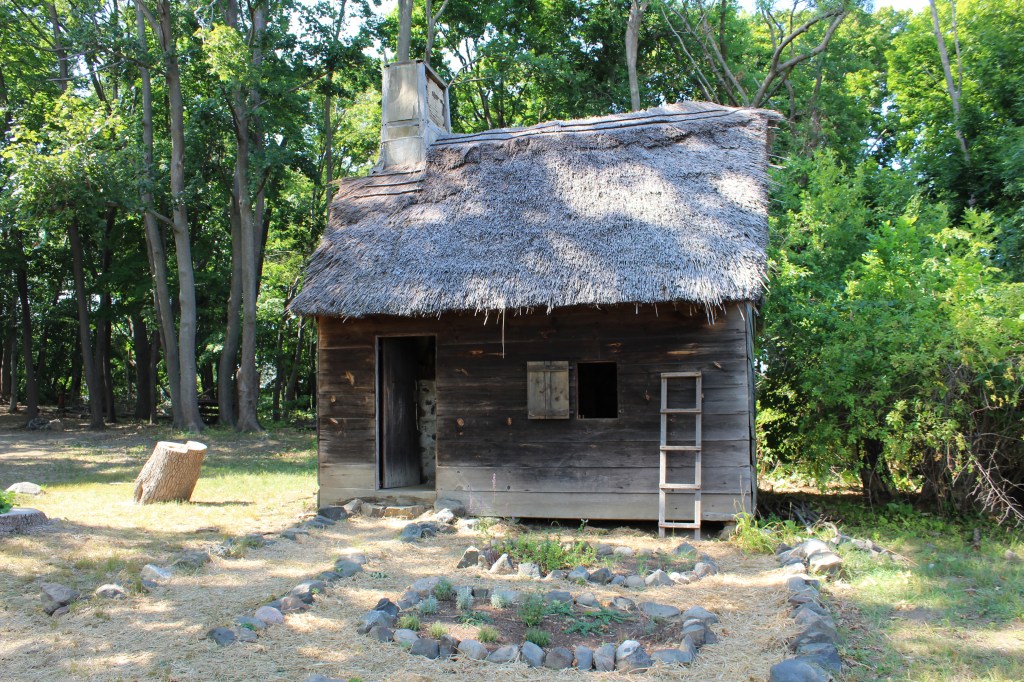
The Gift Shop is a small one-room building with a reed-thatched roof, holding envelopes of herbs, books, calendars, guides, and other items for sale.

Heading up the small rise behind the gift shop, we come to The Wigwam:

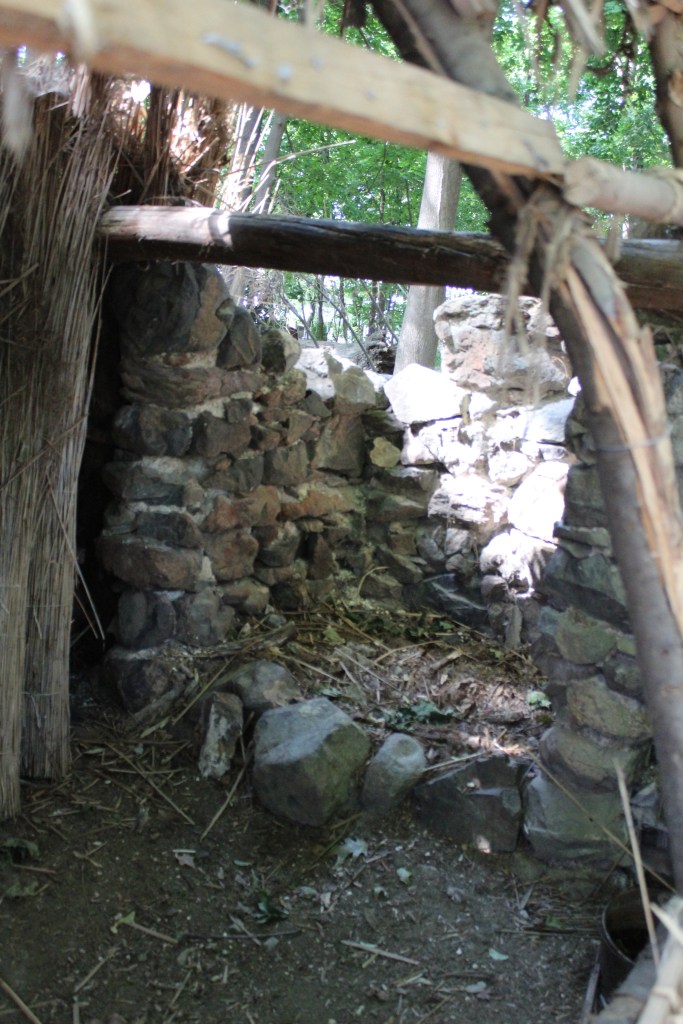
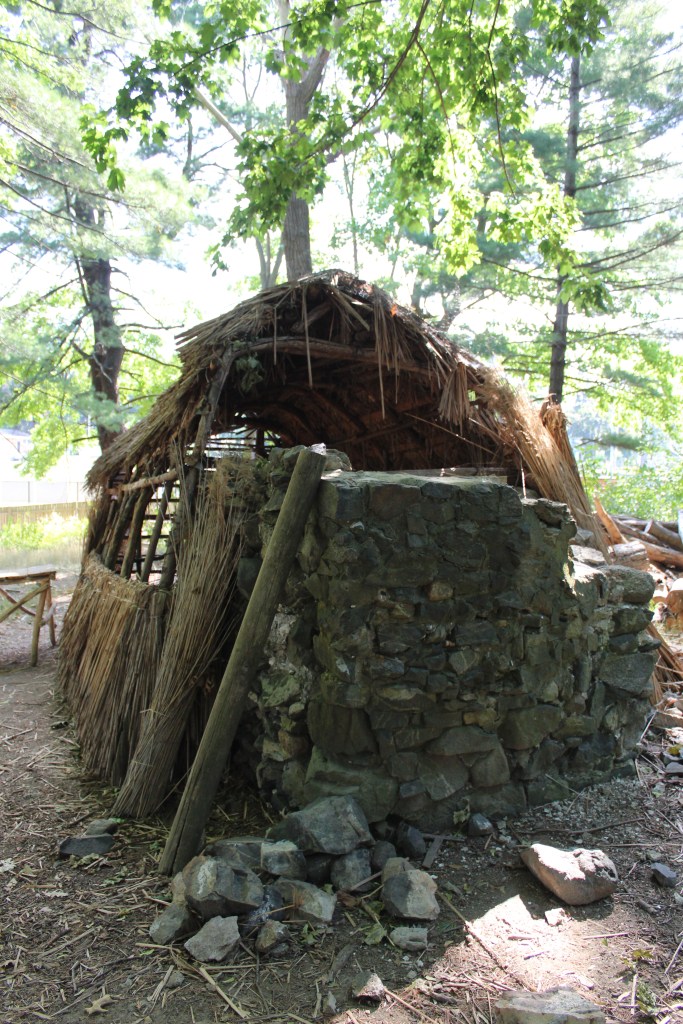
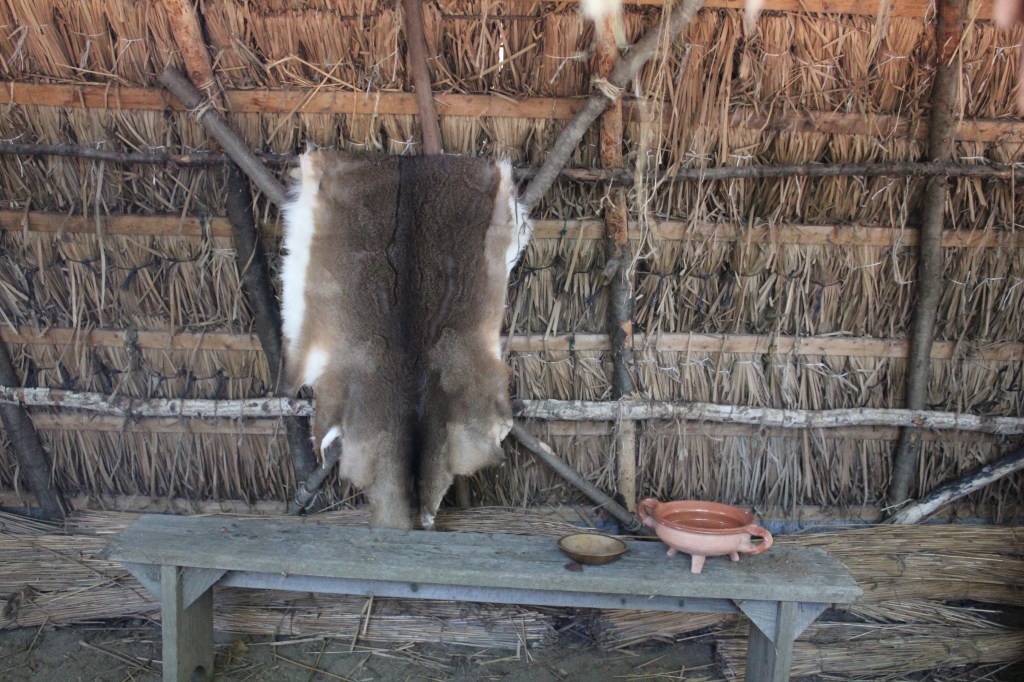
English additions to the Naumkeag wetus include wooden doors, English-style furniture and stone hearths. The wetus would have had the fire in the center. This example is “incomplete” so you can see the inside by looking through the walls.

The early English settlers certainly interacted with, and learned a lot from, the Naumkeag, the indigenous people of the area associated with the Pawtucket, Wompanoag, and Massachusett. This is evidenced by their survival in the harsh wilderness and their use of native plants and crops that were unfamiliar to them. The Naumkeag were a semi-nomadic tribe, creating seasonal structures called wetus (wigwam is the word for “house” in the Abenaki tribe, another Algonquin-speaking tribe from northern New England/Canada) that could easily be built in new locations with the abundant materials at hand. The English settlers took these seemingly “abandoned” structures and added doors, wooden furniture, and stone hearths. These structures served as their dwellings until their wooden structures could be built.

Here, up in the woods, there are also some remnants of former dwellings. There is a fire pit just off the path, as well as a clearing that used to hold the dugout houses for the animals and some of the settlers.

As we descend the path from the wigwam back down to the main path, we next come to The Governors Faire House and Garden:

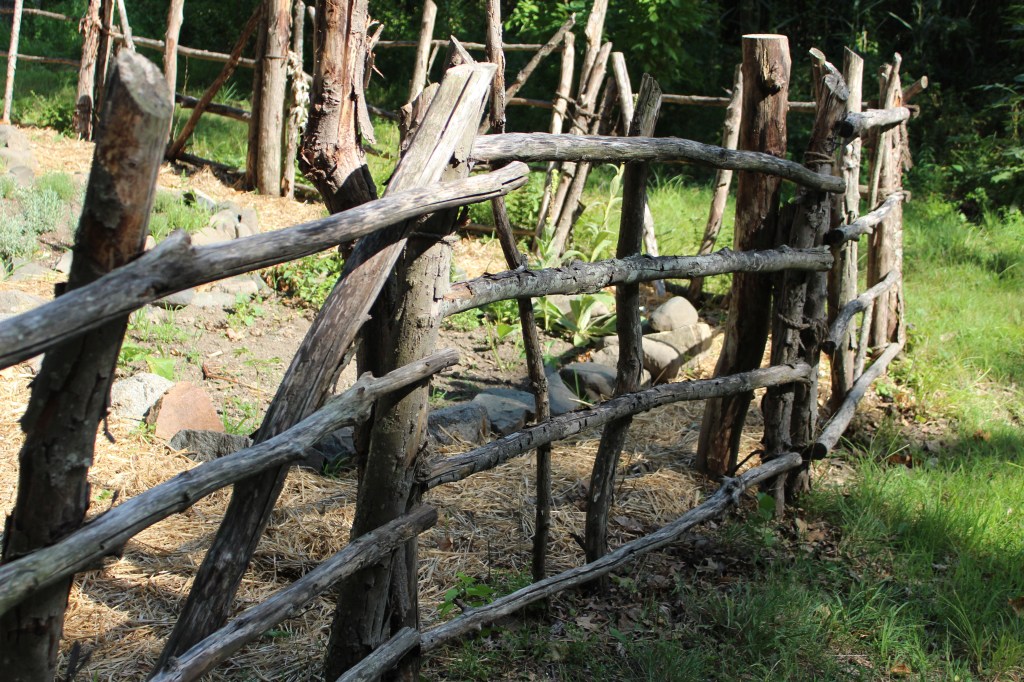
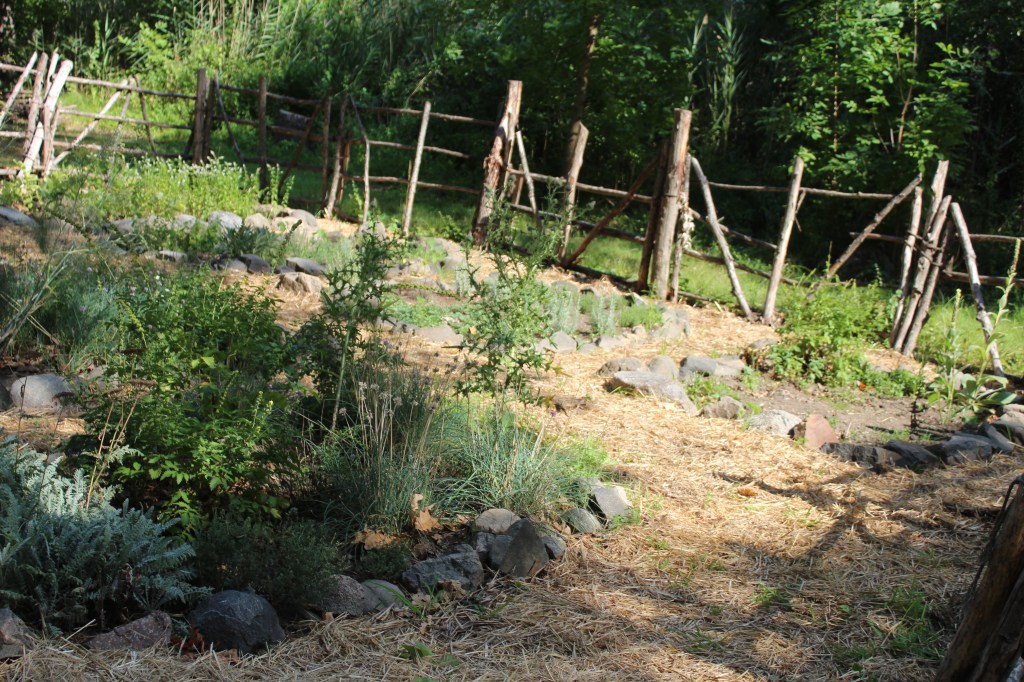
The garden represents one created for survival, containing many herbs used for medicinal and culinary purposes (this one is a parsley shy of being a Simon & Garfunkel song), as well as a few native crops (not shown). In addition to growing crops, they would have had sheep for wool, cows for milk and meat, a beast of burden for ploughing, as well as the fish of the ocean and game of the land.

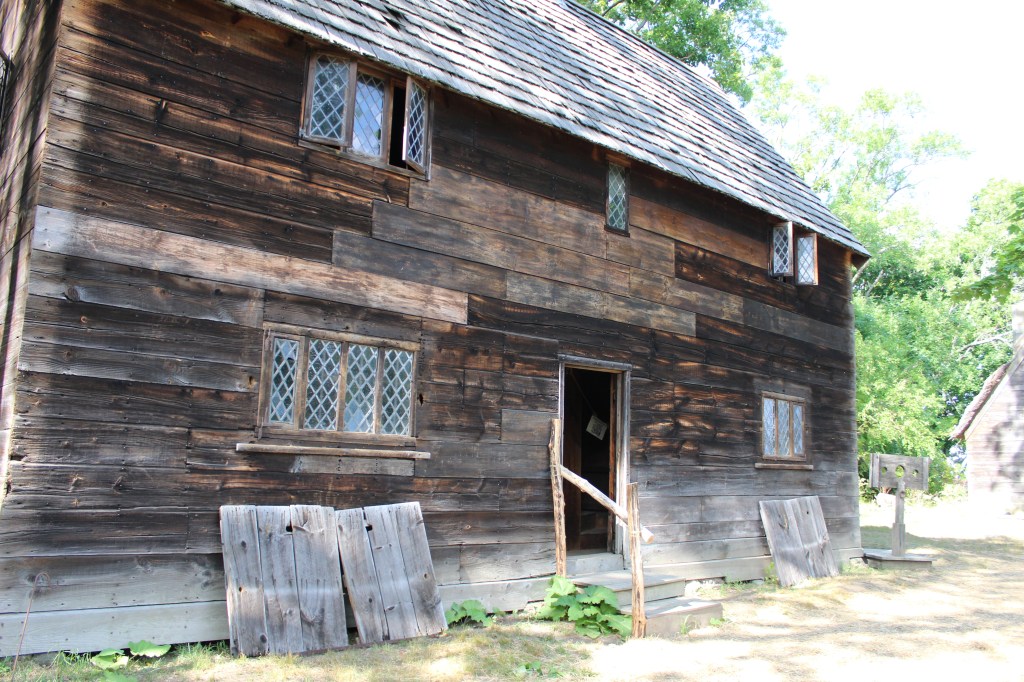
The house is historically unique. It is based on the original plans of the first two-story house to be built in New England. It was originally built in what is now Gloucester, MA sometime between 1620-1625. In 1628, John Endicott (sometimes Endecott), the Governor of the Massachusetts Bay Colony, ordered the house to be dismantled, moved, and rebuilt in Salem to become the Governor’s House. It was extensively remodeled and expanded over the years, but this replica was created through the research of the Pioneer Village creator George Francis Dow. Sadly, the actual Governor’s House was lost in the Great Salem Fire of 1914, but I found these photos of the interior c. late 1800s. The name “The Governors Faire House” comes from an account by Rev. Francis Higginson, who arrived in Salem with his Puritan settlers in 1629 found in the annals of Salem: “we found a faire house newly built for the Governor.” No doubt, Dow included this house in the center of the village because it was in this house that Winthrop and his party ate their first meal after arriving. They dined on venison, beer, and fresh strawberries, according to his diaries. Let’s take a look inside:

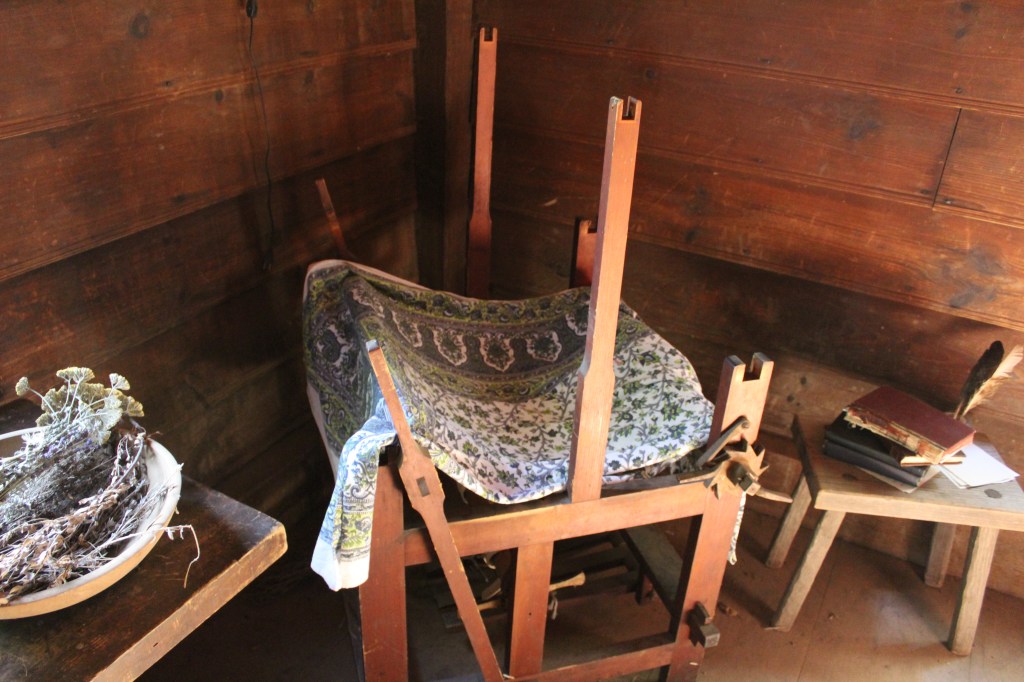
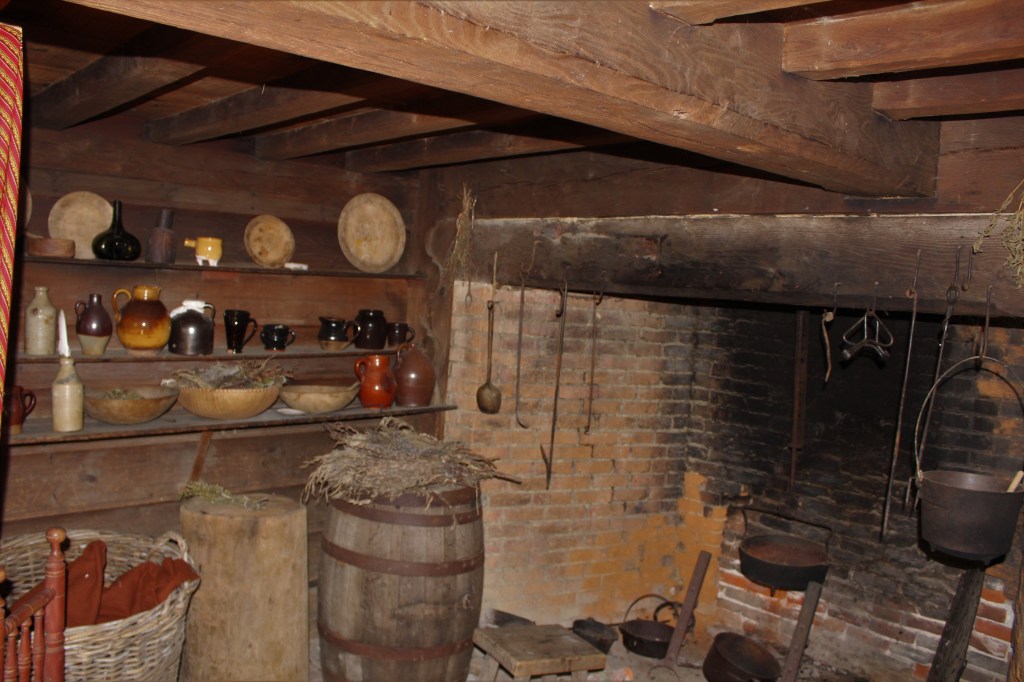
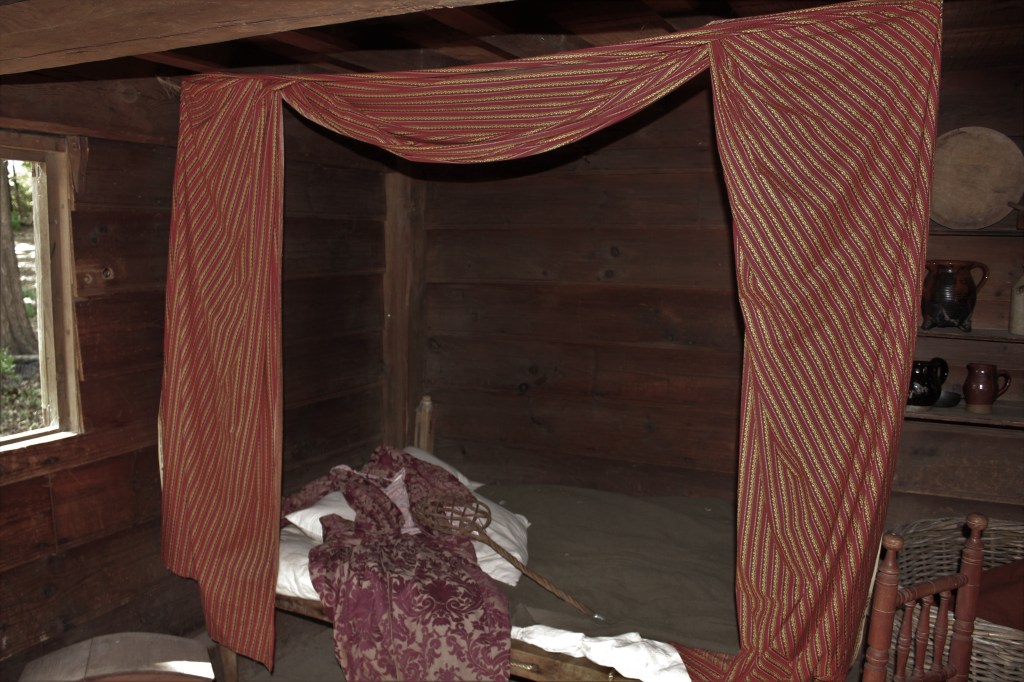
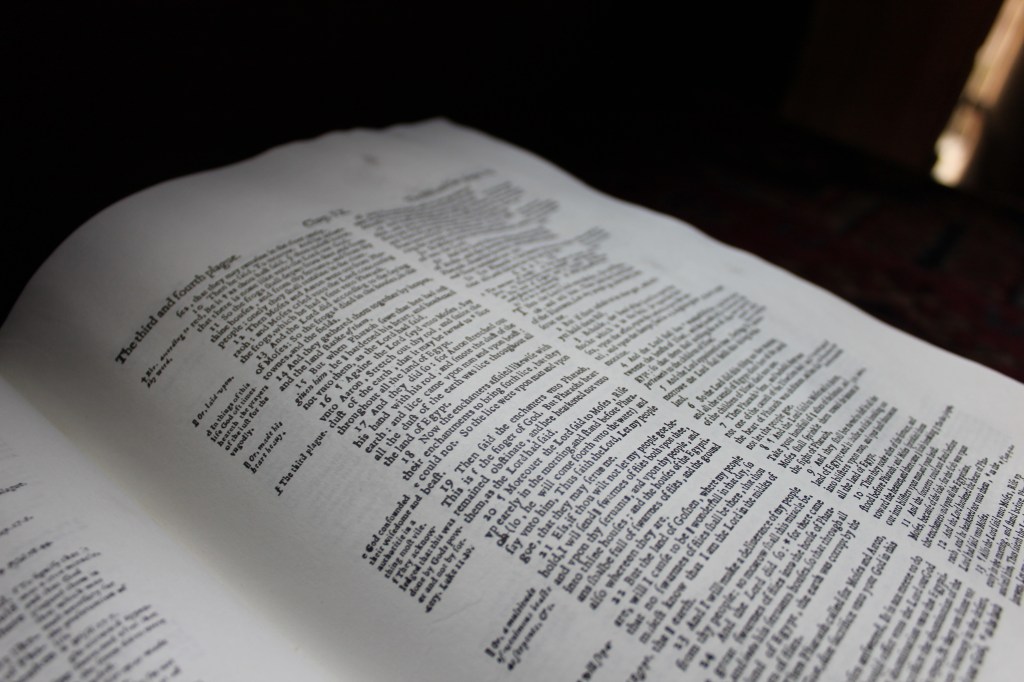
The house is divided into 2 rooms on the ground floor. In the current iteration of the museum, the second floor is used by the staff and is not accessible to visitors. On the left side room, they have highlighted the role of women in colonial America by showcasing the cooking hearth (central chimney), food stores, textiles, a Bible, the many herbs and spices used for medicines, and the bed because… well… birth, life and death all happen there.

The self-guided tour sheet, rather than explaining the items in the room, uses this opportunity to explain how very difficult life was for women at this time. Beyond their overall oppression and inability to own anything, their lives and health were constantly at risk as they were encouraged to “birth the new world.” In contrast, a native woman owned her own property, her own home, her own crops, and took part in tribal discussions (voting) – all the things denied to the colonial woman. Ironically, the colonial women still saw them as savage or living under lesser circumstances than themselves.

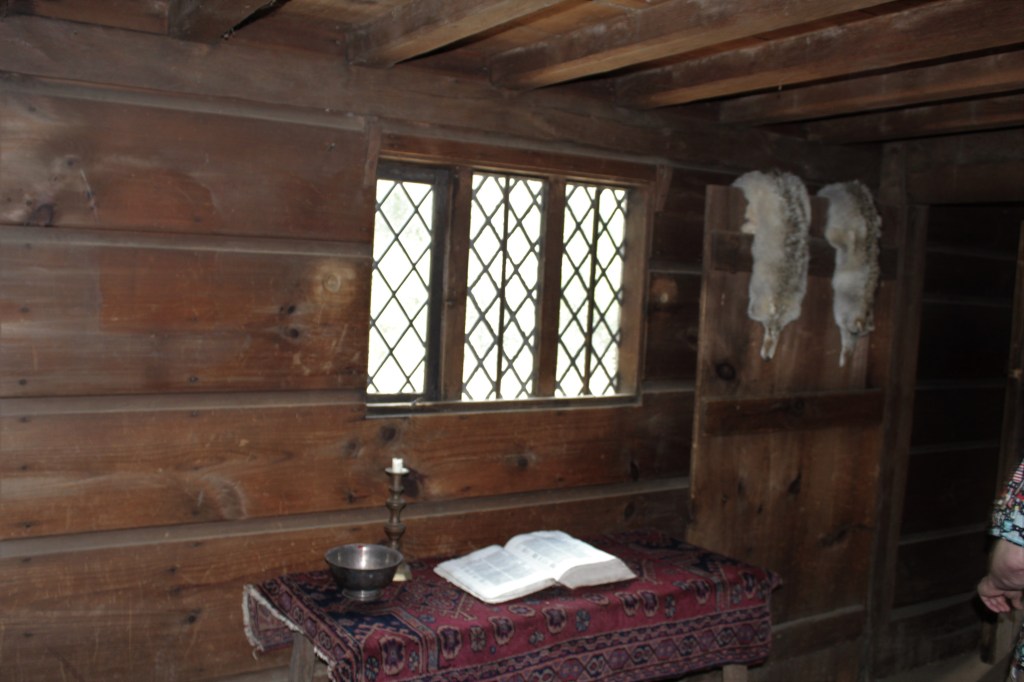
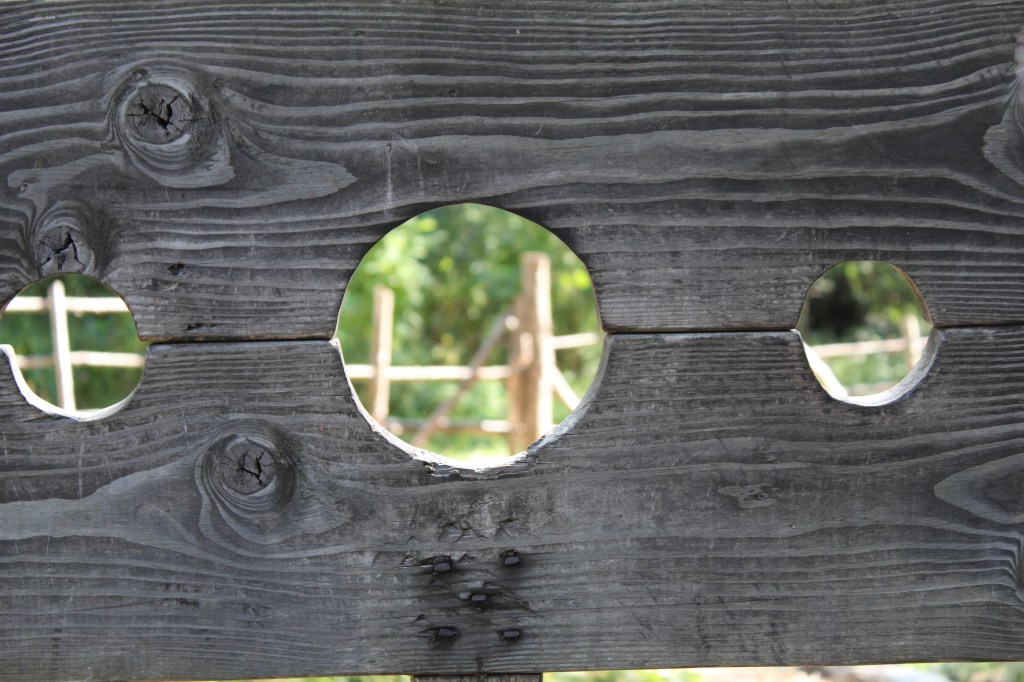
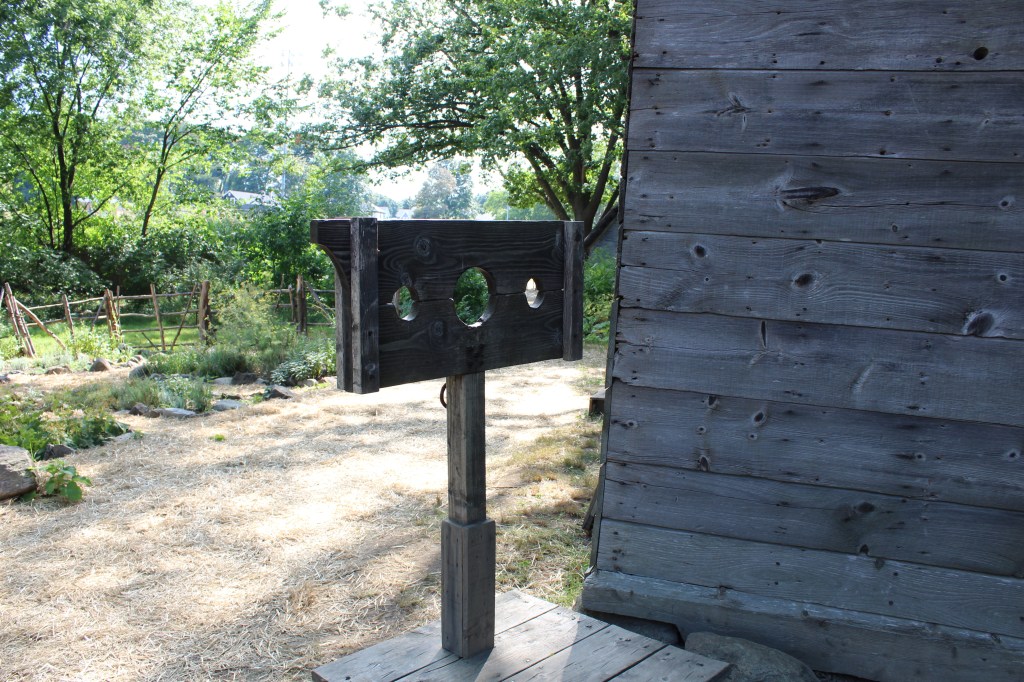
The right side room (also with a fireplace in the central chimney, not shown) highlights the Puritan authority and the world of men. In this room, we have classroom (every person was taught to read the Bible), some hunting spoils, and a place for prayer. Outside the house is a pillory for criminals and those who act against God.

The Puritan way was one of intolerance towards others, whether divided by gender, race, or creed. They even disapproved of other Christian sects. They thought the natives were, by default, worshiping the devil because they were not able to read or understand the Bible.

“Their intolerance and draconian punishments extended even to their own kind. Adulterers could be put to death, thieves could be branded and scolding women could be put in the stocks or pillory and publicly made a spectacle of.”

Pioneer Village Self-Guided Tour handout

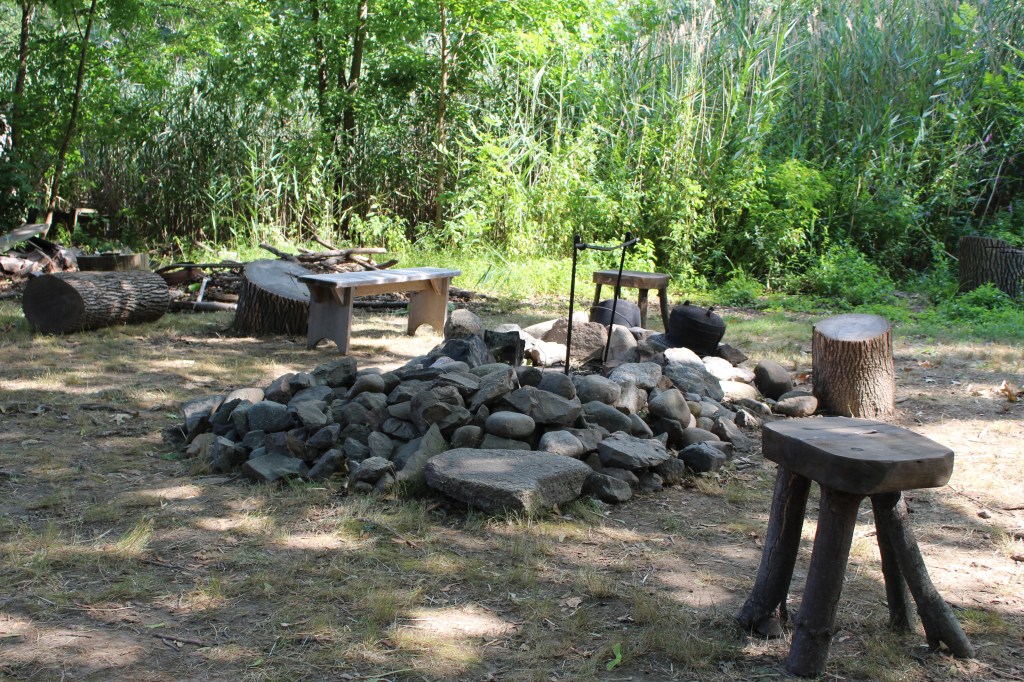
Next to the garden is a fire pit, likely for creating medicines from the garden or communal cooking. With the stools and benches, and the collection of cauldrons, it looks like a communal space:

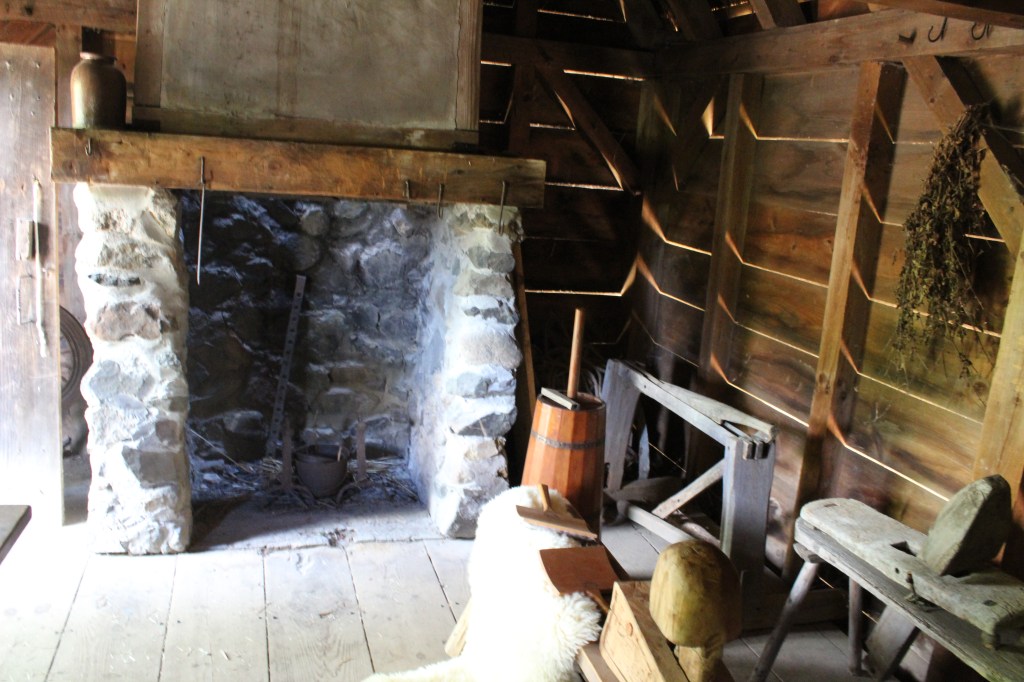
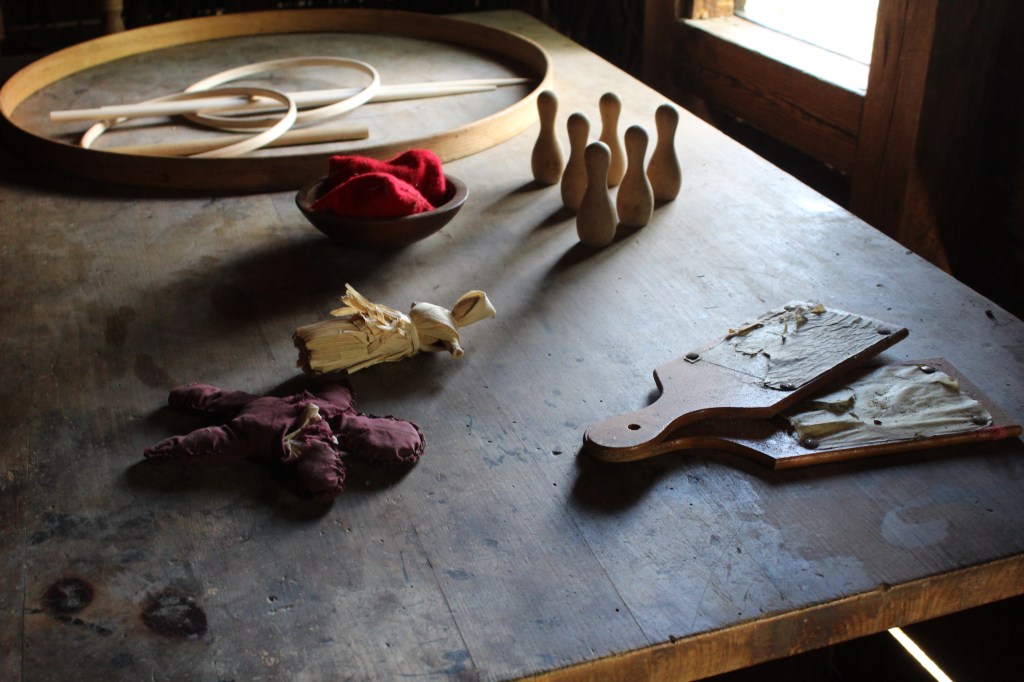
Close by is a small one-room dwelling with it’s own meager garden that is set-up with examples of daily chores and children’s things:

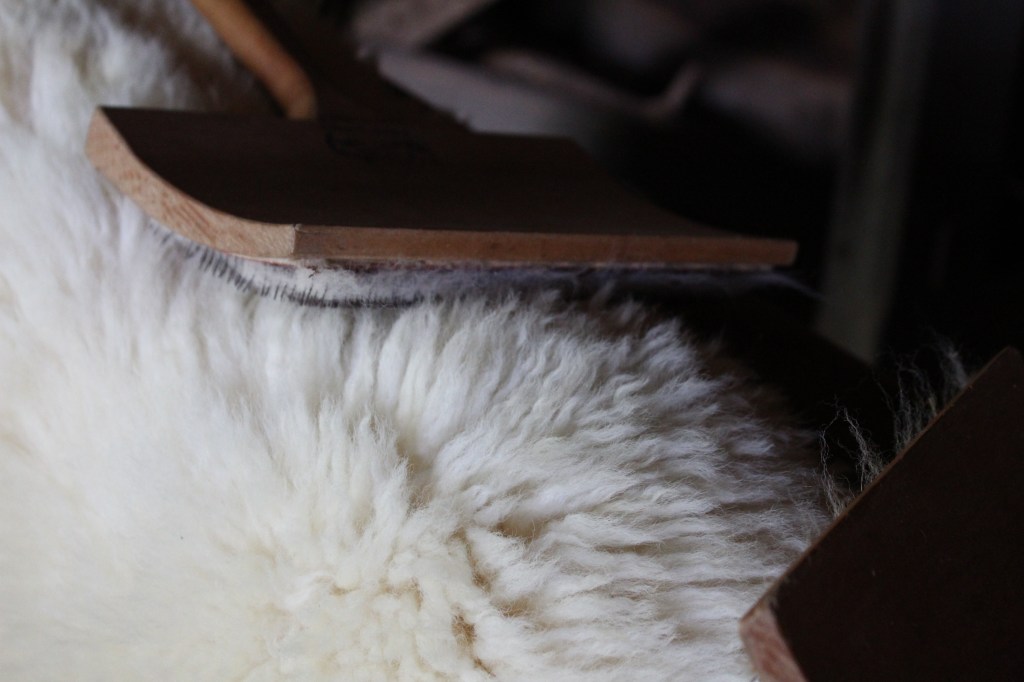
Here we find a butter churn, wool being carded, woodworking benches, a saw, a vice, what looks like a hat block, and various toys: dolls, paddles, beanbags, bowling, and hoops.

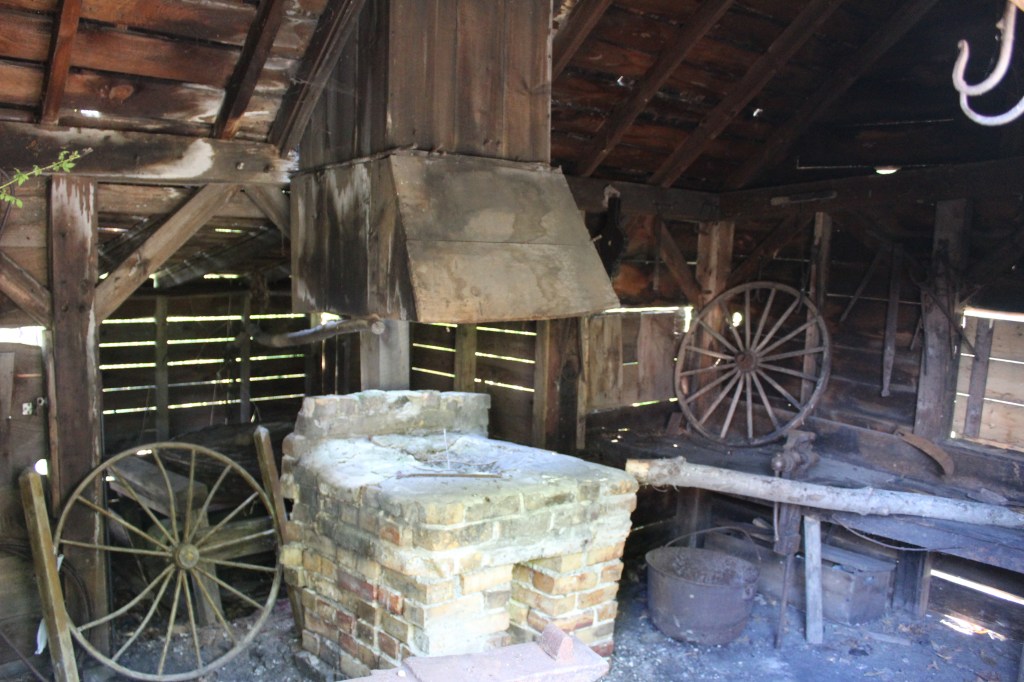
Across from this dwelling is the Blacksmith:

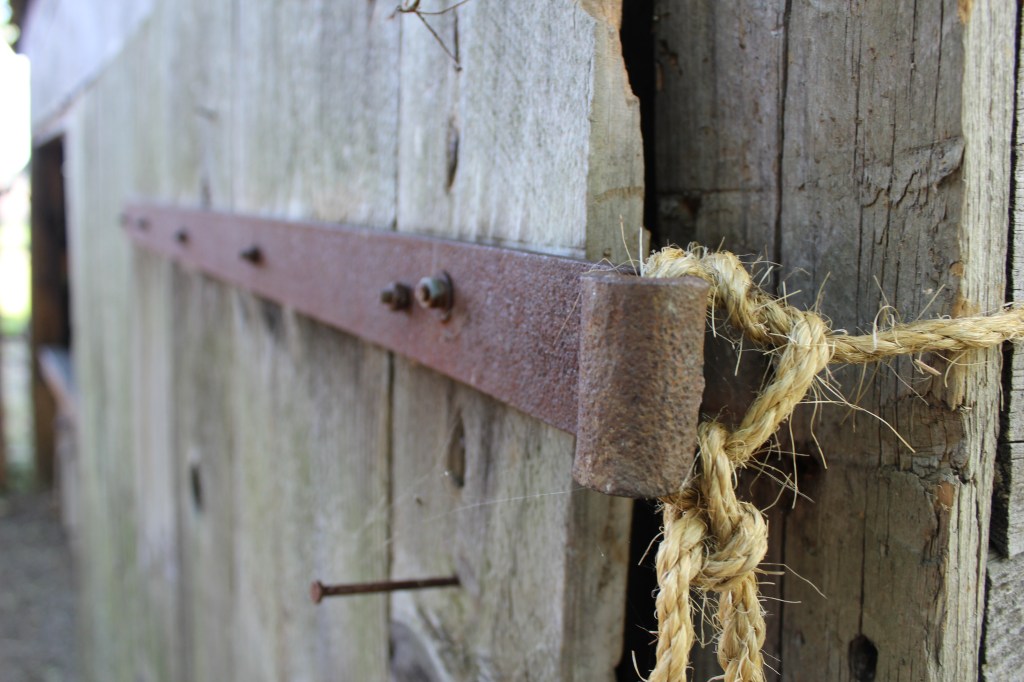
Tools were important to building a settlement: shovels, hoes, pitchforks, hammers, saws, axes, nails, hinges, cooking pots, etc. all served their purpose, and the Blacksmith could repair items that the settlers brought with them. This smithy is located with its back to where they original audience would have been, and I am not sure when it would have been added or moved. It is in a perfect spot, away from the other buildings and directly next to the pond, but it’s situation in the original tableau would block several buildings.

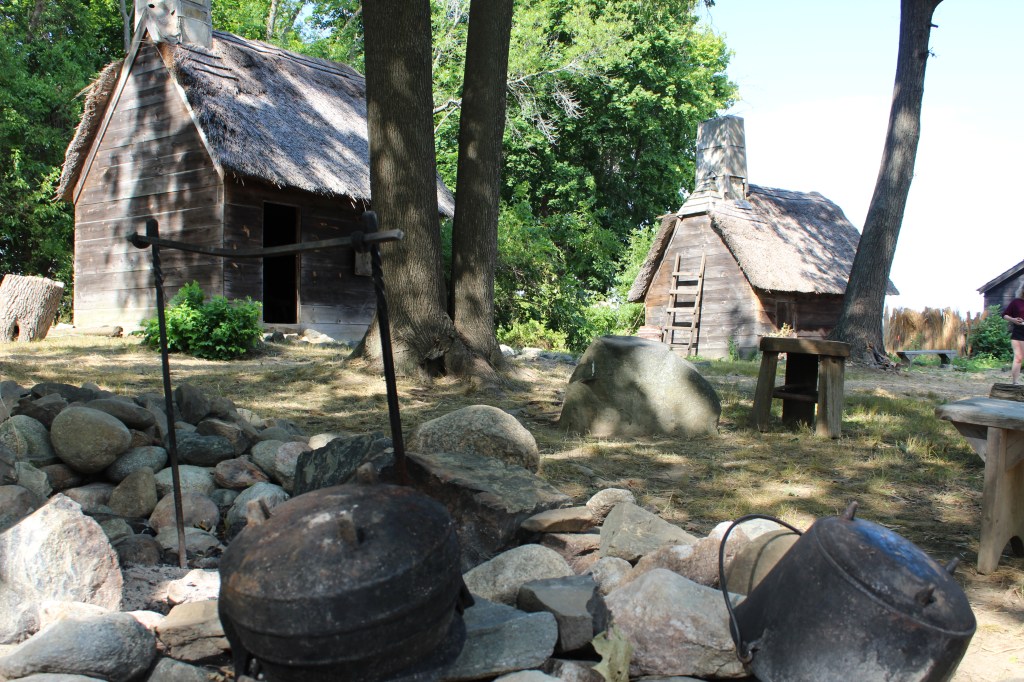
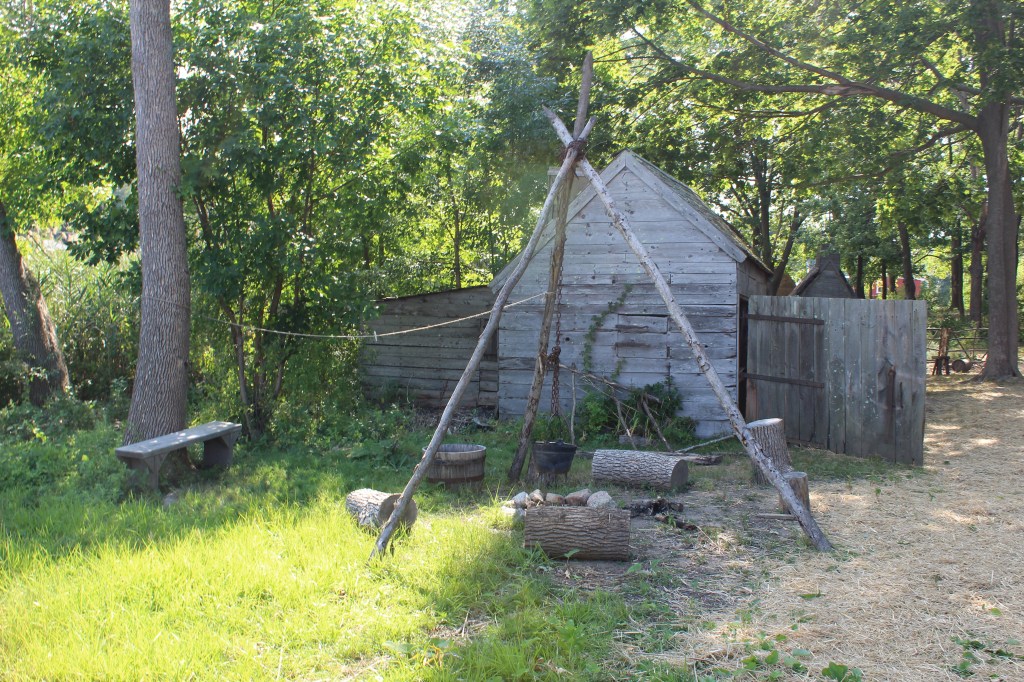
Next to the blacksmith is a fire pit with a cauldron hanging from a tall wooden tripod. Like the larger pit next to the garden, nothing is mentioned of this in the brief guide, though there is a line attached to a nearby tree, perhaps for drying dyed wool, or animal skins:

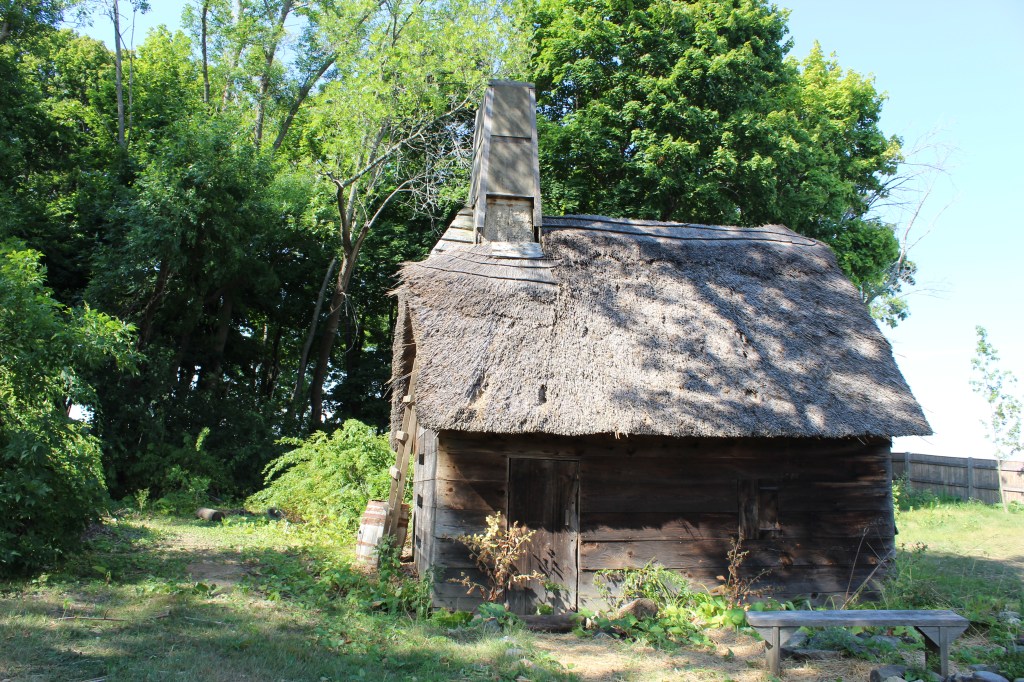
Similarly, there is no mention of what this small building could be:

Though this vintage postcard says it was once known as “Lady Arbella’s House.” Note the placement of the tripod fire pit. Maybe it used to be hers.

There is also no explanation for this final building:

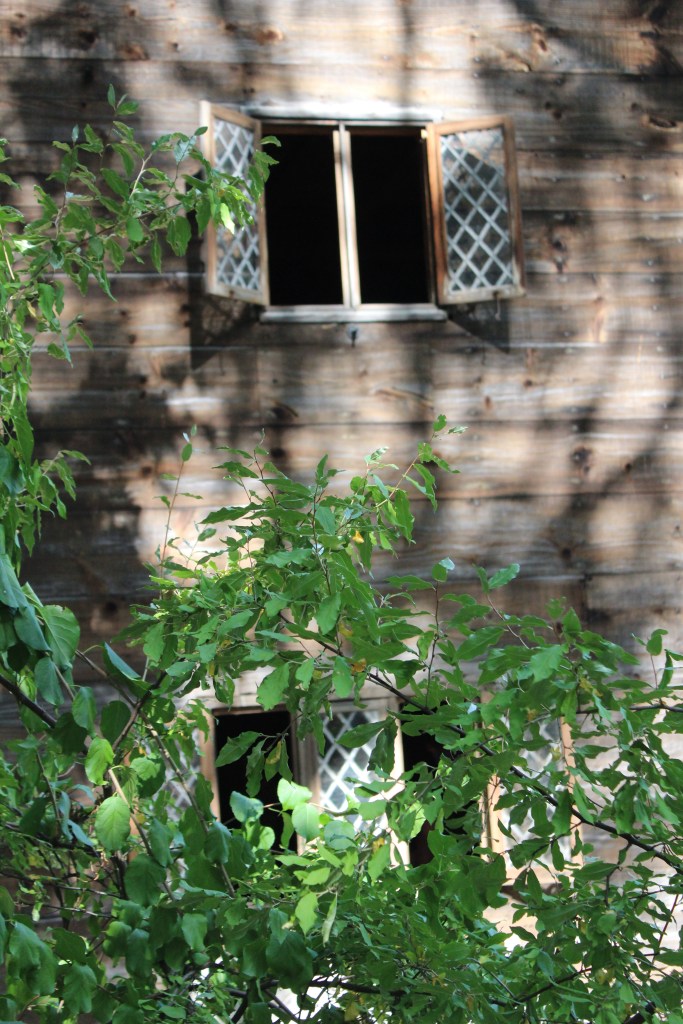
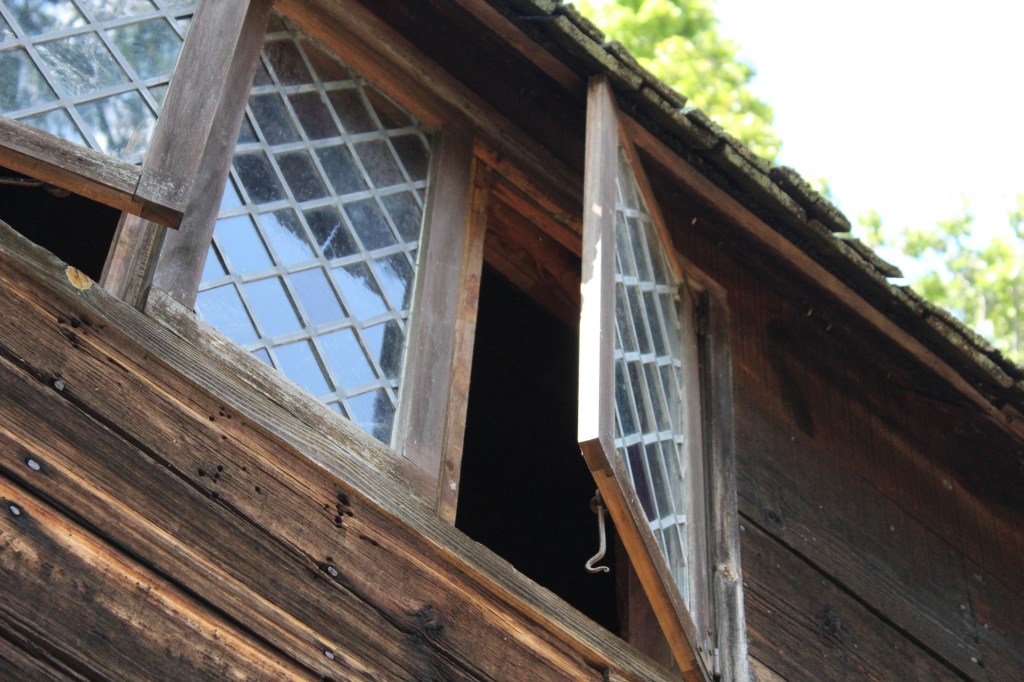
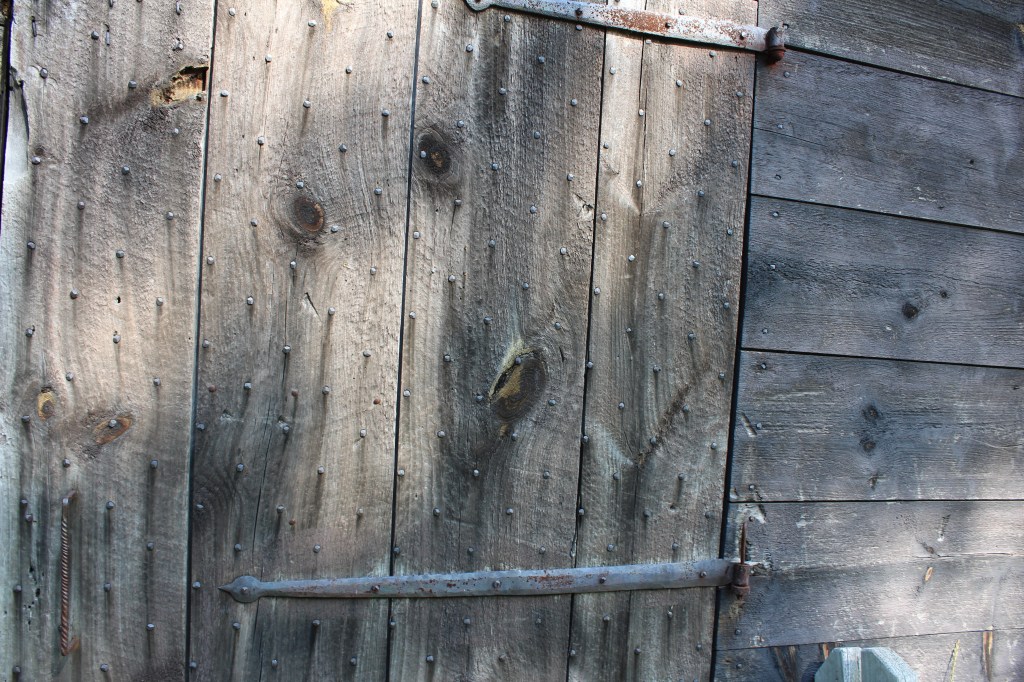
Is this a stable? A dairy house? Grain storage? With the shingled roof, multiple windows, and hobnail door, I also thought it could be the meeting house. I do know that at one time it was used for the staff to get into costume and to eat their lunches out of sight of the guests.

Having reached the end of the “road” in the village (the fence you see in the background leads out to the harbor and a boat launch – not very period), we head back towards the entrance, passing the houses and gardens and leaving via the small bridge that once was the entrance to the village (note that the pillory and stocks have moved around a lot over the years).

As we pass the gift shop and the administration cottage, and pass under the archway out of the gate, we leave 1630 and enter back into 2020, a time of disease, gender oppression, racism, religious intolerance, and inequality. Have we learned nothing in 390 years?

I hope that you will take the time to make a day trip to Pioneer Village. It is definitely one of the best Hocus Pocus filming locations for photos in Salem (the others are exterior residences or buildings) if you are making that pilgrimage.

Quarantine Staycations – Part 2

Note: This is the second installment of a two part series. Part 1 can be found here.

Background:
In an earlier post from April, I offered advice on creating a “Verifiable Weekend” while working from home by either creating or breaking routines (if you missed it, I suggest taking a look at Making Time When It All Blends Together – the weekend section is at the end). With all of our travel plans cancelled and the inability to leave (or return to) the state without a 72-hour COVID-19 negative test, health attestation application, or 14-day quarantine, I have not really thought about taking vacation time. As the end of Summer looms here in New England, and as the Zoom fatigue starts bearing down, however, maybe now is the time to take some time away. I blocked time in my boss’ calendar to make sure she took some time off to de-stress and re-center. I should do the same for myself, and so should you.

Part 2: What if you can leave your house, but can’t leave the state?

Part 1 focused on suggestions for those that have to stay at home. Part 2 will broaden the scope to those that are healthy enough to travel locally, but cannot cross state lines. Since I live in Salem, I will be highlighting day trips within Massachusetts – however, I hope the ideas might inspire you to search for similar trips in your area.

Where to begin?

Planning:
The key to any successful trip, in my opinion, is very careful planning. I chose those words intentionally – I am not saying completely planning every moment, but thinking strategically about the entire trip and being carefully selective in planning key elements. Taking the time to research and make these plans ahead of your vacation will ensure that your time on vacation is spent relaxing and enjoying yourself.

One thing that is very important to schedule: Serendipity. Wait, what?!? “But Eric!”(I hear you say) “Serendipity is defined as the occurrence and development of events by chance in a happy or beneficial way. How can I schedule that?!” When planning your vacation, be sure to schedule free time to let unexpected things happen.

Consider these scenarios:
After arriving at your destination, a local gives you a suggestion of something you simply must do when you are there. If you’ve scheduled every moment, you would be forced to chose whether or not to cancel one of your plans to fit the new adventure in. Or maybe, because you’ve scheduled so many activities or tours, there is no time to enjoy the beautiful pool, the fire pit, or the hot tub where you are staying. What if something took longer than you expected on your Day 1 itinerary? If you’ve scheduled serendipity for Day 3, you can go back and finish anything you skipped, or go back to check out that quirky-looking antique book store that you quickly passed during the hidden secrets walking tour.

Brochures found at the local visitors center

Or, if you are adventurous, you can throw caution to wind and play Lobby Brochure Roulette! Each member of your party closes their eyes and grabs a random brochure, then everyone agrees on one of those chosen (depending on cost, distance, if reservations are needed, physical limitations, etc), and that is what you are doing for the day! As a very good friend of ours used to say:

Let whimsy be your blind date!

James Nance, Gentleman & Scholar

Of course, please also schedule downtime. If you go on three major hikes in three days, you are going to need some time to rest and recover.

Day Trips

A few years ago, I noticed that we worked so hard during the week that we never thought about the weekend until we were in it. Sick of wasting time, and longing to do some of the things we always talked about doing, I filled a jar with day trip ideas. The plan was that we would choose one (Friday night or early in the morning) and that would be what we would do. Here is the list I came up with all those years ago, in case you want to start your own Day Trip Jar (again, this is only going to appeal to the Massachusetts crowd, but note there are some out-of-state options included):
DAY TRIPS

Here in Massachusetts, we are in phase 3, step 1 of reopening, which allows for restaurants (indoor and outdoor), hotels, museums, gyms, outdoor venues, and movie theaters to be open. All businesses that have been allowed to open so far have been given very specific and strict restrictions and regulations to keep both their employees and the public safe.

Please research and adhere to all regulations posted by each place you visit. Most businesses require you to wear a mask when in their establishment, and to practice social distancing requirements. A good rule of thumb, when in doubt, is to wear your mask and stay 6 feet from others, even if it is not required. Be a good citizen. Protect yourself and help to protect others.

Finding the Fun: Vacations should be relaxing, yes, but they should also be fun. Whether you have a family, are a solo traveler, or it’s just the two of you, remember to play.

Play Tourist: Is there a museum, attraction, or historic spot in your own home town that you have never been to because that’s for tourists?! Well now is your chance to be a tourist. In all likelihood, the crowds that usually flock to these places are not doing so right now, so you will have the luxury of it not being crowded, and you will be supporting your local economy. Find a walking tour, either self-guided, or by a local expert. We are lucky enough to have Salem Food Tours, and I expect the nationwide trend of eating/playing/drinking locally means that you probably have one in your city, or one nearby. Maybe you can find a tour of haunted places, or hop on a Segway, a trolley, a kayak, a schooner, or a duck boat that brings you all around the city. You’ll be surprised at the things you learn, and you’ll be better prepared with options when you have future visitors that are looking for something to do.

Play Photojournalist: Here on this blog, I tend to let the photos speak for themselves (see Salem Willows, Witchcraft Victims’ Memorial in Danvers, and the Atlanta Botanical Gardens, for examples), usually because I’ve taken too many photos! Try to be more like the staff of The Atlantic: take your camera (or camera phone) with you and take photos of everything you see, noting special details on a small pocket notebook (or in your phone’s Notes), so when you get home, you can create a full narrative of your day. Try making a short slideshow video with narration or subtitles and post it to YouTube, or start a blog and write-out a full story, weaving the photos throughout. If you are a savvy social media Influencer, create interest in your content by posting the photos in a series, releasing one photo at a time with accompanying captions on Facebook, Tumblr, Instagram, Twitter, or Tik Tok. Heck, you could even create your own book to give as gifts! In the same way that playing tourist in a familiar place can make you see things you’ve overlooked, photographing something with the intent to convey the feeling and sense of a place to someone else can be a wonderful exercise in seeing the world in a unique and meaningful way.

Play Researcher: We don’t have children, but this is definitely the kind of thing we would do with them on a regular basis if we did:

1. Pick a location.

2. Go to the Library (or the internet, if your libraries aren’t open) and do research pertinent to that location.

3. Visit the location, where the Researcher acts as guide and teacher for everyone else.

Examples: Pick a historic place and have the researcher point out the things they learned in their research. Find an autobiography of a local person and visit their home, or all of the local places mentioned in the book. Choose a specific period/style/culture and visit an art, history, or science museum, where the researcher acts as docent. Learn about local flora and fauna and take a walk in a nearby forest, beach, or tide pool, where the researcher can identify specimens. Choose one animal or a remote location (like the Serengeti) and visit a zoo where the researcher can teach about the natural habitat or attributes of the animals. Choose a city block that contains many different architectural styles or features and point out the ones they have learned about. Learn about the three major classical orders of columns (Doric, Ionic, & Corinthian) then walk around a city and point them out.

Several of the items found on the Day Trips list lend themselves to these approaches, and I believe these approaches bring a form of engagement to your activities that can make everyone appreciate and enjoy the trip in a special way.

Overnight Trips

As I mentioned earlier, hotels are now open (with restrictions), as well as campgrounds, home shares, and B&B’s in Massachusetts. Basically, the only things not open are arenas, gambling facilities, theme parks, and other high-capacity venues, along with any non-medical close contact services (massage, waxing, etc.). So if your plans involve large gatherings or a stranger getting up-close-and-personal, then you are out of luck.

A lot of the same rules and ideas apply, but keep in mind:
1. Research what is open and what the local regulations are.
2. Wear a mask (bring several – at least one per day, or plan to disinfect it).
3. Always stay socially distant from those people that are not part of your pandemic pod.
4. Find out if you may need to reserve a specific time to enter certain museums or buildings, and plan accordingly.
5. Check all of the meal options in the area. Do the restaurants offer delivery or pick-up? Consider packing a cooler with pre-made muffins, sandwiches, charcuterie, snacks and water to limit the contact with delivery persons to one meal per day.
6. Pack disinfecting wipes, disposable gloves, and hand sanitizer.

Hotels:
If you walk into a hotel and the person behind the desk is not wearing a mask (or wearing it incorrectly), turn right around and stay somewhere else. This goes for any member of the staff.

If you can, check before you book if the hotel is making safety a priority. Feel free to call them and ask what they are doing to curb the pandemic. If you do not feel comfortable with their practices, book somewhere else. The most important thing right now is that you feel safe during your vacation.

Camping:
My husband’s idea of camping is staying on the Club Level at the Wilderness Lodge, but we have family with RVs and campers. I think those that have the money (and parking space) for an RV are the luckiest during this time. While some campgrounds still remain closed, there are many that are open with restrictions (communal bathing houses and restrooms are hard to control). If your hotel room is on wheels in an RV, you have the most control over your environment. You know if every surface has been thoroughly disinfected, and you can sleep in comfort knowing that you are safe. Unfortunately, this is a luxury most of us cannot afford. If you are camping in a tent, the idea is similar, however, you may be beholden to using the campground public facilities, which can be risky.

Home Sharing:
Unlike corporate hotels, Home Share sites have no governance when it comes to requiring compliance with CDC guidelines and keeping a safe and clean accommodation. I suggest, when making your search for such an accommodation, that you only consider properties where you can contact the owner directly and can ask them how they clean the house between guests. If you do go this route, I would highly recommend bringing your own disinfecting wipes and cleaning products. This is easily done, since you are likely driving to this location – no flight restrictions!

Cash or Card?:
COVID-19 has further divided the populace on the question of cash vs. card. I have seen both extremes, with a drive-through cashier refusing to handle a card (even with gloves) to gas station attendants not accepting cash. It’s hard to know what you will face, so I suggest being ready to use either. Remember: you are the visitor, the guest, in this place – act with grace and humility. If someone balks at you handing them cash, whip out your card, do NOT argue with them or become a Karen. They are risking their health, and the health of their families to provide you with whatever service you are asking for, so please be civil and patient.

Packing Clothing:
Unfortunately, I think you will have to pack twice as much as you normally would. We don’t really know how long the coronavirus can stay active on clothing, but if an asymptomatic carrier should cough on you, or you somehow brush against a hard surface that is infected, you are not going to want to wear that clothing again until it’s been washed and disinfected. Pack large zip seal bags in your suitcase to collect dirty laundry, and wash your hands thoroughly after putting them in the bags. When you get home, wear gloves when handling the laundry, or wash thoroughly after putting them in the machine. Make sure you use a high heat setting on the dryer.

Scared yet?

It is certainly not my intention to frighten you out of taking a vacation – just the opposite. I want you to have the vacation you deserve and to do so in a healthy, relaxing, and memorable way. It’s in my nature to plan for the worst and expect the best, but I am also an advocate for adding fun and frivolity to everyday life to keep it interesting.

I hope you enjoyed this series of posts. I’d love to hear your thoughts on how you make the most of your vacation time during a pandemic, and if you’ve taken any of my ideas, I’d absolutely love to hear how it went! Leave a comment below.

Stay safe.

Vision 2020

As a member of Generation X, I was privileged to grow up with, among many other significant cultural touchstones, The Funtastic World of Hanna Barbera during my formative years (for me, age 9 through my teens). Two of my favorite cartoons from that series were the mix of syndicated and new episodes of both The Flintstones and their space-age counterpart: The Jetsons!*

Supposedly, we are watching the Jetsons living their lives in the year 2062, 100 years from the original series air dates (which means we are only 42 year away as of writing this in 2020). Of course, when I was sitting at home after school or on Saturday mornings watching these cartoons, I didn’t know what year it was supposed to be. It was just “the future.”

The Future

Growing up in the 70’s/80’s/90’s, the “Future” was always just around the corner, sometime in the next millennium. We made it past 1984 and that was doubleplusgood (of course, today in America is eerily similar…). Our parents kept us from watching 2001: A Space Odyssey until we were old enough to handle the suspense, but even as we approached the millennium and it’s Y2K scare, an unthinkably long-off year still grabbed out attention: 2020.

So let’s assume I was imagining that the Jetsons were flying around in 2020. It wasn’t that far of a leap, since in 1985, the movie Back to the Future promised us we’d have a Hoverboard as well as flying cars, in 2015. Five years seemed like plenty of time to build cities in the sky. Let’s compare the Jetsons vision with what we have today.

Video Phones

How many morning Zoom meetings have you wished for a Video Phone mask?

The video phone was certainly not a new idea, but the infrastructure and the technology of the 60’s (and event the 80’s in reruns) just didn’t make it practical. Video Conferencing technology bloomed in the 70’s and belonged exclusively to large multi-national corporations, the governemt, and the evening news. In the late 80’s the video conference began being marketed for personal use, but the technology required was very expensive, and you could only call someone who also had the same set-up. The advent and adoption of cellular telephones by the masses, and the freedom (imprisonment?) of always having a phone with you and always being available to be reached, superseded the wish for video phones. The first Smartphone came out in the 90’s, though they wouldn’t be connected to the internet until 2001. Around the turn of the century, cameras started being built in, though they acted as a single feature, like a Swiss Army Knife, not an integrated application. During this smartphone boom, video conference phones (hard-lined office phones with built-in screens and cameras) evolved and grew smaller, though they still required audio and data lines. It wasn’t until 2010 that FaceTime arrived and completely changed the way people spoke on the phone. We now carry video phones in our pockets and purses.

During this pandemic, those of us that work from home find ourselves on Zoom calls for 4-8 hours each day, causing “Zoom Fatigue.” In fact, it was a casual office Zoom meeting that started the idea for this post a few months ago. We were joking about having to shower and look presentable on screen, and I alluded to Jane Jetson’s face mask for the video phone. No one had a clue as to what I was talking about, so I pulled up the video clip above and made everyone watch it.

I wonder if, when we are all allowed to go back to the office, my colleagues will still call me on Zoom for a quick question, or if they will call. I hope they will choose to walk up to my desk: I do miss that.

With the technologies of Zoom, WebEx, and Facetime, we also get Telehealth or Telemedicine. I am not the first to recognize that The Jetsons foresaw this one, too. In some regions this practice has been going on for many years, but our current situation means that a lot more of us have experienced (or soon will experience) a virtual appointment with their doctor.

In both work life and medicine – do you think we will ever go back to the old ways, or will everything become a sort of hybrid of in-person & virtual?

Moving Sidewalks

Got ’em! They just haven’t moved from the airports to our living rooms, yet.

Smart Homes

Got ’em! And people who recall “Big Brother is Watching You” from 1984 are worried. Anyone who enjoys science fiction already knows the inherent and inevitable dangers of toying with Artificial Intelligence (AI). We can only hope that the creators of our future Robot Overlords will remember Isaac Asimov’s Three Laws of Robotics:

  1. A robot may not injure a human being or, through inaction, allow a human being to come to harm.
  2. A robot must obey orders given it by human beings except where such orders would conflict with the First Law.
  3. A robot must protect its own existence as long as such protection does not conflict with the First or Second Law.

Cities in the Sky

The Jetsons live in the Skypad Apartments in Orbit City. All the homes and businesses in Orbit City are built on columns that allow buildings to be elevated into the sky. The city is on Earth, but we never see the ground. I can find some theories based on one episode as to what exists below these columned platforms, but I offer my own here: water. The Earth in 2062 is flooded from global warming and the planet-covering ocean is polluted with trash and plastics. Any “ground” we see would be another platform that has been terraformed to be a park (all food is made of pellets that turn into food – I assume you don’t need real food to make those).

Bleak? Maybe.
Intentional? Absolutely not.
But pretty prescient, you have to admit!

Flying Cars

Flying Car sound can be found here – of course, if you’ve ever seen the show, you heard it in your head as soon as you saw the picture… or you are making the sound right now.

We may not all have flying cars, but we’ve been promised they are coming for some time without actually getting them. Maybe we have to wait to be living in the sky city, where they would definitely be needed, before they are a priority.

Utopia(?)

Some major and glaring problems with The Jetsons today is its lack of racial diversity and treatment towards women. The Jetsons were originally created by, and reflect the ideals of, those who held authority in 1962 America: white men. There are absolutely no discernible people of color to be found at any time – even in crowds. The show was the product of the post-war American Dream and tried to emulate that. Unfortunately, at the time, that meant excluding people of color – as they were systematically excluded from this dream (EDIT: I found this amazing article after posting this part!). In this current world of Black Lives Matter (BLM) and growing, yet still insufficient, visibility for People of Color (POC) in the media, The Jetsons are blindingly white. As science teaches, modern humans emerged dark-skinned from the cradle of civilization and we will soon evolve to be the same.

Jane Jetson’s profession is listed as Homemaker. The only socially acceptable profession for a woman in this era. As with most female characters written by men, she is a cookie-cutter character: she raises the children, is obsessed with shipping and gossip, and is overwhelmed with housework (see the Rosie video below for more on that). Jokes and gags revolve around her getting her hair done, going shopping, her bad cooking, etc. In a fully-automated, push-button world, why couldn’t she have a career? George is a “Digital Index Operator,” which means he turns a computer on and off with his finger. In the real world, we know that Jane is doing all of the work, and George is getting the credit for bringing in the money.

Elroy in his personal flying pod, being delivered to school.

In the trailer, we see Elroy (the youngest) placed in his personal pod and sent off to school. This adorable post-war American Dream Nuclear Family vision grew out of the move of the populace from the cities to the suburbs, where Father, going off to work in the Big City, could drop his child off at school on the way. What a lovely, wholesome image. What do we have, instead, in 2020? Now we have children in cages.

Image: Migrants are seen outside the U.S. Border Patrol McAllen Station in a makeshift encampment in McAllen
NBC News

Authority

The Police on The Jetsons were all bumbling idiots. Harmless because of their ineptness.

Police brutality is such a systemic and global problem, that there is an entire section of the Encyclopedia Britannica devoted to it. In comedies and cartoons, the police are almost always portrayed as bumbling idiots or blowhards and in serious dramas, they are usually crooked. This has been the case since the advent of moving pictures and continues today.

When something becomes a trope, it means it’s moved beyond the agreement of the few and become an accepted, wide-spread belief.

Then there is this: https://www.ajc.com/news/nation-world/portland-oregon-mayor-tear-gassed-by-feds-during-police-declared-riot/BG7OJN3U2BAGXC52BAZQNX2ITI/

In Conclusion

Maybe our vision of the future has never been 20/20 (I know you were waiting for that pun). If 2020 were a person, I wouldn’t blame them for shutting down and sending coronavirus, murder hornets, jellyfish, and other plagues at us. We put too much pressure on 2020 to be the year of the future, and yet we seem, in some regards, to be reverting back to the past.

Please accept, on behalf of all of the humans, our humble apologies for expecting too much from you, 2020. Please sit back and relax with some trash TV and maybe some cookies, and call-off your plagues. We will set our sites on another future where Equality and Justice are more important than flying cars.

I hope this had served as an enjoyable distraction for you, and perhaps you learned something or were exposed to some new information. I’m sorry to end on such negative (though real) issues, so here is an Opus on the appreciation of Rosie the Robot:

The Ideal Maid

I’d love to hear your thoughts on “Promises of the Future” that you envisioned for 2020 (or earlier) that have or have not come to life. Please comment below.

*BONUS: while doing research for the dates and links, I found out about The Partridge Family 2200 A.D. for the first time. The concept was began as a 1974 studio pitch for a reboot for the original Jetson family, but 10 years in the future. Some studio exec decided, instead, to create a spin-off of the recently cancelled Partridge family. Far out!

Salem Visitor Information Booth 2019

14725712_10153796892516898_173245631148326676_n“Ask Me – I’m a Local”

That’s what my button says.  We volunteers wear them during our shifts at the Salem Visitor Information Booth in October during Haunted Happenings in Salem, MA.  I “freelance” when not in the booth by wearing my pin all month long and helping any lost-looking tourists to find their way around town.

For 2019, we had SO MANY volunteers (a blessing, to be sure) that I was only able to book two initial shifts at the booth – and the earliest was October 13th!  Once everyone had a chance to choose their initial shifts, the schedule was opened-up again and I took three additional later in the month (including Halloween!!).

If you haven’t read about 2018’s booth experiences, you can find those here, and I share some further thoughts on the booth in this post.

Sunday, October 13th: 12-2pm (actually 12-2:15pm)

IMG_2753

I was so excited to start my first shift.  Though I had been walking around town wearing my button and helping people up until this point, it’s not the same as standing at the booth and having people from around the world come to you.  It seems to be tradition now that I always begin my season in the Ambassador Witch costume (above and left).  I have had return visitors recognize me in that outfit, and the local vendors and street performers have been starting to recognize it as well.

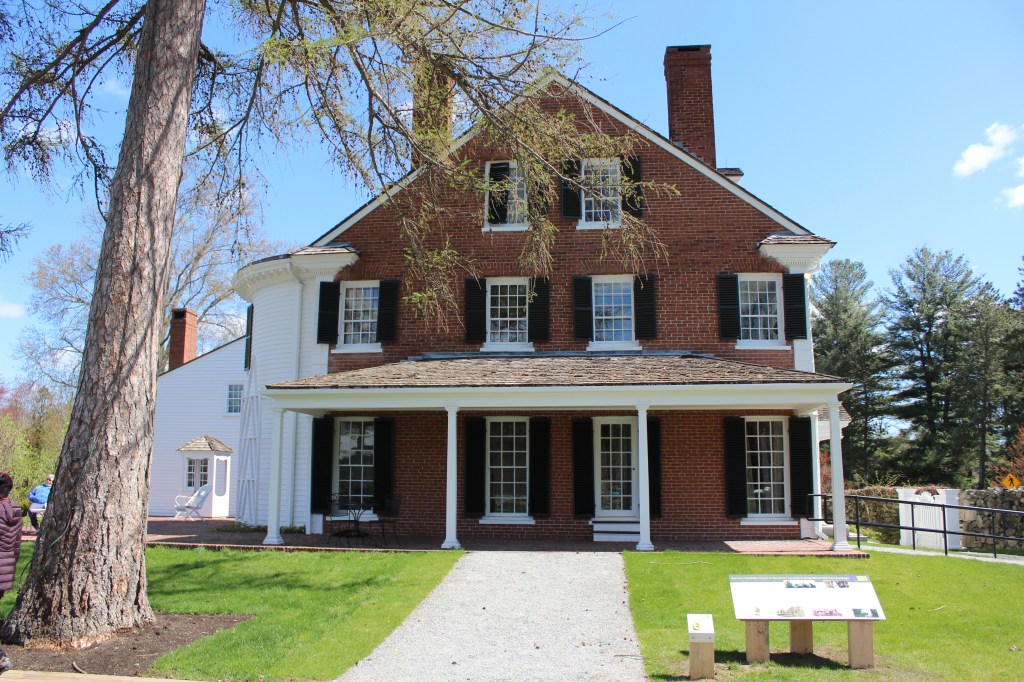
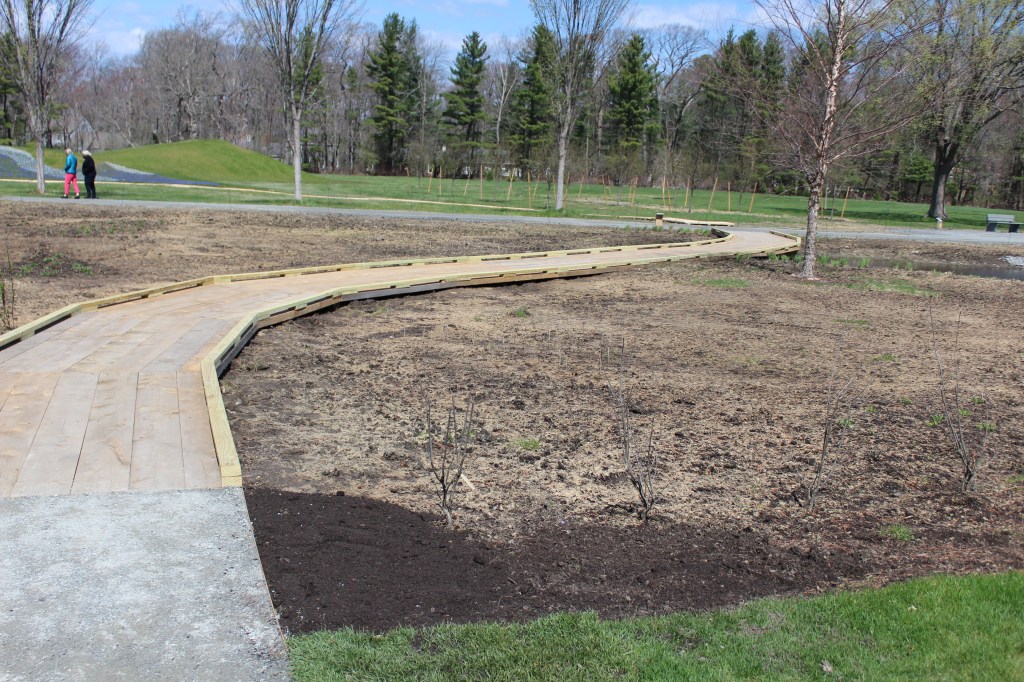
During this shift, I met visitors from Canada, Washington, DC, Connecticut, New Jersey, Ireland, and Israel and helped 453 individuals in my 2h 15m shift (the woman replacing me was late, so I stayed to help until she showed-up).

Sunday, October 20th: 4-6pm

IMG_1470

My first evening shift (I prefer the 10-12 or 12-2), I only had 186 people on my clicker at the end of it.  I think by that time of day – especially on a Sunday – people don’t need directions or help in finding things to do.  I don’t think I’ll take another late shift, unless it’s Halloween night (I am scheduled 2-4!).  Today’ I was the Herbology Professor (right), which was my ‘new; costume for 2018.

In addition to the booth shift, a friend that runs Creative Collective asked me if I could help them out loading street vendors for the weekend markets on 19, 20, 26 and 27th.  Of course I said I would – then he told me I had to be there at 7:15am…  It was COLD and early, but all of the vendors were very sweet and happy to have a friendly face helping them load-in.  It did make for long days, though.  I have a feeling he’s going to ask again during the next markets.

Saturday, October 26th: 12-2pm

Image result for brave little tailor"

A wonderfully sunny and beautifulIMG_2803 day in Salem! 

 I am trying, every year, to have a new costume in rotation (see above).  For 2019 , I had created Mickey Mouse’s Brave Little Tailor.  What do you think?  It was a big hit and has to be one of the most photographed costumes I’ve worn.  

IMG_3094

There were a few people calling me Peter Pan and Robin Hood, which bummed me out, until one guy came walking across the cross walk and yelled to me “Seven in one blow!”  I must have grinned from (mouse) ear to (mouse) ear!

Because it was a beautiful day, it was peak time, and it was the last Saturday before Halloween, it was CROWDED.  I helped 428 people during my shift.


Sunday, October 27th: 12-2pm

Sunday was a miserable as Saturday was beautiful.  IMG_2812It was pouring rain, cold, and windy.  Because of the weather, most of the street vendors had cancelled, so I didn’t have to stand in the cold rain at 7:15am, but I did keep my shift at the booth.  I struggled to find an outfit that was fun, but also weatherproof.  I settled on a polyester “Beetlejuice” suit I had in the closet from a Night Circus-themed masquerade ball we attended, complete with top hat and umbrella (necessary in that weather).  I only clicked 138 people on my counter, and I came home chilled and soaked to the bone, with awful blisters from the tux shoes (bad idea).
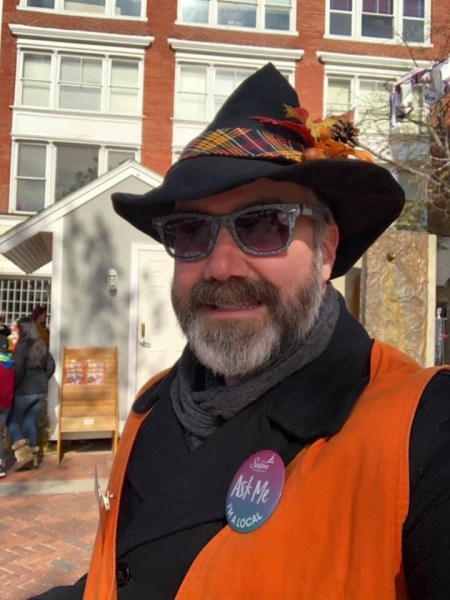
Thursday, October 31st (HALLOWEEN!): 2-4pm – Cancelled

The weather was so awful, that they cancelled anyone scheduled to be outside.  We decided to keep the booth open for the next weekend, so they moved my shift to:

Saturday, November 2nd: 12-2pm

IMG_3095While it was technically past Halloween, the crowds still came on Saturday, perhaps because of the weather that week.  It was clear, but chilly.  I wore the Ambassador Witch hat and socks, but with long johns  and a thick wool pea coat.

The calendars and brochures that we usually give out were now out-of-date, but I pointed people to the map and descriptions, telling them what was still running and open.  All-in-all, I helped 183 people during this shift, plus a dozen more on my way home.

Total people helped (at the booth): 1388 

That’s a far cry from the 1967 of 2018, but I blame the weather and my shift selections for that.

In 2020, Halloween will fall on a Saturday, and the Haunted Happenings kick-off parade will be on Thursday October 1st.   That means we will have one full month of Haunted Happenings!  And did I mention that both October 1st and 31st are full moons?  Yeah.  It’s going to be crazy.

I can’t wait!

It’s the most wonderful time of the year!!

To some parents, it’s back to school time.  To kids,* it’s the winter holidays.**

To those of us that love Halloween, it’s time for Salem Haunted Happenings!

Holiday displays before Thanksgiving, 4th of July Peeps, and Halloween in August?

We Americans tend to overdo anything we find special or unique, especially if it is inherently limited, or seasonal.  It is in our marketing/consumer nature to push it passed the saturation point, bringing it as far away from the reason we first fell in love with it as possible, either by extending the season, or making the limited unlimited.

Go ahead and put “Pumpkin Spice” in your search bar and see what comes up…

I mean… really?  Pumpkin Spice Spam sold out in 7 hours. What have we come to?  Is this irony, nostalgia, kitsch, or will certain people buy anything that remotely references something they once loved? Maybe they are doing it for the ‘gram.  Starbucks released their PSL’s on August 27th this year.   I don’t know what the weather was like where you live, but it was NOT a day I wanted to put on some flannel and sit by the fire sipping my latte.  Even my beloved Walt Disney World decorated for Halloween and started Mickey’s Not So Scary Halloween Parties on August 16th.  Full disclosure: we went to this party when we were there on August 27th.  It was ridiculously hot and humid.

Because of this trend, I start to worry when tourists and tour buses start jamming our streets in early September, and think that maybe we are pushing the festivities too early.  I understand that making the season longer helps to grab as much of that tourist revenue as possible, but thankfully we have enough going on in the summer that we don’t start October in August.  We have an estimated 1 million tourists each year for maritime and literary history, museums, cultural festivals, and a bustling food and drink scene, but the word on the street is that most small businesses can make 50-80% of their annual income during the month of October alone.

What’s in a season?

We typically have 4 weekends of heavy activity each October, starting with the Haunted Happenings Parade (typically the first Thursday) to kick-off the official festivities, and ending with the fireworks on Halloween night.  This year, the PEM opens it’s new wing to the public on September 28th.  In celebration, they are offering free admission to all and hosting parties throughout the weekend.  We also happen to have a Food Truck and Craft Beer Festival that weekend nearby on the common.  For this reason, the Salem Visitor Information Booth is opening a week early to assist with the expected crowds.

Booth
The booth is delivered to its home for the next few weeks.  It will be surrounded by flowers, decorations, and a rack for free maps and guides by the time you come visit.  Photo Credit: Salem Main Streets

The booth is staffed by volunteers every weekend, plus some weekdays during special events (the parade, Farmers’ markets, Halloween, etc).  If you look at the Haunted Happenings guide, you will see that there are special events every day in October, including new night markets on select Friday nights, and weekly specialty nights at most of the bars and restaurants, but there is a higher concentration of special things to do on the weekends, as the majority of tourists come in as day trips or overnights then.

But what are the crowds really like?

Have you ever been to a Disney Park during school vacation?  Our city’s historic and cultural district spans just over 1 mile in length, and half a mile wide when looking at the map, yet, we can reach half a million people in that area just on Halloween night.    On one of my Saturday shifts at the booth last year, I helped 474 people in 2 hours!  I am, what I like to call, “Aggressively Helpful” when working the booth.  I will walk up to people looking at GPS on their phones, or trying to read the giant map nearby (for some reason, it’s posted backwards, which isn’t obvious when you look at it).  If those people wave me away and say they know where they are going, 90% of the time they come back to me saying they got lost and needed help.  I will compliment costumes, give a smile and a warm “Welcome to my city!” or “Happy Halloween!” to every person walking by.  If it’s cold, I will tap a time step.  I have had people come back to thank me for my suggestions and ask me for more, and I’ve had people recognize me from helping them the previous year – it’s like they have a friend that lives in Salem! We only count people that we actually talk to, but can include whole groups, even if we only talk to one person from that party.  That’s probably how I got 474, although a 3.5 people-per-minute average is not hard to do with families or groups, especially if they have a specific question.  I also hand out maps to even more people that I don’t count.  The final Saturday before Halloween last year, we had a bad nor’easter come through.  There were many intrepid travelers out on the streets that day, undaunted by the weather (and they had already paid for their trip, so why not?), and I still ended up helping 108 people in my 2 hours.  The very next day, the storm had passed, and I was back up to 450.  All totaled, I personally helped 1967 people (officially – I don’t count the ones I help when just walking around town).  The entire booth staff of 75+ volunteers helped over 22,000 tourists that season.

True story: I have yet to meet an angry or mean tourist at the booth.

People may be tired, frustrated, or hungry.  They may have been sitting in traffic, or waiting in line for an hour for a haunted house that was a minute in length.  They may be overwhelmed with how much is going on, but they are here to have fun, and they are choosing to chat with me, rather than relying on their smart phones.  That’s not to say there aren’t tons of a-holes wandering around, getting drunk, and heckling performers.  My friends in the service industry have nightmare stories about awful customers, or disrespectful tourists that treat our historic cemeteries like they were fake movie sets.

Tell me again why you love it?  It sounds…awful.

I can see someone reading those numbers, or hearing complaints about waiting in line, or trying to drive through the city, could think that it’s too crowded or too frenetic, but I absolutely adore my city: its history, culture, and charm – it’s my little European Walking City right here on the North Shore of Massachusetts.  When I first moved her almost 20 years ago, I griped about the traffic and ‘those tourists’ clogging my city, taking my seat in the restaurant, and crowding the sidewalks.  My friends and I commiserated, and sighed heavily waiting for November to arrive, but as I got to know the city, and became friends with many of the business owners, I realized how much the city depends on the tourist industry – not only the shops and restaurants, but I’ve met many people that moved to Salem after having visited as a tourist.

What I didn’t explain above is that those 75+ volunteers are all Salem residents, like me, that volunteer our time.  We do it because we love our city and we want to help other people to love it, too.  We are an expanding family of dedicated, passionate, slightly kooky, people with a need to help others.  This year, there are over 100 of us!  This is wonderful, of course, but (selfishly) all these new people are taking my spots!  I was only able to book 5 shifts this year, and the first one isn’t until October 13th.  I’ll have to wait weeks!  Oh well… I guess I’ll have to go rogue and walk around town with my “Ask Me, I’m a Local” button and a bag full of brochures…

I’ll create another post with this year’s booth highlights and running tally (like last year).  Look out for at least one new outfit, too!

Make your plans now!

In 2020, there will be 5 weekends in October.  Halloween 2020 will be on a Saturday… during a Full Moon…  Book your hotels now, it’s going to be crazy!


*and kids at heart

**I know, the word “Christmases” appears in the chorus, but other than that, the song is a secular piece about the season of peace and good will to all.